
VIDEO
Natural Causes of Climate Change
Throughout Earth history, the climate has changed globally and locally and throughout nearly all time periods.
Climate change has many natural causes, such as variations in the amount of solar radiation that come in to Earth’s system, the position of Earth relative to Sun, the position of continents relative to the equator, and even whether the continents are together or apart. Smaller factors that are important over shorter time periods are volcanic eruptions and asteroid impacts. This chapter also discusses how natural climate oscillations caused by interactions of the atmosphere and oceans take place on time scales of decades or years.
Solar Variation
Solar radiation is so important to Earth’s climate that changes in sunlight could bring about changes in climate. These changes could occur over long or short time frames.
Since the Sun was born, 4.55 billion years ago, the star has been very gradually increasing its amount of radiation so that it is now 20% to 30% more intense than it once was. Even so, Earth was about the same temperature back then as it is today because CO2 levels were much higher. The resultant greenhouse warming made up for the smaller amount of solar radiation. The average solar radiation reaching Earth has changed only slightly during the past few hundred million years.
Sunspots-magnetic storms that appear as dark, relatively cool regions on the Sun’s surface – represent short-term variations in solar radiation. Sunspot activity varies on an 11-year cycle. When the number of sunspots is high, solar radiation is also relatively high. Satellite data collected over the past two sunspot cycles has shown a variation in solar radiation of only up to 0.1%, probably too little to affect Earth’s climate. However, during the time between 1645 and 1715, known as the Maunder Minimum, there were few sunspots. This period correlates with a portion of the Little Ice Age (LIA), but is not necessarily the cause.
The amount of solar radiation that reaches Earth’s atmosphere is known as insolation. The rate of insolation is affected by the amount of clouds, dust, ash, and air pollution in the atmosphere. Rapid changes in insolation can also be caused by volcanic eruptions and asteroid impacts.
Milankovitch Cycles
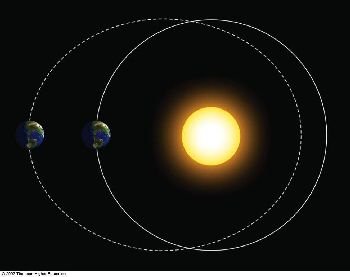
Significant variations in the amount of solar radiation striking the planet can be the result of differences in Earth’s position relative to the Sun. Solar radiation in a particular location can vary as much as 25%, although the global average varies much less. Nonetheless, large deviations in solar radiation have profoundly influenced global climate through Earth history by, for example, initiating ice ages. The patterns of variation are described by the Milankovitch theory, named for the Serbian geophysicist Milutin Milankovitch, who proposed the idea in the 1930s.
The Milankovitch theory describes three variations in Earth’s position relative to the Sun:
Earth’s orbit around the Sun changes from a more circular route to a more elliptical one on a cycle of about 90,000 to 100,000 years: This variation is called eccentricity. When the orbit is more circular, as it is now, the amount of solar radiation the Earth receives during a year differs by only 6%. When the orbit is at its most elliptical, solar radiation varies by between 20% and 30%. Such a large variation in solar radiation profoundly affects global climate.
Earth also wobbles on its axis of rotation. This wobble is known as precession. Currently, Earth’s axis of rotation points toward Polaris, the North Star. Precession moves the orientation of the axis of rotation so that in about 12,000 years it will point toward the star Vega, which will then be the new North Star. At that time, the Northern Hemisphere’s summer will take place when Earth is closest to the Sun (unlike now) and Northern Hemisphere winter will be when Earth is farthest from the Sun (also unlike now). As a result, winters will be much colder and summers will be much warmer than they are today. However, precession will continue, and in 27,000 years Polaris will again be the North Star.
Earth’s seasons are caused by the 23.5° angle of the planet’s axis of rotation. As Earth orbits the Sun, the tilt of the planet’s axis relative to the Sun changes throughout the year.
The Northern Hemisphere is tilted the most toward the Sun on summer solstice (June 21 or 22), when the Sun’s rays reach the farthest north. The Northern Hemisphere is tilted farthest away from the Sun on winter solstice (December 21 or 22). But this axial tilt (or obliquity) is not constant. Over a period of about 41,000 years it varies between 22.1 and 24.5 degrees. The smaller the planet’s tilt, the less variation there is between summer and winter in the middle and high latitudes. When winters are milder and summers are cooler in the high latitudes, glaciers are more likely to form.
The superimposition of these three variations results in a variation in climate pattern of about 100,000 years. Scientists have shown that the climate in the past several hundred thousand years, and particularly the glacial advances of the Pleistocene Ice Ages, has been closely associated with the 100,000-year pattern of these Milankovitch cycles.