
VIDEO
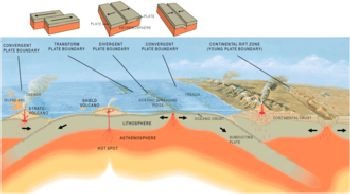
Plate Tectonics
The movements of the continents and the processes that cause them are described by the theory of plate tectonics.
Because plate movements determine the shapes and sizes of continents and ocean basins, plate tectonics can have a long-term effect on climate. When all the continents are joined into one supercontinent, as they were 225 million years ago (MYA), most of the land area is far from the oceans, and a harsher continental climate dominates. But when the continents are separate, as they are today, ocean currents are better able to distribute heat because more of the land surface is near an ocean.
This results in less extreme global and regional climate. Plate motions also reinforce Milankovitch cycles. If continents are located near the poles, and the amount of solar radiation reaching the poles is low, snow and ice will accumulate, which is favorable to planetary cooling and perhaps the initiation of an ice age.
Plate tectonics cause geologic activity that, in turn, influences climate. When limestone or other carbonate rocks push up to form mountain ranges, or when tectonic activity lowers sea level so that more carbonate rocks are exposed, these rocks undergo a weathering process that releases the greenhouse gas CO2 into the atmosphere. But if plate tectonics processes cause the sea level to rise, carbonate breakdown decreases.
Plate tectonic movements cause most volcanic eruptions. These can have short-or long-erm effects on the climate. The aerosols released by the 1991 eruption of Mt. Pinatubo in the Philippines reduced global insolation by 5% and decreased average global temperature by about 0.9°F (0.5°C) the following year. As a result, the United States had its third wettest and coldest summer in 77 years.
In addition, extremely rare, but incredibly large, eruptions of flood basalts produce very fluid lava that covers millions of square miles (km) with extremely thick flows. These violent eruptions propel ash, dust, and aerosols into the stratosphere, block sunlight, and cause global cooling. Conversely, the eruptions release CO2, which causes greenhouse warming.
If the basalt eruption is rich in sulfur gases, the sulfur combines with water vapor to produce sulfuric acid haze. Sulfur-and nitrogen-oxide gases in the atmosphere combine with water vapor to form sulfuric and nitric acids, which later fall as acid rain, rain that is more acidic than natural rainwater. Acid rain can damage plants and dissolve shells and have many other negative effects.
Similarly, asteroid impacts can cause climate change as enormous amounts of particles are thrust into the air and block sunlight, leading to global cooling. On the other hand, sulfur gases, CO2, and water vapor are greenhouse gases that cause global warming. Mass extinctions are possible results of asteroid impacts or flood basalt eruptions.
Mass Extinctions
During a mass extinction, 25% or more of all of Earth’s species go extinct during a geologically brief period. Mass extinctions have mostly been caused by asteroid impacts, massive volcanic eruptions, or climate change. Since life began to flourish 600 million years ago, there here have been at least five major mass extinction events and many smaller ones.
Many scientists agree that the mass extinction that occurred at the end of the Cretaceous Period 65 MYA was brought on by a strike from an asteroid 6 miles (10 km) wide. By the end of this period, two- thirds of Earth’s species, including the dinosaurs, were gone. The story scientists have pieced together is frightening.
The asteroid struck water, causing giant tsunamis that flooded coastal regions, even thousands of miles away. Dust and gas flew skyward and then coalesced into balls that fell back to earth as fireballs.
This released so much energy that the atmosphere was as hot as a kitchen oven on broil. Animals roasted and forests burned. Shortly afterward, dust and smoke blocked out sunlight and the planet froze.
The darkness triggered a major decline in photosynthesis, causing the plants and animals that survived the initial impact to starve. Gases that were released into the atmosphere from the limestone rock that the asteroid hit formed acid rain, which dissolved phytoplankton shells and caused the oceans’ food webs to collapse. (A food web is the complex set of food interactions between organisms in an ecosystem.
An ecosystem is composed of the plants and animals of a region and the resources they need to live.) Carbon from the limestone mixed with oxygen in the atmosphere to form CO2, which brought about years of intense greenhouse warming.
Scientists think that other mass extinction events may also have been caused by asteroid impacts, including the extinction that took place 250 million years ago, at the end of the Permian Period, during which 95% of Earth’s species perished.
Floods basalts can also trigger mass extinctions by causing global cooling, global warming, or acid rain. Two of the largest flood basalts, the Deccan Traps of India and the Siberian Traps, (which occurred 65 million and 250 million years ago, respectively) date to the times of the two massive extinctions mentioned above.
Scientists hypothesize that the eruptions first caused the climate to cool, due to the particulates blocking the Sun, and then to warm, due to high atmospheric concentrations of volcanic gases, such as sulfur, which brought about global warming.
Whether each extinction event was caused by one phenomenon a flood basalt eruption or an asteroid impact or by a combination of the two is a matter of much debate among scientists.
Even without asteroid impacts and volcanic eruptions, climate change can cause mass extinctions. Planetary cooling resulting in immense glaciations is thought to have caused the extinction of nearly 80% of the planet’s species 544 million years ago. Climate change is at least partially responsible for the extinctions of large animals that came at the end of the ice ages 10,000 years ago.