VIDEO
Climate and Weather Oscillations
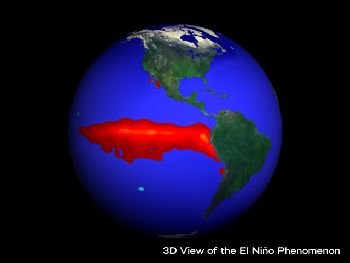
Natural climate variations take place on time scales of years or decades and are caused by shifts in atmospheric and oceanic conditions. These shifts are due, at least partially, to the way the oceans store and transport heat. An example of a natural climate variation is the El Niño-Southern Oscillation (ENSO).
ENSO oscillations have a cycle of about 3 to 8 years and are directly related to the interactions between the ocean and atmosphere. ENSO is the foremost source of multiyear variability in weather and climate around the world.
ENSO impacts the South Pacific gyre. In a normal year, the cold Peru Current travels northward up South America. The cold, dense current allows nutrient rich deep ocean water to rise to the surface, causing plants and animals to thrive. This current travels north to the equator, where the trade winds then push it westward.
The equatorial Sun warms the current as it goes. After reaching the western Pacific, most of the water moves north, south, or even back across the equatorial region as a subsurface countercurrent. But some of the water piles up in the western Pacific and continues to warm. The trade winds move from east to west across the equator because the cold water in the eastern equatorial Pacific cools the air above it and creates a low-pressure cell, and the warm water in the western Pacific warms the air above it and creates a high-pressure cell.
In time, the high and low atmospheric pressure cells weaken, causing the trade winds to weaken or reverse direction. These reversed trade winds drag warm water rapidly from west to east, enhancing the countercurrent. When the warm water hits South America, it spreads over the cooler, denser water and shuts off the rising of the deep, nutrient rich water from below. This begins an El Niño, named for the Christ child by Spanish fishermen because the phenomenon often begins around Christmas. Without nutrient rich water reaching the surface, the marine food web suffers.
An El Niño event ends when most of the warm western Pacific waters have moved east, about one to two years after it begins. When the event is over, normal circulation patterns resume in both the atmosphere and ocean. The oscillation between atmospheric high- and low-pressure cells in the western and eastern Pacific is termed the Southern Oscillation. Sometimes, after the El Niño ends, the air and water move to the west more vigorously than normal and unusually cold water accumulates in the eastern Pacific. This pattern is called La Niña.
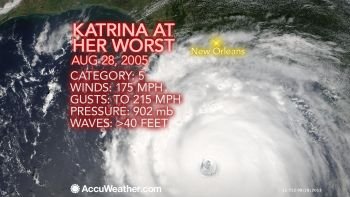
The change in wind and ocean circulation alters weather patterns worldwide, with some regions experiencing drought while others experience flooding. The Southern Hemisphere is the most affected. Storm activity increases in some locations. Atlantic basin hurricane activity decreases during El Niño events and increases during La Niña events.
(A hurricane is a potentially deadly tropical storm with high winds, abundant rain, and high seas.) The North Atlantic Oscillation (NAO) is much weaker than an ENSO, although the patterns are similar. This climate pattern mostly affects Europe. The NAO oscillates between a low-pressure cell over Iceland and a high-pressure cell over the mid-Atlantic Azores Islands.
At high NAO, storm tracks are shifted northward into northwestern Europe so that northern Europe is warm and wet, and Mediterranean Europe is dry. At low NAO, storm tracks are shifted southward into the Mediterranean region. Over the past 30 years, the NAO has become more intense, perhaps due to global temperature increases or natural variability.
Pacific climate oscillations also include the Pacific Decadal Oscillation (PDO), with has a 23-year pattern, and the Interdecadal Pacific Oscillation (IPO), which has a 15- to 30- year cycle. Oscillations in the Atlantic include the Atlantic Multidecadal Oscillation (AMO).
Wrap-Up
Natural processes alter Earth’s climate on various time scales. Climate can be altered by singular events, such as volcanic eruptions and asteroid impacts. Climate can be altered by short-lived variations in atmosphere ocean interactions, such as ENSO and NAO that act on cycles of several years. Milankovitch cycles, which involve the relationship between the Earths’s wobble, its tilt, and orbital position relative to the Sun, take place over tens of thousands of years. Large or rapid changes in climate can cause the extinction of species, sometimes even on a mass scale. After a mass extinction, the Earth’s ecosystems are very different from the way they were before.