
“The environment is everyting that isn`t me.”
Albert Einstein
VIDEO
Geological Time
Have you ever thought much about time? Or how long it takes you to do things? How much time it takes to brush your teeth? How long it takes to bake a cake?
What is the time difference between riding a bicycle to school instead of walking? How long before your next birthday? How long before your brother finds out you ate the last slice of pizza? What about the amount of time before you get your driver’s license or graduate from high school or Start College? These measurements of time are all common within our daily activities, but what about larger amounts of time? How long will it take before you graduate from college and/or graduate school and start a career? How long before you finish a tour of duty in the Armed Services or Peace Corps? How long before you get married, have children, and grandchildren? How long before humans build a colony on the Moon or Mars or beyond? These things could take decades or even a century or two. What about travel to distant stars?
Without a new, as yet undiscovered fuel to travel faster than the speed of light or the ‘‘warp engine’’ of science fiction that travels through bends and folds of time, travel much beyond our solar system is not practical. It can only be done with current rocket enginesif the travelers didn’t want to return. Generational ships that carried families into space on a grand adventure of colonization would also face radiation shielding, life support/environmental issues, micrometeor impacts, physiological adaptations, and many other challenges.
But does the human race have any other choice? From a scientific view, millions of years from now, the Sun will run out of energy and will eventually cease to exist along with most of the planets in our solar system, including the Earth. But that is a bit far out to plan for, so we might as well keep working on the geological problems we have now. To study and learn about our planet is much more fun!
Earth Time
What about time measured only in our imaginations? What about millions and billions of years? What kind of timescale can bridge vast stretches of time?
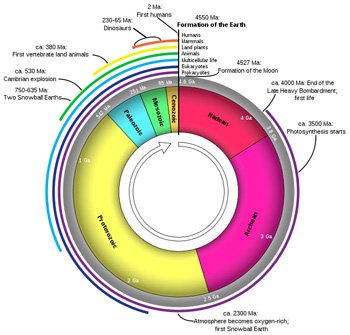
Time that spans millions of years is known as geological time. The entire history of the Earth is measured in geological time. Geological time includes the history of the Earth from the first hints of its formation until today. Geological time is measured mathematically, chemically, and by observation.
In 1785, Scottish scientist James Hutton, called the father of modern geology, began to try to figure out the Earth’s age from rock layers. He studied and tested local rock layers in an attempt to calculate time with respect to erosion, weathering, and sedimentation.
Hutton knew that over the period of a few years, only a light dusting of sediments are deposited in an undisturbed area. He thought that sedimentary rock that has been compacted and compressed, tighter and tighter, from the weight of upper rock layers must have happened over many ages. He also thought that changes in the sedimentary rock layer, through uplifting and fracturing of weathering and erosion, could only have taken place over a very long period of time. Hutton was one of the first scientists to suggest that the Earth is extremely ancient compared to the few thousand years that earlier theories suggested. He thought that theformation of different rock layers, the building of towering mountains, and the widening of the oceans had to have taken place over millions of years.
Hutton wrote the Principle of Uniformitarianism that suggested that changes to the Earth’s surface happened slowly instead of all at once. His early work paved the way for geologists to consider that the Earth was not in its final form, but was still changing. Gradual shifting and compression changes were possible across different continental land forms.
Time Measurements
Ancient people, until about the 17th century, believed the Earth was approximately 6000 years old. This estimate, based mostly on the history of humankind handed down through stories and written accounts, seemed correct. Except for theory, there were no ‘‘scientific’’ ways to check its accuracy. However, in the 1800s scientists began to test rock samples for their age. It was during this time that scientists used dating methods to suggest the Earth might be millions or even billions of years old.
Relative Time
Geological time is studied by two different methods. The first is a hands-on inspection of the positioning of the different layers of the Earth. This is known as relative or chronostatic time measurements. Relative time measurements are used to find the age relationships between layers and samples. Using relative time measurements, the age of earth layers is found by comparing them to neighboring layers above and below. Even when the exact date of rock or materials is not known, it is possible to figure out the sequence of events that led to the current position of a sample. This ordering of samples and events is known as relative dating.
Placing a sample in an approximate time period compared to other samples with known ages is called relative dating. The earliest attempt to order geologic events was done by Nicolaus Steno in 1669 when he described the following three laws that placed samples in time:
1. Law of Superposition,
2. Law of Original Horizontality, and
3. Law of Lateral Continuity.
The first law is the simple description of layers as they were piled on top of each other over time. Figure 2-2 shows the simple layering in the Law of Superposition that occurs when layers are left undisturbed.
This is the foundation of all geological time measurements. For example, when archeologists study layers of ancient settlements and cities, they record the most recent top layers first, followed by older layers that are uncovered the deeper they dig.
Steno’s second idea, the Law of Original Horizontality, was also a new idea at the time. He believed that sediments were geologic layers found mostly in a flat, horizontal direction. Any solid material (rock or organic) that settles out from a liquid is known as sediment. Driving along highways that have been cut into hills and mountainsides, you will see horizontal rock layers shifted at steep angles. These sediment layers were shifted after the original sedimentation took place. The third of Steno’s laws describes the Law of Lateral Continuity. This law describes the observation that water-layered sediments thin out to nothing when they reach the shore or edge of the area where they were first deposited. This happens even though they were originally layered equally in all directions.
Sometimes scientists find in studying sediments that layers of different sections are missing. These layers have been split far apart through geological movements or by timeless erosion. If a sample is taken from a section with a missing or eroded layer, the true picture of its sedimentation can’t be seen.
An unconformity is a surface within several layers of sediment where there is a missing sedimentary layer. This is usually found between younger and older rock layers. If this unconformity happens in a wide area of erosion, maybe over an entire mountain range, the time period under study may be misunderstood or completely lost. We will learn more about different kindsof unconformities found in sedimentary rock when we take a closer look at strata and land eras.
A disconformity contains an area where the sedimentary rock layers, located above and below, are aligned in parallel, but have an area in-between that is different. This can happen when layers of water-covered sediment are uncovered for a time in one era, allowing the environment to erode away or add a different layer, then recovered with water. The layer that was exposed to the environment will be different from its neighbor. However, when they are both covered with water again, the sediment layer will be deposited on both the same way. So unless scientists look closely or the exposed layer is especially thick, the differences might not be noticed.
Fossils
Scientists who study ancient plants, animals, and their environment are called paleontologists or paleobiologists. By studying layers of sedimentary rock and their contents, biologists can tell a lot about what was going on during different geological time periods. The weathering of different rock layers made people think that the Earth must be very old, since it takes a long time for rocks to wear away by water and wind.
A certain climate can be researched by looking for fossilized plants that lived in a specific climate during a certain time period. Much of the study of relative time measurements is done using fossil remains found in rock and frozen in polar ice. Some of these fossils are discovered all in one piece when a road or the foundation of a building is dug, but sometimes only the tip of the toe is showing with the rest buried in rock. Other times, the fossils are like what you see at the beach; a mixture of broken shell and bone fragments scattered across a wide area. Depending on what you are looking for, either of these finds give the paleontologists important information. In fact, when you look at a chart of major fossil types from a certain period, you will only see representative plants or animals. These are the main specimens that have been discovered and placed in a certain time frame. But, the important thing to remember is that just like today, the ancient world had a rich, diverse plant and animal community. You see more than one dog and one pine tree in a large area.
Fossils include the outer cast, imprint, or actual remains of a plant or animal preserved in rock. Fossils were formed over millions of years by the buildup of sand, silt, or clay over plant and animal specimens in ancient lakes, seas, and oceans. For example, fossils can be the outer shell of a creature like the ancestors of horseshoe crabs called trilobites. Fossilized ants and insects, trapped millions of years ago, are often found intact in a petrified, rock-hard tree sap, called amber. Depending on the type of tree and environmental conditions at the time, ambers are found in hues from brown and burgundy to orange and pale yellow.
Other fossils are formed beneath frozen tundra, desert sands, and tar pits. Animals that die in a place where the amount of oxygen is very low, like tar pits, suffer very little decay. These are usually found whole, like dinosaur remains.
Fossils are formed and preserved when their soft parts decay and the elements of their hard or bony parts are exchanged for the minerals found in the surrounding sediment layers in which they were first enclosed, like petrified wood or sea life.
Many fossils and seashells are found in areas that were originally primitive seas. Larger fossil remains are most often uncovered by water and wind erosion. Scientists who study and dig at one fossil site one year and then leave it to return a few years later, often find a bit of bone sticking up through the soil that has become exposed by weathering. When paleontologists investigate this new find and uncover the entire skeleton just below the surface, they often begin their work at the site all over again.
This has happened at many of the major fossil sites. A good example is the Burgess Shale quarry in the Canadian Rockies of southern British Columbia, Canada. From the time Charles D. Walcott, working for the Smithsonian Institute, began studying the Cambrian fossils preserved in the shale in the summer of 1909, until the present, many groups from leading museums and universities have worked that site and found new specimens.
One thing to keep in mind is that as the Earth was going through major changes, like the break up of the supercontinent, Pangea, during the Triassic period, the inhabitants of those landmasses were being shifted around as well. During the Mesozoic period, the continents began to drift apart, expanding the oceans between them.
Over millions of years, as the continents moved farther apart, life on the ‘‘islands’’ of continental land got more and more different from their relatives. That is why we see such an unusual diversity of plants and animals in Australia. Without certain predators, living on other continents to sneak up on them and enjoy them as a tasty morsel, animals (like the kangaroo and duck-billed platypus) were able to enjoy the good life and develop in unique ways. We will take a look at several significant fossil periods and locations in
much greater detail in Chapter 10. The huge number and variety of fossils from different time periods and in different environments around the world is amazing. Some areas have produced fossils, large and small, in the tens of thousands.
The world’s oceans have also had their share of change. The sea floor of the Atlantic and Indian oceans appears to have been created at the ocean ridges since the Jurassic period. Geologists have not found any fossils older than the Jurassic period in these sedimentary areas of the sea floor. All the rock of the ocean floors is fairly young in geological time. New rock is created by volcanic eruptions and rising magma. Ocean levels have changed many times over the years with the highest levels taking place in the Precambrian, Jurassic, and Tertiary periods. During some periods, the oceans were at ‘‘high tide’’ and left deposits of marine organisms far inland. Millions of years ago, a shallow sea stretched from Canada down through the United States. Now that this sea is gone, geologists find exposed rock containing millions of ocean organisms in these areas. When the oceans receded, the main places of fossil deposit were off the continental land and in the open ocean.