
Tipping Point of Arctic and World Food
Ocean will have no ice at the end of the summer of 2060.
Melting Ice and Snow
Ice and snow that have been around for thousands of years have rapidly begun to melt and disappear. Approximately 10 percent of the earth’s land and 7 percent or its oceans are permanently covered by ice. The massive transformation of much of this ice and snow to liquid water is probably the most conspicuous indication of global warming. Winter comes later to the northern hemisphere and leaves sooner each year.
Rivers and lakes freeze 5.8 days later and thaw 6.5 days earlier each year than they did a century ago. For every year since 1966, snow cover in the northern hemisphere has decreased by 5 percent.
ARCHIMEDES’ PRINCIPLE-THE DIFFERENCE BETWEEN FLOATING ICE AND LAND ICE
If you place an ice cube in a glass of water and come back a few hours after the ice has melted, you will find that the level of the liquid has remained just where it was before. (We are assuming that there is no significant evaporation of water). The ancient Greek scientist Archimedes explained why this happens. Ice fl oats because the liquid it is floating in exerts a buoyant force that equals the weight of the floating ice. Archimedes discovered that the buoyant force on an object equals the weight of the water that is occupied by the part of the floating object that is underwater. This exactly equals the weight of the floating ice. As a result, when the ice melts, the same exact volume of water is returned to the sea as was occupied by the floating ice.
Arctic ice caps, icebergs, and ice shelves are like that ice cube. They fl oat on seawater and do not contribute to an increasing sea level when they melt. Ice supported on land is another story. Glaciers, snow caps on mountains, and the Greenland and Antarctic ice packs will all add to the volume of the sea as they melt and contribute to a rise in sea level.
ARCTIC SEA ICE IN SUMMER
There is 7.4 percent less Arctic ice now during the summer months than there was 10 years ago, leaving a diminishing extent of permanent ice in that region. The melting of Arctic ice is more pervasive in the summer months than year round, and there is an annual 2.7 percent reduction in overall ice cover. During the summer of 2007, spacecraft operated by the European Space Agency produced imagery that showed a brief opening in the Northwest passage through the Arctic Ocean. The amount of Arctic ice coverage that summer had shrunk to the lowest level on record. A sheet of ice the size of California that had been present since at least the 1970s when satellite imaging began had completely melted. A sea channel through the Arctic ice was once actually a dream of traders in the northern latitudes early in Western exploration and is actually listed by some people as one of the few positives that may come from global warming. However, this is not a positive for Arctic wildlife or for the indigenous human populations inhabiting the polar regions, whose traditional way of life is now threatened.
Total breakup of the Arctic sea ice could seriously compromise the ability of some Arctic animal species to survive. Seals bear their young and rest on the ice. Larvae of small fish are sheltered in the ice structure. These larvae develop into fish that are a source of food for beluga whales and narwhals. Loss of the Arctic ice sheets owing to global warming likely will have a significant impact on the fish and animals that depend on it for their survival.
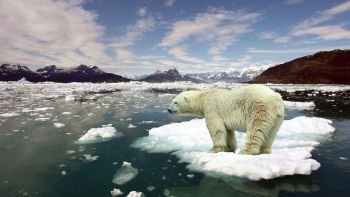
Estimates put the Arctic polar bear population at between 20,000 and 25,000. Polar bears hunt and migrate on the Arctic ice sheets, frequently moving from one iceberg to the next in search of prey. It is not unusual for polar bears to trek thousands of miles across the ice. Some bears tracked by satellite travel as far as 150 miles across the open ocean. Polar bears are dependent upon seals that breed on the Arctic sea ice. Roughly one of twenty attempts to secure food is successful for the polar bear. As the sea ice coverage during the summer months becomes progressively smaller, the bears lose access to hunting areas.
Female polar bears are more severely affected than males. After their typical 5-to 7-month annual winter fast while nursing, females are in an especially weakened condition and emerge badly in need of nourishment. With Arctic ice shelves now breaking up 3 weeks earlier than they did in the early 1970s, the bears must come ashore earlier and, as a result, fast longer. With the bears’ ability to capture food severely compromised, their prospects for survival are becoming increasingly difficult. In 1987, in one Arctic region there was an estimated polar bear population of around 1200 bears. By 2004, there were less than 950 bears. It is thought that similar trends can be observed throughout the Arctic. Scientists are now saying that if Arctic temperatures continue to rise between 2.5 and 3°C (4.5 and 5.4°F) above preindustrial levels, the risk of extinction of Arctic polar bears will become significant.
Most of the warming that has occurred over the past few decades has taken place in the northern hemisphere. Arctic sea ice has been declining at a rate of 9 percent every 10 years. Satellites map the ice cover of various regions of the earth using microwave detecting instruments. These satellites do not require sunlight and are capable of penetrating the clouds that often obscure the Arctic region. Compare the images collected by the Nimbus 7 and Defense Meteorological Satellite Program (DMSP) satellites in 1979 and 2003. The marked differences between the two images suggest that a significant climate change is taking place in the Arctic. National Aeronautics and Space Administration (NASA) scientists attribute the decrease in the extent of Arctic summer ice to the increase in atmospheric temperature, which has been increasing recently at a rate of 1.2°C during the summer over Arctic ice every 10 years. (The global average air temperature did not even increase by this amount in the past 100 years).
Geologists believe that there are vast untapped reserves of oil located on the sea floor of the Arctic Ocean. Now that the prospect of ice-free sea lanes in the Arctic may become a reality owing to global warming, countries adjacent to this resource have begun to establish their positions to exploit it. Scientists from the U.S. National Snow and Ice Data Center (NSIDC) estimate that at this rate of melting, the Arctic
GREENLAND
Greenland is covered by a huge central ice sheet with glaciers, which are like giant rivers of slush fl owing to the surrounding sea. The largest of Greenland’s glaciers is called Jakobshavn, and it has doubled its speed of descent to the ocean to roughly 37 m (120 ft) per day. It alone contributes 11 cubic miles of ice each year to the sea.
Together, all the glaciers of Greenland contribute to the 54 cubic miles of ice that fill the surrounding fiords with melting icebergs. This is twice as much as was discharged into the ocean 10 years ago. The pace is quickening and has exceeded the expectations of many researchers studying the region.
As Greenland’s glaciers progress seaward, the sections projecting toward and floating on the sea, called the tongue, break off and fl oat away. However, Jakobshavn’s tongue has receded 4 miles inland. Researchers are finding that when glacial tongues actually floated on the sea, they served the purpose of shoring up the glaciers and slowing their decent to the sea. With the tongues gone, the glaciers flow unimpeded at a faster rate than scientists previously thought possible. Satellite measurements such as those from the GRACE satellites, which monitor total mass in their field of view by detecting minute variations in the earth’s local gravitational field, confirm Greenland’s pace of melting.
Parts of Greenland actually appear to be cooling, with snow being added to the ice pack in the central part of Greenland, but melting is occurring along the coastal regions. Overall, there is more melting than buildup of new ice pack. The data collected by the GRACE satellites, show the overall ice mass of Greenland between 2002 and 2005.
The GRACE satellites are a pair of satellites orbiting together in tandem. They make extremely accurate measurements of the earth’s gravitational field. These satellites do this by detecting small changes in the gravitational field by registering minute disturbances to their orbit. This enables the satellites to pick up very small changes in the mass directly below their orbital path. Reduced gravitational attraction means reduced mass, which is a sign that an ice sheet is melting.
Greenland is losing ice mass at a rate of about 162 km3 per year. Notice the periodic seasonal increases during the winter months and declines in the summer months and the overall downward trend. This amount of melting contributes an increase of 0.4 mm per year (0.15 in) to the sea level.
Snow melts seasonally as the warmer months approach. One indicator of the onset of a warmer climate is that the number of days that melting can occur increases. DMSP satellites measure ice and can detect the how many days ice melts during the summer months. These satellites indicated that snow melt occurred more than 10 days longer in 2006 than in previous years. The darker regions show the locations where melting occurred 5–10 days more in 2006 than the average number of days between 1988 and 2005.
If global warming continues at its current level, within as few as 50 years, the temperature threshold necessary to melt all of Greenland may have been crossed. Before we rush to redefine a new boundary for “ocean-front property,” though, it is expected to take a few thousand years for all of Greenland to melt.
If all the ice and snow in Greenland melted, the seas would rise by about 7.3 m. A source of concern is that melting ice reflects only 50 to 60 percent of the sunlight striking it in contrast to fresh, dry snow, which reflects 80 to 90 percent of the incoming sunlight. Pools of liquid water forming on melting ice can be observed in images captured by the satellite (you can find many in internet).
The more days melting occurs, the more additional heat is absorbed by the ice, further prolonging the time of melting. As melt water flows across the ice and drains to the bedrock, it lubricates the ice, which then slides faster. This gives an idea of the powerful forces that can be set in motion when glacial melting is initiated. Once the melting process is set in motion, it can become self-perpetuating and accelerate the rate of ice loss.