
VIDEO
Climatic Evidence From Sediments – Exploring the Science of Climate
Sediments
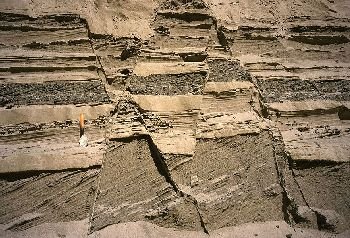
Sediments collect in layers on seafloors and lake bottoms. Like ice, sediments can be drilled as cores with the oldest layer located at the bottom. Sediments can be found dating back millions of years. They can be composed of sand, rock fragments, clay, dust, ash, preserved vegetation, animal fossils, and pollen.
Perhaps the most useful sediments are the remains of plankton that once floated at the ocean surface before dying and sinking to the bottom. These tiny shells harbor many kinds of information on the conditions of the atmosphere and surrounding seawater. One type of plankton-mall, coiled foraminifera (forams)-re extremely sensitive to ocean temperature, and therefore each of the species in this group is present only within a specific, narrow temperature range.
The presence of a particular species in a core yields the sea surface temperature (SST) at the time the organisms lived. One species of foram, Neogloboquadrina pachyderma, changes its coiling direction from leftto right when the surface water temperature warms above 46°F (8°C).
With temperature information from all around the seafloor, scientists can reconstruct the patterns of ocean currents during any time period from the past 150 million years or more.
The isotope ratios of marine fossils also contain useful information. 18O/16O in shells, teeth, bone, and other hard tissues yield the temperature at the time the organism lived.
The shells of some forams contain an average of 2% more 18O during a glacial period than a warm period. 18O/16O can also be used to calculate the amount of the Earth that was covered by ice. Because heavy water is more likely to precipitate near the equator, snow that falls in the high latitudes is light. During an ice age, this light snow is trapped in ice sheets, and therefore seawater is enriched in 18O.
The 18O/16O value of seawater is therefore directly related to the amount of 16O enriched ice that covers the Earth. Oxygen isotopes also give information on sea level: A rise or fall in 18O/16O of just 0.01% indicates a 33 foot (10 m) change in sea level.
Isotopes and Their Scientific Uses
An atom is the smallest unit of a chemical element (a substance that cannot be chemically reduced to simpler substances) having the properties of that element. At an atom’s center is its nucleus, which contains protons that have small, positive electrical charges and neutrons that have no charge. An atom’s atomic weight is the sum of its protons and neutrons. A particular element, for example, potassium, will always have the same number of protons in its nucleus, but it may have a different number of neutrons. Potassium always has 19 protons but it can have 20, 21, or 22 neutrons.
Therefore, the atomic weight of a potassium nucleus can be 39, 40, or 41, which creates the different isotopes of potassium: potassium-39, potassium-40, or potassium-41.
Oxygen isotopes are especially important in deciphering Earth’s past climate. Nearly all oxygen is either 16O (8 protons and 8 neutrons) or 18O (8 protons and 10 neutrons). Either isotope may become part of a water molecule. H2O containing 16O is “light” and so is slightly more likely to evaporate than “heavy” H2O containing 18O. When water evaporates, the water vapor is enriched in 16O while the liquid water left behind is enriched in 18O. Therefore, the 18O/16O of the liquid is relatively high, and the 18O/16O of the vapor is relatively low.
Similarly, a heavy water molecule (one containing 18O) is slightly more likely to condense to form a raindrop or snowflake thana light water molecule. For that reason, the 18O/16O of the raindrop is higher than that of the remaining vapor. Hydrogen isotopes work the same way, with lighter 1H (one proton) more likely to be in water vapor and heavier 2H, (one proton and one neutron) more likely to be in liquid water.
Air cools as it rises or moves toward the poles and releases some of its moisture. Because 18O is more likely to condense into a raindrop, the first precipitation to fall has a relatively high 18O/16O ratio. With time, the 18O is depleted from the air so the 18O/16O ratio of the raindrops decreases. Because air moves toward the poles from the equator, 18O/16O decreases with increasing latitude. As a result of these processes, higher 18O/16O indicates warmer air temperatures; lower 18O/16O indicates cooler temperatures.
Therefore, 18O/16O is a proxy for temperature. 1H/2H can also be used to reconstruct the temperature at the time of precipitation. These isotopes can be used as a proxy for temperature in ice cores and marine sediments. As temperature increases and ice sheets melt, fresh water enriched in light oxygen returns to the sea. Low 18O/16O ratios indicate less ice cover and, therefore, higher temperatures. 18O/16O is also a proxy for local rainfall: Because the 18O precipitates first, low 18O/16O means that a large amount of rain has already fallen.