
Life Cycle Assessment as part of Strategic Sustainability for Product Design
STRATEGIES YOU CAN USE (2)
Life cycle assessment
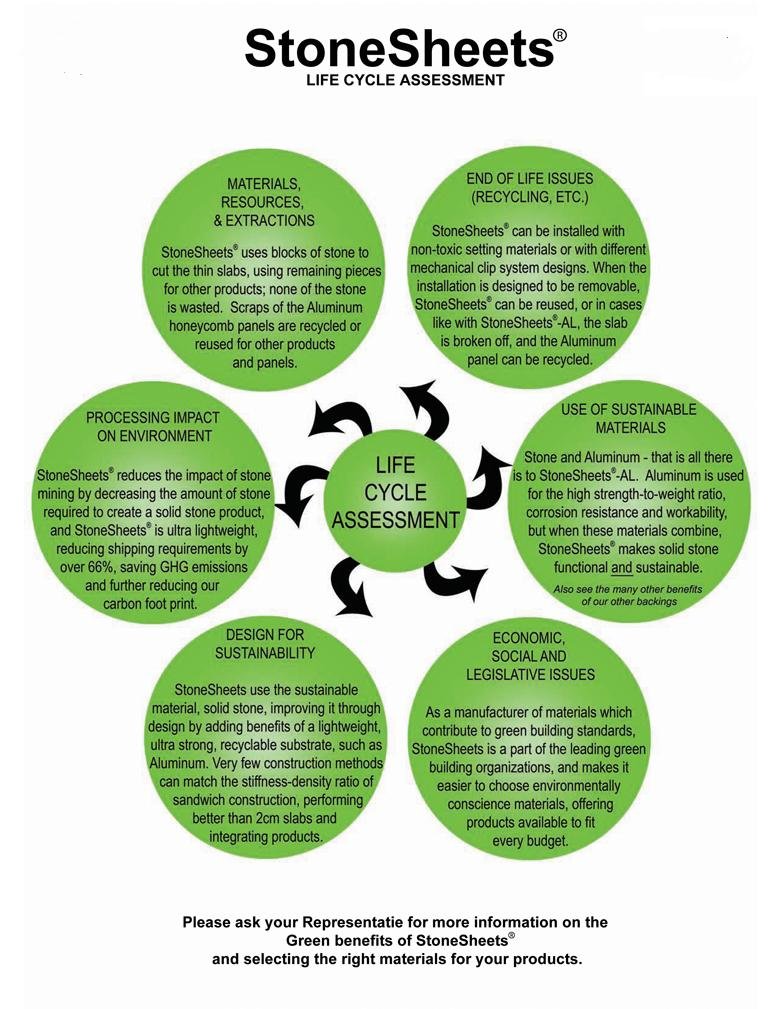
Life cycle assessment (LCA) is a process of examining the impacts of a product over its entire lifetime: where do the raw materials come from? How are they transported? How is the product manufactured? How is the product transported and sold to a customer? How does the customer use the product? What happens at the end of its useful life?
LCA quantifies the environmental impacts at each step in this life cycle. You can use LCA to design products so that they have the least negative environmental and social impacts. Doing a full-blown LCA can be a daunting and complicated process, fraught with embedded assumptions, and unfortunately the results are often not easily transferable from place to place because the energy, transportation and use profile may differ greatly from country to country. If you hope to make public claims that your product is environmentally better than a competitor’s, such a thorough analysis may be necessary. However, a more cursory analysis can still yield useful insights. Electrolux, after solving a customer challenge, began to wonder what they should do to improve the environmental performance of their other products.
When they examined their washing machines, they asked, where is the biggest impact of this product? Is it in the manufacture, use or disposal? Based on their analysis, they discovered that most of the impact was in the use of the product, the many years of laundry loads, using 40 gallons or so of water, and often energy-intensive hot water, a time.
So they developed new, now common, front-load washers that use a fraction of the water needed by traditional machines. This new design also reduced energy use and lengthened the lifetime of the clothes being laundered. The innovation gave them early access to the burgeoning Chinese market. And over the past several years, their environmentally preferable products have been making up a larger and larger percentage of sales, and with higher profit margins than their traditional lines.
The practice of life cycle assessment and life cycle inventories is evolving rapidly and many new tools are being developed to reduce the time and costs associated with doing them. The following are some of the resources and tools you should investigate.
Life cycle costing
Related to LCA is life cycle costing (LCC), examining the costs (as opposed to the environmental impacts) over the life cycle of a product: from research and development and manufacturing to maintenance and disposal. Similar to activity-based costing, LCC helps you get a clearer picture of the true costs of several product options. Through LCC, it becomes clear that the cheapest first cost is often not the cheapest in the long term. LCC allows you to take into account such factors as the longevity of the product, associated safety precautions and disposal costs.
For example, vinyl flooring is usually one of the cheapest first-cost flooring options. However, many other flooring options last longer, avoiding the cost of buying more flooring and the associated installation. Over the lifetime of the floor, in other words, vinyl is often not the best choice.
LCC can help you determine the best overall return between options in capital projects. For example, most of the cost of a building is in its operation, not its construction, so LCC can help you determine which environmental features make financial sense over the long term, even if they add up-front costs. LCC can also help you work out which of your product lines is really most profitable. Once you factor in training, safety equipment, hazardous waste permits and disposal costs, a product you thought was profitable might turn out not to be.LCA and LCC can be combined to help you sell your products: you can emphasize the life cycle benefits of your products over those of competitors which may initially cost less.
Product life cycle management and product life cycle tools
Related to life cycle assessment is an emerging field of product life cycle management software tools. ‘Product Lifecycle Management (PLM) is more to do with managing descriptions and properties of a product through its development and useful life, mainly from a business/engineering point of view; whereas Product life cycle management (PLCM) is to do with the life of a product in the market with respect to business/commercial costs and sales measures.’8 These tend to be industry-specific. For example, Gerber Technology and Infor recently introduced the latest versions of their product life cycle management system for the apparel/textile industry, Conformia is working on the life sciences and alcoholic beverages industries, and Siemens offers a product for the process industry, and Enovia’s Life Sciences Accelerator for Engineering Design addresses the medical devices industry.9
Grey lists, black lists and supply chain management
A number of countries and customers are publishing grey lists (of chemicals that they want phased out) and black lists (of chemicals they will not permit in their products). This is where Sony ran into conflict with the European Union by having too much cadmium in certain components of its Playstation. Of course, to know what is in your product, you must also know what is in the components, dyes and other inputs that you purchase from suppliers. And if you make a product such as PVC plastic that is commonly being listed, you have a major business threat.
What gets a chemical on to one of these lists? Usually it possesses, or its manufacture creates as a by-product with, one or more of the following attributes:
• Carcinogen – causes cancer;
• Teratogen – causes birth defects;
• Endocrine disruptor – mimics hormones (often also a teratogen);
• Mutagen – causes mutations of genetic code, thus passing on the problem to future generations;
• Persistent bio accumulative toxin (PBT) – a chemical that is not easily broken down by biological processes which accumulates in body tissue. William McDonough and Michael Braungart worked with a Swiss textile mill, Rohner, to produce upholstery for DesignTex furniture products. They collaborated to create a high fashion fabric that was created and dyed with a limited array of chemicals. Rohner had been informed by Swiss authorities that the trimmings from the factory were now classified as hazardous waste and that the closest waste disposal site was in Spain. McDonough and Braungart examined the roughly 1600 dyes in use, eliminating those that caused cancer or other health problems, and identified 16 that were safe. From these 16 chemicals, they could make virtually any colour at a competitive price. They designed a new fabric made from benign inputs that performed better than the traditional fabrics, was biodegradable and won them design awards. The waste trimmings can now be converted into mulch and weed fabric, a new product line. When the inspectors came to check their factory, they thought their equipment was broken – the water leaving the factory was as clean or cleaner than the water coming in! The process of making fabric was actually filtering the water. As William McDonough says, ‘Here, the filters of the future will be in our heads, not on the ends of pipes. They will be intelligence filters.’
Green chemistry
Closely related to grey lists and black lists is the emerging field of green chemistry. Whenever you produce something, you create not only a product but also unintended byproducts. Until recently, chemists never concerned themselves with how toxic these byproducts were. This led to odd ironies such as pharmaceutical companies making carcinogens and other toxic by-products in the process of producing medicines, potentially making us sick while they make us well. Environmental risk has long been seen to be a function of the hazard as well as exposure: Risk = Hazard × Exposure
To manage the risk, most effort to date has been put into reducing or eliminating exposure: protective clothing, scrubbers, filters, warning labels, training, etc. Green chemistry, on the other hand, addresses the hazard portion of the equation. Even with our best efforts, accidents happen. According to the Toxics Release Inventory (which only covers about 650 chemicals out of the 80,000–100,000 we produce and only larger emitters operating in the US), we released 6.16 billion pounds of these chemicals in 2001, 45 per cent of this contributed by the mining industry.11
The costs of managing environmental and health risks through regulations and compliance are enormous. In 1996 DuPont’s environmental compliance budget equaled that for research and development! Together these two items represented 41 per cent of chemical sales revenues. But managers are often blind to these costs because they are usually buried in different accounting line items – training, permitting, protective gear, insurance, health costs, paperwork, fines, legal fees, etc. – instead of being linked directly to specific products or production lines.
The old response – the solution to pollution is dilution – doesn’t work when the chemicals are persistent and bio accumulative. Studies around the world confirm that people of all nations are carrying a ‘body burden’ of hundreds of synthetic chemicals – wood preservatives, industrial solvents, pesticides, fire retardants – and that these are being passed on to our children via, among other things, breast milk. So we are warned against eating certain types of fish because of the high levels of mercury. Where is the mercury coming from? Mostly from coal-burning power plants.
Entropy happens. Everything spreads.
Green chemists recognize that the best way to control these emissions is to not make them in the first place. And often changing the production process yields other benefits. For example the BHC Company (Boots, Hoechst-Celanese) in Bishop, Texas, applied green chemistry principles to the manufacture of ibuprofen, a common painkiller. The old
‘stoichiometric’ process took six steps and roughly 60 per cent of what was created was byproduct, not ibuprofen. They switched to a process using a catalyst that can be recovered and reused after the chemical reactions. This green chemistry process took only three steps (versus six) and 99 per cent of what is created is either product (80 per cent, twice as much as before), recovered catalyst (which can be used again to make more ibuprofen) or a byproduct, acetic acid, which is the dominant ingredient in vinegar.12
More recently Pfizer has been quoted as saying that green chemistry has saved the company ‘tens of millions of dollars’ on two of its top-selling drugs. They reduced organic solvents like acetone. In the case of Viagra, they reduced it from 1300 litres per kilogram of drug produced to only 6.3 litres.13
Converting products to services
One of the reasons our manufacturing processes are so problematic is that the incentives are wrong. If you view yourself as a product company, then the way to make more money is to sell more products, regardless of how hazardous such products may be. Functional obsolescence is the key to profitability. The sooner the customer throws it away and needs a new one, the better.
However, some progressive companies are seeing a better business model, both for themselves and for the environment. The answer is sometimes to convert a product into a service. Usually the customer doesn’t really want to own the product; instead they want the service it provides. I don’t want a drill bit; I want holes.
In a business-to-business situation, a number of organizations are using service contracts where they align their own interests with those of their supplier. This is most commonly used in resource management and haulage contracts or in purchases of toxic chemicals (paints, cleaning products, etc.). DuPont, for example, has changed its relationships with auto companies. They used to sell car paint, and thus were rewarded the more they sold. Now they are selling the service of painting cars.
The car maker specifies the level of quality and the price they are willing to pay; DuPont operates a paint shop on the car maker’s own factory floor. The car maker never has to take possession of the paint, which means they don’t bear the responsibility for storing, handling, clean-up or disposal. And DuPont is now rewarded for conserving the amount of paint used, as long as quality levels are maintained.
In a business-to-customer situation, Interface, one of the largest makers of commercial carpet tiles, offers the Evergreen Lease programme. Customers don’t buy carpet but lease it. Interface monitors the carpet, removing tiles as they show wear. The customer benefits by saving the initial capital investment, converting it instead to an expense item. Interface benefits because they level out their revenues across the boom-and-bust construction cycles. They turn the old carpet into new carpet, saving on raw material costs, and they maintain a long-term relationship with their customer.