
Climate Change through Earth History
Constructing a history of Earth’s climate is easiest when examining more recent time periods because there are more tools available and better recordkeeping. Nonetheless, climatologists have been able to construct a detailed record of the planet’s more distant climate history, going back thousands of years. This text discusses how climate has played an important role in the evolution of life and has even guided the course of human history.
Ancient Climate
During much of Earth’s history, the planet has been relatively warm and wet, with no glaciers or ice sheets. These steamy periods were punctuated by ice ages, when much of the planet’s surface was coated in ice. On average, over Earth’s history, the planet’s temperature was between 14°F and 27°F (8°C and 15°C) warmer than the temperature today. Scientists speculate that a temperature variance of only 18°F (10°C) makes the difference between a fully glacial earth and a nice free planet, in part because high temperatures are more extreme at high latitudes where the presence or absence of ice sheets plays an important role in global climate. Conditions now are relatively cool because the planet is coming off the extreme cold of the Pleistocene Ice Ages, which ended about 10,000 years ago.
Atmospheric greenhouse gas concentrations have also varied in Earth history. CO2 has fluctuated from between less than 200 ppm to greater than 5,000 ppm, a high concentration reached hundreds of millions of years ago. Ice core and other samples show that greenhouse gas levels correlate with temperatures: When CO2 or methane levels are high, temperatures are also high.
Paleocene-Eocene Thermal Maximum
After the mass extinctions at the end of the Cretaceous Period, 65 million years ago, the planet was relatively warm and ice free. Temperatures rose until they became so high they triggered an even greater warming event around 55 million years ago. This period is known as the Paleocene-Eocene Thermal Maximum (PETM), a time when the Arctic was swampy and Antarctica was covered with forests.
Paleoclimatologists are piecing together the story of the PETM, mostly from the chemistry of forams collected from ocean sediment cores. The PETM arose over a very short period of time geologically. About half of the warming, 3.6°F (2°C), took place over no more than a few hundred years, with the rest occurring over less than 5,000 years. Sea surface temperatures increased by between 9° and 14°F (5° and 8°C), with a striking rise of 15°F (8.3°C) occurring in the polar regions. The deep sea warmed dramatically as well.
Forams show a major decline in the ratio of heavy carbon (13C) to light carbon (12C) across the Paleocene Eocene boundary. The explanation favored by scientists is that a load of methane, which is rich in light carbon, flooded the atmosphere. The most likely source of such vast amounts of methane is the methane hydrate deposits buried inseafloor sediments. According to this scenario, the PETM was triggered when ocean temperatures rose above a critical threshold: the temperature at which methane hydrates melt. Melting released the methane trapped inside the hydrates, and the greenhouse gas deluged the atmosphere. Such large increases in atmospheric methane explain the rapid and extreme global warming seen during the PETM.
The high temperatures of the PETM had many consequences. Warm surface waters caused ocean currents to switch direction, a condition that lasted for about 20,000 years. Because warm water cannot hold as much gas as cold water, oceanic oxygen levels were very low. In the atmosphere, methane broke down and formed CO2, which then formed carbonic acid. The evidence for this is that the deep ocean sediments are very rich in clays, suggesting that the carbonate shells of many organisms dissolved.
High acidity and low oxygen caused 50% of deep sea forams and possibly other deep sea animals to die out. While there was no mass extinction on land or in the surface ocean, fossil evidence supports changes in the abundance of some life forms and in their evolutionary pathways. This is the time when modern mammals, from rodents to primates, first evolved and flourished. The PETM lasted for about 200,000 years, likely ending when all the available methane had been released into the atmosphere. Over time, the CO2 that the methane broke down into was sequestered in forests and plankton and dissolved into the oceans.
The Pleistocene Ice Ages
After the end of the PETM, temperatures fell, ultimately bottoming out during the Pleistocene Ice Ages, which began 1.8 million years ago and ended 10,000 years ago. The Pleistocene was not a time of relentless cold: Glaciers advanced and retreated many times. At the height of the most recent glacial advance, between 18,000 and 22,000 years ago, glaciers covered much of Eurasia and North America, from New York City northward. Average global temperatures were about 10°F (5.5°C) colder, and sea level was about 395 feet (125 m) lower than today. The low sea level exposed the Bering land bridge, allowing humans and large animals to migrate from Asia into North America. The bountiful forests south of the ice sheets were home to giant ice age mammals such as cave bears, saber-toothed cats, and wooly mammoths.
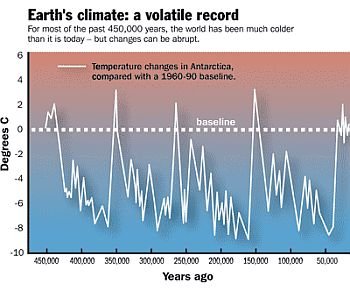
During the warm periods, known as interglacial’s, temperatures were more than 2°F (1.1°C) higher, and sea level was about 16 feet (4.8 m) higher than today. CO2 was higher than during the glacial periods but never rose above 300 ppm. Interglacial periods lasted about 10,000 years (although one of them lasted as long as 27,000 years). Even the interglacial periods were broken up by relatively short cold spells. CO2 was stable at or below 280 ppm for at least 400,000 years. The glacials and interglacials of the Pleistocene were caused by the Milankovitch and other natural cycles. Greenhouse gas levels also played a role. At the beginning of each glacial advance, CO2 and methane plunged and then resurged at the end. Ice cores from Greenland and Antarctica exhibit CO2 values that are 30% lower during glacial periods than during interglacial periods.
Climate changed quickly during the Pleistocene, with rapid transitions between glacial and interglacial periods. One especially dramatic temperature change took place early in the interglacial period that began 12,700 years ago. At about 10,500 years ago, as glaciers were retreating, the warming trend suddenly reversed. Temperatures in parts of the Northern Hemisphere fell as much as 20°F (11°C) in as little as 10 to 100 years. The summit of Greenland was 27°F (15°C) colder, and Great Britain was 9°F (5°C) colder than they are now. This climatic period, which lasted about 1,400 years, is called the Younger Dryas. At the end of the Younger Dryas, temperatures returned to normal in only about 10 years.
Such rapid and dramatic cooling was likely the result of a massive influx of freshwater from North America. When an enormous lake of glacial melt water that was held back by an ice dam was breached, freshwater flooded the North Atlantic. The freshwater was light and floated on the sea surface, shutting down thermohaline circulation. As a result, warm equatorial waters were stopped from flowing northward.