
Unwasted: The Future of Business on Earth (Full Length Documentary)
STRATEGIES YOU CAN USE (7)
Zero waste
Nature operates on the principle that the waste of one organism becomes food for another.
The industrial revolution was built on quite a different, linear model, which Paul Hawken and others have referred to as Take-Make-Waste. Manufacturers were not expected to consider what happened to a product after its useful life. That was an externality, a cost imposed on municipalities and their citizens. But all that is changing.
Zero waste strives to eliminate all forms of waste in an organization. Like the ‘zero defect’ policies of the quality movement, this bold goal drives radical innovation and improvement in efficiencies.
Zero waste does not mean that you produce no by-products; instead it implies that you think of waste as a resource and find markets for all your residual products. Some people use the term ‘zero waste to landfill’, which helps to make this distinction, but this term only relates to solid waste and does not look at other forms of waste (eg air emissions, energy). Any manufacturing process is likely to have by-products that are not needed in the process. Zero waste simply means that none of those by-products go to waste.
If you have any waste, then you are also wasting money. This isn’t just bad for nature; it’s bad for your bottom line! Remember, waste is something you paid for and then were not able to sell. One study of ‘material throughput’ in US manufacturing discovered that only 6 per cent of the cumulative inputs ended up in the final product!
The remaining per cent generated in the extraction, manufacture and transportation can be thought of as waste. In addition, waste costs you even more because you often have to pay to dispose of it or pay for permits to emit it.
As the GrassRoots Recycling Network likes to quip, ‘If you’re not for zero waste, how much waste are you for?’ So how do you really eliminate the concept of waste? Is it possible to get to zero waste?
To some degree it may depend on how you define ‘zero waste’. The GrassRoots Recycling Network lists organizations that have eliminated 90 per cent or more of their waste streams. As an example they cite Hewlett-Packard in Roseville, California, which reduced its waste by 95 per cent and saved $870,564 in 1998. One action that contributed to this savings was switching from pallets to reusable slip-sheets to transport products.
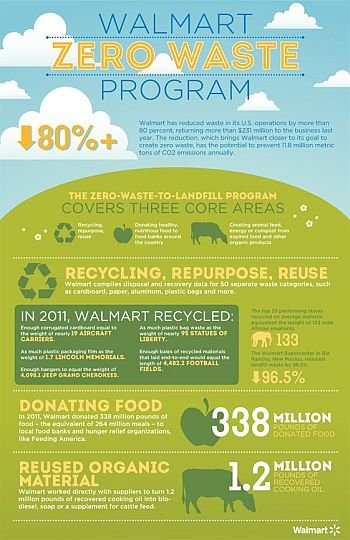
Certainly zero waste to landfill is easier to achieve than zero waste in everything. Imagine no skips. In 2000 Epson in Portland, Oregon reduced its waste to landfill to zero and saved over $300,000 in the first year (through avoided disposal fees and income from the sale of residual products).
They bought a compactor to compress foam packaging so that it could be manufactured into floor molding by another company. Excess printer ink was used as pigment by paint manufacturers. Ninety per cent of their waste was reused, recycled, or sold as input to someone else’s product. The 10 per cent that was left was shipped off to a power plant to be burned for electricity.
Of course, if you do sell or give your residual products to others, make sure they will be used for safe purposes along their entire life cycle. Unbelievably, for decades industry has legally turned hazardous waste into fertilizer, spreading arsenic, lead, cadmium, chromium, dioxins and radioactive ingredients on to agricultural lands, some of which got absorbed by crops and showed up on our dinner tables.
This practice has also been implicated in clusters of health problems in farming communities (it is linked to cancer and lung disease) and is alleged to have rendered some farms incapable of growing anything for years. Just because a practice is legal doesn’t make it right.