
What about Solar Dimming?
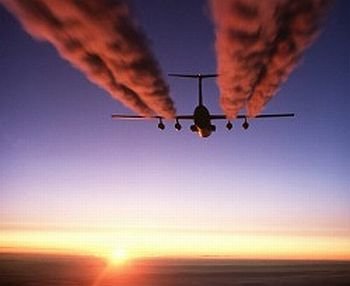
Increased blocking of solar radiation has been referred to as solar dimming. During the 1970s, the effects of air pollution were severe enough to cause a small, temporary decline in the overall pattern of global warming. All indications are that global warming would have progressed even more rapidly without the effects of global dimming. The overall trend is toward warming despite the negative influence of increased cloudiness, reflective pollution, and occasional volcanoes.
ABSORPTION-WHERE DOES ALL THAT ENERGY GO?
Where the Earth Keeps Its Energy
Nearly 90 percent of the energy received from the sun goes into the oceans. It may seem odd that with all that heat, the temperature of the oceans has risen only 0.1°C over the past few decades. What happened to all that heat? It takes an enormous amount of heat to change ocean temperature. Not only is the volume of seawater so huge, but water also requires more heat that many other materials on the earth’s surface to result in a temperature change. Less than 3 percent of the incoming energy goes into melting ice in glaciers, Greenland and Antarctic ice caps, and Arctic sea ice.
Heat and Temperature
Heat and temperature are not the same. Heat is the amount of energy that is contained in a material. Temperature is a measure of how fast the molecules of that material are moving. For example, a cup of tea has a higher temperature but contains less heat than a swimming pool filled with cooler water. Heat energy is stored in matter by the motion of the molecules of the material. The faster the molecules move, the higher is the temperature of the material. The overall effect of all the molecules moving is the heat energy contained in the material.
Heat Capacity
More heat energy is needed to change the temperature of a given mass of water than to change the temperature of either rock or air. Light energy absorbed by water will change the temperature of that water by a smaller number of degrees than it will change the temperature of air. With close to 70 percent of the earth’s surface covered by oceans and lakes, water has a moderating influence on temperature. The specific heat of a material is the amount of heat (in joules) that it takes to raise 1 kilogram of that material by 1°C.
Air gets get hotter four times faster than water (both of the same mass and both exposed to the same amount of heat). The temperature increase for rock when exposed to the same heat energy input is faster than that of either air or water. Without the vast stretches of oceans and lakes covering the earth’s surface, the temperature increase from the greenhouse effect would be much more severe.
Latent Heat
Heat energy also can be incorporated into matter in a way that does not change its temperature. This form of heat transfer is called latent heat. In the case of ice, it is the amount of heat needed to melt a given mass of material. When ice or any other material melts, it absorbs heat without changing temperature. This means that to the extent that ice is melting, there is no net increase in temperature even though the earth is absorbing more heat. Like water, ice caps and glaciers have a moderating effect on how fast the earth’s temperature increases.
The significance of this is as follows:
• If absorption of solar radiation by the earth results in melting ice, the full impact on the earth’s average global temperature will be delayed until the ice melts.
• As the ice melts, abrupt changes in local temperature and their associated impact on climate may occur. While an ice sheet is melting, the immediately surrounding ice, water, and air maintain an equilibrium that is close to the melting point of ice, which is 0°C (32°F). Once the ice melts, no more of the incoming heat energy is tied up in the latent heat of melting ice. At that point, any additional heat energy goes into heating the water and air.
Ultraviolet Absorption
Some light coming from the sun is invisible. Light coming into the atmosphere whose waves are spaced apart further than red light is called infrared light, which has a longer wavelength than red light. The earth also receives some ultraviolet light, which has an even shorter wavelength than blue light. Light whose waves are closer together than violet light are called ultraviolet light. Some, but not all, of this ultraviolet light is absorbed in the stratosphere by the ozone layer. This results in thermal absorption in the stratosphere which is readily reradiated back out to space. Absorption of light radiation in the stratosphere has an overall cooling effect on the surface of the earth since less energy penetrates to that level.