
A Climate Minute – Natural Cycle
Natural Climate Cycles
SUNSPOT CYCLES
In order to identify how much human activities are influencing the temperature of the earth, it is important to isolate changes that would be taking place without the presence of humans. Accurate measurements of solar output date back only as far as 1978, when satellites began measuring solar intensity outside the interfering influence of the earth’s atmosphere. Details about how these satellites monitor the various aspects of the earth’s climate can be found in Appendix C. Satellite measurements are accurate enough to detect variations associated with the sun’s rotation on its axis about every 27 days. This variation is much smaller than the 11-year solar activity cycle associated with maximum and minimum sunspot periods. Solar radiation is slightly lower when there are fewer sunspots.
Satellite data found that the solar “constant” mentioned earlier is actually not perfectly constant. Instead, it fluctuates in an approximate 11-year cycle along with the ebb and flow of sunspots. This causes a minor ripple in the earth’s temperature, which rises and falls by as much as 0.1 percent approximately every 11 years. This variation is accounted for in the overall earth’s energy budget but is far too insignificant to be responsible for the observed increases in global air temperature.
During the seventeenth century, an astronomer named Edward Maunder noticed that there were much fewer sunspots at the time than usual. The Maunder minimum is the name given to the period roughly from 1645 to 1715 when very few sunspots were recorded and coinciding with a decrease in solar intensity and significantly colder temperatures on earth. Climate records from that time suggest that the sun was 0.15–0.3 percent less bright than the present day. Some scientists attribute this period of colder temperature known today as the “little ice age” to the reduced solar output.
The sun continuously projects a stream of charged particles, called the solar wind, at high velocity toward the Earth. When sunspots are at a maximum, the solar wind is most intense. The solar wind affects the electronics and solar panels on satellites and, in the most severe instances, disrupts power and communications on earth. The solar wind is also responsible for the display of shimmering lights called the northern and southern lights (aurora boreolis and aurora australis). Some scientists see the variation in intensity of the solar wind as a possible infl uence on some of the ongoing recurrent climate cycles on earth (K. Frazier, Our Turbulent Sun, Prentice Hall, Englewood Cliffs, N.J., 1982).
MILANKOVITCH CYCLES
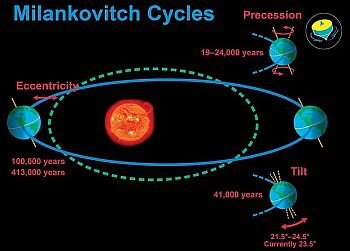
In Earth’s path around the sun, the shape of its orbit and the tilt of its axis of rotation undergo small but signifi cant changes over time. These changes are the result of the gravitational pull of other planets in the solar system, most notably Jupiter. A Serbian mathematician named Milutin Milankovitch completed a study published in 1930 of these changes and their impact on the earth’s climate.
Milankovitch thought that small slowly evolving changes in the earth’s orbit around the sun would eventually lead to an ice age. Based on his orbital calculations, Milankovitch predicted that ice ages should occur every 100,000 years, with smaller temperature swings occurring every 41,000 and 19,000–23,000 years. Recent evidence from past climate records, including ocean core samples and coral reef measurements show that Milankovitch’s predictions were quite accurate, with ice ages peaking just about every 100,000 years. The three conditions contributing to the Milankovitch cycles are described below.
Eccentricity
Like all the planets in the solar system, the earth follows an elliptical path in its annual orbit around the sun. Every 100,000 years, the earth’s orbit goes through a cycle that brings it from a nearly circular orbit to one with a slightly greater eccentricity. The very slight gravitational pull of other planets in the solar system, especially Jupiter and Saturn, on the earth are thought to be responsible for this slight orbital adjustment. The eccentricity of an ellipse is a measure of whether the ellipse looks more like a circle or more like an oval. This affects the average global temperature because it determines how far the earth is from the sun during each of the seasons.
Currently, the difference between the closest and furthest distance from the sun is 3.5 percent, translating to a 6.8 percent variation throughout a yearly cycle of solar intensity. (Note: Solar intensity varies as the inverse square of the distance between the earth and the sun.) During the most highly elliptical orbit, there would be a variation of 23 percent in the solar intensity during the earth’s yearly path around the sun.
Axis of Rotation Angle
The earth rotates on an axis that is tilted at an angle of 23.4 degrees to the plane of the earth’s orbit. This angle-which is also known as obliquity-can vary slightly over time through a range of 2.4 degrees. The earth’s axis shifts between a tilt angle of 22.1–24.5 degrees and back again over a period of approximately 41,000 years.
When this angle is at it greatest, the earth becomes hotter in summer and cooler in winter. A smaller angle would result in a smaller range of temperature extremes between the seasons. During the parts of this cycle when the tilt angle is smaller, cooler summers occur near the poles. As a result of less melting of the previous winter’s ice and snow, cooler summers lead to a continual cumulative buildup of ice. This creates a condition that favors the start of an ice age.
Currently, the earth is tilted at 23.4 degrees from its orbital plane, about midway between the maximum and minimum angles. The tilt is decreasing slowly and will reach its minimum value in about 8000 years.
Wobble-Precession of the Equinoxes
As the earth spins, it wobbles slightly like a top. This wobbling is known to astronomers as precession and is the change in the direction of the earth’s axis of rotation with respect to the earth’s orbital path around the sun. Therefore, not only does the tilt angle get larger and smaller, but the axis also points in different directions. The direction that the earth’s axis spins goes through a full circle roughly every 19,000–23,000 years. The driver of this top-like motion is the force exerted by the sun, moon, and planets on the earth, which is not a perfect sphere. As we saw in Figure 4-1, at present, the earth is closest to the sun during the winter season in the northern hemisphere. The wobbling eventually will bring the earth’s axis of rotation to a point where the northern hemisphere is tilted toward the sun at a time when it is closest to the sun. This will cause the summer in the northern hemisphere to get hotter and the winter to be colder. As with variations in the axis of rotation, one hemisphere will have a greater variation between the seasons, whereas the other hemisphere will have milder seasonal differences.
How This Affects Climate
The dominant effect that triggered the ice ages was orbital conditions that favored reduced sunlight during summer seasons in the northern hemisphere. This resulted in accumulation over time of increased reflective layers of ice that promoted further cooling.
The Milkanovich cycles provide a good explanation of the historical 100,000-year cycle in ice ages. The combined effect of these natural cycles is a variation in the sun’s energy that reaches the earth at different times and in different locations. These cycles result in variations in the overall solar intensity received in the northern hemisphere shown as solar forcing.
These natural climate changes are significant, but they are distinct from the effects of global warming caused by the enhanced greenhouse effect. This natural climate change is exerting a slow cooling trend that will take tens of thousands of years to occur. However, any thought that global warming will be offset by the next Milankovitch cycle should be put to rest because the next naturally occurring ice age is not expected for at least another 30,000 years.
Natural cycles such as those involving the earth’s orbits have contributed to initiating past climatic changes. They are not, however, responsible for the global warming that is taking place today.