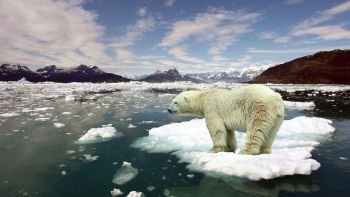

ALERT Ice Age cometh Gulf Stream Slowed 2013 Earth in Danger Weird weather
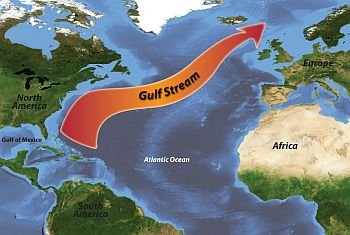
Distribution of Heat around the Earth-Thermohaline Circulation and the Gulf Stream The thermohaline circulation (THC) is a global ocean current that transfers massive amounts of heat from near the equator to higher latitudes in a process often compared with a conveyor belt. This circulation is driven by a combination of cold temperatures and high salinity near the ocean surface. The THC is synonymous with the meridonal overturning circulation (MOC).
Every day, the Gulf Stream carries the heat equivalent of all the coal that is burned everywhere on the earth for a decade. This is why Great Britain has much milder winters than other places at comparable latitudes, such as Canada and Russia. The THC drives the Gulf Stream. The thermal satellite image gives an idea of how heat is redistributed from one part of the world to another. As the Gulf Stream swings northeastward across the Atlantic Ocean toward Europe, it called the North Atlantic drift. Surface waters of the North Atlantic drift approach Europe. There, they grow dense and sink and begin the tedious trek back to the southern hemisphere. This trip takes 1500 years to complete. The massive movement of water and heat has a profound impact on the earth’s climate. This circulation also stirs up nutrients from the ocean depths, facilitating ocean life in more places. Ocean currents (such as the Gulf Stream and the North Atlantic drift), air currents (such as the jet stream), and local wind conditions are nature’s way of redistributing heat. The energy transported by the Gulf Stream is equivalent to the power output of 1.5 million state-of-the art nuclear reactors.
The process of transferring heat by using a moving fluid (such as water or air) is called convection. The earth’s weather and climate largely are the result of vertical and horizontal convection currents moving in complex paths across its surface. One way scientists know that this is happening is by tracking compounds in the water such as halocarbons, whose presence pins them down to a particular time period. Scientists track how long these trace materials were last in the air and compare their concentration at various depths and locations in the oceans. From this, a map of the THC can be generated.
Ocean circulation patterns are the result of a delicate balance established over thousands of years by the complex interaction of a large number of variables, including salinity and temperature gradients. These circulation patterns may be very sensitive to small changes. Dilution of the ocean’s salt content from the accelerated melting of Greenland’s glaciers could be the catalyst to initiate this change. Scientists are struggling to see how close we are to the point of no return, but most scientists agree that climate models will need to be much more accurate before we can know for sure. It is not clear how delicate the balance is that keeps the Gulf Stream fl owing the way is does. Scientists are also asking how much of a change in ocean temperatures would alter the North Atlantic drift current. This current keeps the climate of Western Europe much more temperate than that of Labrador, which is at comparable latitude. While the possibility of disrupting this long-established ocean pattern may be real, the likelihood is consistent with only the most pessimistic climate change scenarios.
Key Points
• The sun provides a relatively constant 1368 W for every square meter of the earth’s surface.
• This solar “constant” varies by 0.2 percent (±0.1 percent) as part of a natural 11-year sunspot cycle.
• Light is received from the sun in the form of electromagnetic waves. The solar spectrum includes visible, ultraviolet, and infrared light.
• Different colors have different wavelengths. Ultraviolet light has a wavelength that is too short to see. Infrared light has a wavelength that is too long to see.
• The earth’s temperature varies throughout the year because of the shape of its orbit around the sun and the angle of its axis of rotation.
• Yearly averages taken over the entire earth eliminate the natural variation that occurs through an annual cycle and at various locations around the planet.
• About 30 percent of the incoming energy from the sun is reflected back into space from clouds, snow, and to a lesser extent other surfaces.
• The balance of the incoming energy from the sun is absorbed by land, air, water, or ice.
• As the earth warms, it radiates invisible infrared light that is partly absorbed by greenhouse gases in the atmosphere, making it warmer. This is called the greenhouse effect.
• The greenhouse effect occurs naturally. Human activities have produced an enhanced greenhouse effect as a result of increasing greenhouse gases above historical levels.
• Without the greenhouse effect, the earth would be at the much colder temperature of –19°C (–2°F) instead of the 14.4°C (58°F) it currently enjoys. • The planet Venus, with a much higher concentration of carbon dioxide in its atmosphere, is a good example of extreme conditions resulting in a greenhouse effect.
• Natural cycles in the earth’s motion caused climate changes throughout the earth’s geologic history. These changes occur at intervals of 100,000 years in how elliptical the orbit is, 40,000 years in how the angle of the axis of rotation varies, and 11,000 years in variation of the orientation of the axis toward the sun between the seasons. The cycles are known as the Milanovich cycles and are responsible for past ice ages and interglacial warming periods.