
Earth’s atmosphere
The Earth’s climate is influenced by its distance from the Sun and the composition of the atmosphere, the layer of gases that surrounds the Earth.
On a local level, climate is controlled by a particular region’s latitude (the distance north or south of the equator as measured in degrees), altitude (the height above or below mean sea level), wind patterns, proximity to an ocean, and the makeup of its surface. The water cycle and carbon cycle are both important to understanding Earth’s climate.
Earth’s atmosphere
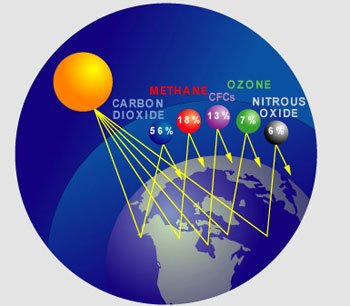
Earth’s atmosphere is made mostly of nitrogen and oxygen. The concentration of water vapor (gaseous water [H2O]) varies depending on the humidity. Carbon dioxide (CO2) makes up a tiny portion of the atmosphere (only 36 of every 100,000 gas molecules; a molecule is the smallest unit of a compound that has all the properties of that compound), but it plays the most important role in climate change. Methane (CH4) and nitrous oxides (NO and N2O) each make up an even smaller percentage of the atmosphere, but they also play important roles in climate change. Ground-level ozone (O3) forms by chemical reactions mostly involving car exhaust and sunlight.
Carbon dioxide, methane, nitrous oxides, and ozone are important components of the atmosphere in part because they are greenhouse gases, which trap heat in the atmosphere. The presence of excess greenhouse gases creates the greenhouse effect. Greenhouse gases influence climate the world over: A rise in greenhouse gas levels in one region alters climate on the entire planet.
Concentrations of Some Important Atmospheric Gases
Gas – Symbol – Concentration (%)
Nitrogen – N2 – 78.08
Oxygen – O2 – 20.95
Water vapor – H2O – 0 to 4
Carbon dioxide – CO2 – 0.036
Methane – CH4 – 0.00017
Nitrous oxides – NO, NO2 – 0.00003
Ozone – O3 – 0.000004
Particles (dust, soot) – 0.000001
Chlorofluorocarbons -(CFCs) – 0.00000002
Source: Ahrens, C. Donald, Meteorology Today, Pacific Grove, Calif: Brooks/Cole, 2000.