
3. Size and Shape
The shape of the Earth was guessed at for thousands of years. Most early people thought the land and seas were flat. They were afraid that if they traveled too far in one direction, they would fall off the edge.
Explorers who sailed to the limits of known navigation were thought to be crazy and surely on the path to destruction. Since many early ships didn’t return from long voyages (probably sunk by storms), people thought they had either gone too far and simply fallen off, or had encountered terrible sea monsters and were destroyed.
It wasn’t until the respected Greek philosopher, Aristotle (384–322 BC), noticed that the shadow cast by the Earth onto the Moon was curved, that people began to wonder about the flat Earth idea. Remember, Aristotle was widely respected in Greece and had written about many subjects including, logic, physics, meteorology, zoology, theology, and economics, so some people wondered if he might be right about the round Earth too.
Aristotle believed the Earth was the center of the solar system. In the early 1500s, Polish astronomer, Nicholas Copernicus, sometimes called the Father of Modern Astronomy, suggested that the Earth rotated around the Sun. His calculations and experiments all pointed to this fact.
Unfortunately, many people believed that the Earth was the center of the Universe. They didn’t like the idea of the Earth being just another rock circling the Sun. It threatened everything they believed in, from the way they raised crops, to their faith in God. Copernicus and others to follow him, however, continued to question and write about the way things worked and the Earth’s place in the cosmos. It didn’t help early people that the Sun, though very bright, doesn’t look all that big in the sky.
To someone standing on the Earth and seeing fields, mountains, ocean, or whatever, as far as the eye can see, it was no wonder most people thought the Earth was the center of everything. They had no idea of the distance.
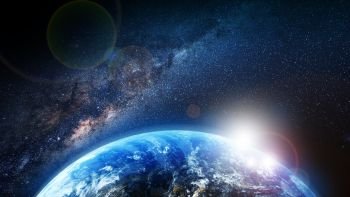
The Earth is known as one of the inner planets in our solar system. The four terrestrial or Earth-like planets found closest to the Sun are Mercury, Venus, Earth, and Mars. They formed closest to the Sun with higher heat than the farther flung planets. Most of the radiation and other solar gases expelled by the Sun blew off high levels of hydrogen, helium, and other light gases to leave behind rock and heavy metal cores.
These ‘‘hard’’ planets, including our Moon, are similar chemically and the best picks for establishing human colonies in the near future. The outer planets, made up of volatile matter slung way out into space, are huge compared to the inner planets. These include Jupiter, Saturn, Uranus, Neptune, and Pluto (the tiny ‘‘oddball’’ of the outer planets made mostly of ice).
The giant outer planets have rocky cores, but are mostly made of nebular gases from the original formation of the Sun. Just as the planets are held in different orbits by the Sun’s gravity, the well-defined rings of Saturn made up of gases and particles are also held in orbit by gravity.
To remember the placement of the nine planets in our solar system, picture a baseball field. The distances are nowhere near proportional, but if you think of the inner planets (Mercury, Venus, Earth, and Mars) as the ‘‘infield’’ and the outer planets (Jupiter, Saturn, Uranus, Neptune, and Pluto) as the ‘‘outfield,’’ it’s easy to keep them straight.
Compared to the gigantic Sun, which is over 332,000 times the mass of the Earth, the Earth is tiny, a bit like the size of a human as compared to the size of an ant. The Sun is 1,391,000km in diameter compared to the Earth which is approximately 12,756km in diameter.
That means the diameter of the Sun is over 100 times the diameter of the Earth. To picture the size difference, imagine that the Sun is the size of a basketball. In comparison, the Earth would be about the size of this ‘‘o.’’
Our planet turns on its axis once a day at a tilt of 23.58 to the plane of the Earth’s orbit around the Sun. The other planets spin on their axes as well and roughly share the same plane of rotation as the Earth. The colossal size of the rotating Sun holds the planets in their particular places by gravity.
The plane of the ecliptic is the angle of incline with which the Earth rotates on its axis around the Sun. The distance to the Sun is an average of 93 million miles from the Earth.
This distance is so huge that it is hard to imagine. It has been said that if you could fly to the Sun in a jet going 966 km/hr, it would take over 300 years to get there and back.