
Climate Science Lecture – The Basics of Global Warming
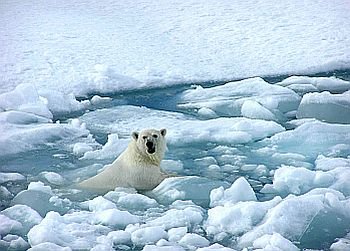
The Tipping Point
Climate scientists are becoming concerned about the speed at which temperatures are rising, and the consequences of global warming are being realized. James E. Hansen, director of the National Aeronautic and Space Administration’s (NASA) Goddard Institute of Space Studies, said in 2006 that temperature increases of 4°F (2.2°C) in this century would “imply changes that constitute practically a different planet.” Hansen’s statement suggests that climate may, in the next few decades, reach the point of no return: the place scientists call the tipping point, a concept that will be described.
What is the tipping point?
A toy car sitting on the flat above a steep slope can be inched slowly toward the slope for a time. Eventually, though, enough of the car’s mass will be over the slope that the car will careen down the hill. The point when the car is about to head downhill, at which its downwardmomentum can no longer be stopped, is its tipping point. A system’s tipping point is tied to its positive feedbacks. Climate will reach the tipping point when catastrophic change becomes inevitable: When it reaches the point where it is too late to act. There are many tipping points along the way. The first will be when the first irreversible event occurs, but many others will follow it. Some climatologists say that the first tipping point will come in the next several decades if greenhouse gas emissions are not halved over the next 50 years.
This chapter describes some of the events that warming temperatures may push to their tipping point, just as the toy car was inched to its tipping point. The time frames of these events range from the coming decades to centuries or millennia. Each event has a different tipping point, and each is irreversible once that point is crossed, at least on a timescale that is meaningful for humans.
The Loss of Major Ic e Sheets and Rising Sea Level
When a glacier warms, the rate of melting increases because meltwater lubricates the glacier and causes it to slide more and melt faster. Once an ice sheet begins to break up, it may not stop until it has all melted away, or until the next ice age arrives. Although no one can know what the tipping point for the Greenland ice sheet is, many scientists think it could be reached with a regional temperature increase of 5°F (2.7°C), which corresponds to a global increase of 2.7°F (1.5°C) above the present level. This magnitude
of global increase could be reached through a doubling of CO2 and could occur as early as 2080 or even sooner. After this tipping point is reached, thermal inertia would keep the ice sheet from melting abruptly. Eventually, though, the ice sheet would melt completely, raising the sea level about 23 feet (7 m).
Recent reports indicate that ice loss in Greenland is greatly accelerating. One study showed that melting in 2006 was twice as fast as in the previous five years. Greenland’s ice mass has already decreasedby 50 cubic miles (208 cubic km), as more of the ice sheet melts and more giant icebergs calve into the sea. In early May 2006, temperatures were almost 20°F (11°C) above normal, just below freezing. Prolonged local heating of that magnitude could greatly hasten the loss of the Greenland ice sheet.
Models suggest that Antarctic ice sheets are more stable because they are larger and thicker. Nonetheless, the West Antarctic Ice Sheet (WAIS) is in the early stages of disintegrating, says the head of the British Antarctic Survey, Chris Rapley. In the report Avoiding DangerousClimate Change, Rapley wrote, “The last IPCC report characterized Antarctica as a slumbering giant in terms of climate change. I would say it is now an awakened giant. There is real concern.” The total collapse of the WAIS could raise sea level by 16 feet (4.9 m).
The effect of all that melting, coupled with thermal expansion, would be an enormous sea level rise. The record of the geologic past suggests that during ice sheet collapse, the sea level can rise 16 feet (5 m) per century. A 20-foot (6-m) increase in sea level would inundate Seattle, portions of Manhattan, and the southern one-third of Florida (including Miami). According to former U.S. Vice PresidentAl Gore’s book An Inconvenient Truth, a 20-foot (6-m) rise in sea level will displace 20 million people in Beijing, China; 40 million in Shanghai, China; and 60 million in Calcutta, India, and Bangladesh.
The melting of ice sheets would be fairly slow because of thermal inertia, but history indicates what will happen once this melting occurs. When the average temperature was last 5°F (2.8°C) globally and 10°F (5.6°C) at the high latitudes, about 3 million years ago, sea level was 80 feet (24 m) above what it is today. A rise of that magnitude will partially or wholly inundate many regions, including San Francisco, New York, portions of Los Angeles, Washington D.C., and nearly all of Florida and the Gulf of Mexico coastal region. Globally, Tokyo, London, Beijing, and much of the Netherlands would be submerged.
An Ice Age for Europe
Global warming threatens oceanic currents that have been stable for thousands of years. Paradoxically, changing currents could cause Europe to cool at a time when most of the rest of the world is heating up. The prediction is for a scenario like the Younger Dryas, about 10,500 years ago, when an influx of freshwater into the North Atlantic slowed thermohaline circulation in the region. The freshening of the North Atlantic during the Younger Dryas was due to a breached ice dam that allowed glacial melt water to flood the surface ocean. Future freshening will be the result of increased rainfall, runoff from melting ice sheets, and a lessening of sea ice formation. Because this relatively light freshwater will not sink, Atlantic meridional overturning circulation in the North Atlantic will end or slow considerably.
North Atlantic surface water salinity has been decreasing for the past few decades. As a result, overturning circulation weakened by 30% between 1957 and 2004, according to a 2005 report in Nature by Harry Bryden and other scientists at the National Oceanography
Center in Britain. Although the northward flow of the Gulf Stream is so far unchanged, about 20% less deep water appears to be traveling southward. These observed changes are consistent with climate model predictions. Eventually, the continued influx of freshwater into the North Atlantic may slow or stop the pull of the equatorial Gulf Stream waters toward the north. If this occurs, temperatures in the British Isles and northern Europe will cool by about 5.4 to 12.6°F (3 to 5°C), which is comparable to the Little Ice Age of the sixteenth to eighteenth centuries.
The Younger Dryas, in addition to a more recent freeze that occurred 8,200 years ago, took hold over a decade or two and lasted for hundreds of years. While it clearly is possible for the salinity of the North Atlantic to reach a tipping point that slows or stops normal ocean circulation patterns, no one knows when this might next occur; there are many scientists who say that it is unlikely to occur at all. Still, Hans Joachim Schellnhuber, who directs Germany’s Potsdam Institute for Climate Impact Research, has run multiple computer models that concluded in 2006 that there is a 50% chance that the Atlantic meridional circulation will collapse within 200 years.