
Geologic History of the Earth: Part 1
Strata and Land Eras
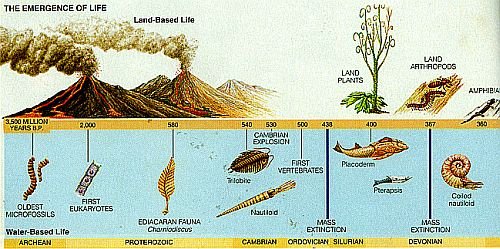
Land eras are the broad ranges of time that geologists use to group different information. For example, if a geologist wants to talk about the time of the dinosaurs, the Jurassic period might be mentioned. Remember, Jurassic Park, the ‘‘science-gone-terribly-wrong’’ movie where scientists use genetic material preserved in petrified tree sap to produce prehistoric dinosaurs?
It couldn’t be named Cambrian Park because the much earlier Cambrian period was home to mostly microorganisms, ancient horseshoe crab-like invertebrates (trilobites), and other shelled inhabitants. They aren’t nearly as exciting to watch on the big movie screen.
We will learn more about the specific types of sediments laid down by rivers, glaciers, ocean movement, decay of microorganisms, and other factors, but first, let’s step back and look at the bigger picture. Why are geologists interested in studying sedimentary layers in the first place? What kind of geological history can be discovered through studying different rock forms?
Well, geologists look at strata (rock layers) like pieces in a history puzzle. The make up, depth, type, angle, and compression of sedimentary rock give geologists an idea of the ‘‘how and when,’’ of rock deposition.
Strata is the layering of the Earth’s sedimentary rock layers into beds, either singly or layers upon layers over geological time.
When visiting deep cuts into the Earth’s sedimentary rock layer, like the Grand Canyon, millions of years of sedimentary layering can be seen. Geologists try to reconstruct the Earth’s developmental history and formation by studying these rock layers. The theory of plate tectonics came into full acceptance after decades of careful measurements and study
of the formation and movement of the Earth’s strata by geologists. The study of the Earth’s strata, known as stratigraphy, also allows the sequencing of formation events.
Stratigraphy includes the formation, composition, sequence, and relationship of sedimentary rocks in strata.