
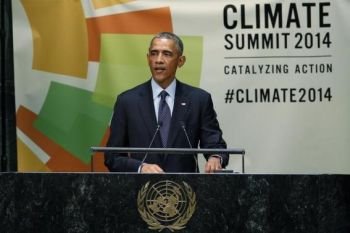
President Obama Speaks at the 2014 Climate Summit
Climate Summit 2014 Catalyzing Action – UNEP
Developed Versus Emerging Economies
The United States produces a larger amount of greenhouse gases than any other country. With around 5 percent of the world’s population, the United States contributes roughly 25 percent of the world’s greenhouse gases, making the United States one of the highest per-capita contributors to global warming. This also means that the rest of the world contributes 75 percent of the greenhouse gas emissions.
China is the fastest growing contributor to global warming and is on pace to surpass the United States during this decade. As a rapidly developing nation, China currently has a far lower per-capita greenhouse gas contribution. The European Union contributes nearly 14 percent of the world’s greenhouse gases.
The mature economies have developed transportation and electricity-generation systems. The emerging economies are rapidly assembling the infrastructure to provide an improved standard of living for their citizens. This means electricity and cars-and the associated global warming they bring. There are many more people in countries with emerging economies. If they use the same greenhouse emission-producing forms of energy as the present industrialized countries have, the pace of global warming will accelerate. Some forecasters expect that by 2015, the total contributions from the emerging economies will overtake those of the more developed countries. It is clear from looking at Table 6-4 that no single country is responsible for the world’s greenhouse gases and no country alone can correct the problem independently.
The United States has contributed the most to the overall buildup of carbon dioxide in the atmosphere to date. It is contributing a smaller percentage in 2005, not because it has reduced it carbon dioxide emissions but rather because the rest of the world is catching up. China is becoming a close second and is closing rapidly. Some countries are showing a decrease in the percentage of their carbon dioxide emissions. This shows progress toward greenhouse gas emissions that some of these countries committed to at The International Framework Convention on Climate Change in Kyoto in 1997.
World Energy Use
Most of the greenhouse gases come from energy use-especially combustion of fossil fuels. The largest three are the fossil fuels-oil, coal, and natural gas. This is followed by biomass, which includes both wood and ethanol. About 90 percent of the world energy supply comes from combustion (80.6 percent fossil fuels and 9.4 percent biomass). Only 10 percent of the world’s energy supply is based on technologies that do not produce greenhouse gases. These include nuclear energy, hydroelectric power, and minor contributions from emerging renewable.
Coal-fired power plants are dominant, providing 82 percent of the carbon dioxide generated in the process of producing the United States’ electricity. Natural gas is the only other significant contributor to electricity generation. This is not surprising given the abundance of coal in the United States.
Defining the Problem-Key Ideas
• The main greenhouse gases are carbon dioxide, methane, nitrous oxide, and CFCs.
• The major contributors of carbon dioxide worldwide are fossil fuels.
• Coal is the main source of energy used for electricity generation worldwide and is a major source of carbon dioxide.
• Use of petroleum-based fuels for transportation (i.e., cars, buses, trucks, and airplanes) is also a major source of carbon dioxide.
• The major source of methane is agricultural practices and production of fossil fuel products.
• Nitrous oxide comes primarily from agricultural sources.
• CFCs used throughout industry are minor greenhouse gases at present but have an enormously long lifetime in the atmosphere.
• Radioactive forcing is a concept used to compare the impact that greenhouse gases and other influences such as forest clearing and solar intensity variations have on the earth’s temperature.
• Several items have a cooling affect on the earth, including reflectance of incoming solar energy by air pollution (aerosols).
• Scientists know that carbon dioxide added the atmosphere comes from human sources by measuring the mix of naturally occurring elements that give a signature of its origin. These include carbon-14, carbon-13, and carbon-12. In addition, the ratio of distribution of carbon dioxide between the northern and southern hemispheres is a factor.
• Overall radioactive forcing from all sources is positive.
• The United State contributes 25 percent of the world’s greenhouse gases.
• The rest of the world generates 75 percent of the greenhouse gases
• Rapidly developing countries are increasing their greenhouse gas releases.
By 2015, developing countries are expected to produce more greenhouse gas emissions than industrialized countries. China is very close to overtaking the United States as the largest contributor of greenhouse gases.
What We Can Expect and What We Can Do Consequences of Global Warming
We are now ready to link cause and effect. This chapter investigates how much a particular change in a greenhouse gas concentration or surface reflectivity affects climate. We will explore climate models, which are computer programs that give climate scientists a way to predict what may happen next. The wild card, of course, is guessing what people, companies, and governments around the world may choose to do. Various possibilities are explored to better understand the impact of different efforts. This chapter will present forecasts based on different scenarios.
Climate Models
What Climate Models Do
Climatologists try to predict what a particular set of changes will do to the earth’s climate. How hot will the air get? How much ice will melt next year in Greenland? How much will sea level rise off the coast of Bangladesh in 200 years?
Unlike most other scientists, climatologists cannot just go out and do an experiment as a chemist, physicist, or biologist might do. The use of models provides climatologists with a method to test their theories that is common to other sciences as well. Climatologists then can begin to call their shots by predicting the outcome of a set of climate conditions. They then compare their predictions with actual results to validate their method and to fi ne-tune their models. Where models overlap, climate data derived from historical records strengthens the correlation between efforts to understand the future and investigations focused on the past.
The Intergovernmental Panel on Climate Change (IPCC) expects that climate models will be able to reliably predict changes in critical climate variables. The most repeatable results will be on large (continental) scales. Differences between models depend mostly on different estimates of the effect of feedbacks, as well as on how periodic climate patterns such as the El Niño southern oscillation (ENSO) are handled in different ways in different models. As models are tested, some of these differences are expected to be reconciled.
What Goes into a Climate Model?
The basic tool in the climatologist’s toolkit for making predictions is the climate model. A model is a mathematical description that relates the physical, chemical, and biologic properties of a system. Models address cause-and-effect relationships and include the impact of feedback.
Models have varying degrees of complexity and can include the following elements:
1. Initial physical conditions are established, such as solar intensity, starting temperatures of air and water, salinity, greenhouse gas concentrations, absorption properties for those gases, and albedos of all exposed surfaces.
2. Cause-and-effect relationships between the variables, including direct forcing and feedback, are defined. This includes equations that define the energy balance, climate sensitivity assumptions (temperature changes for given greenhouse gas concentration increases), and ocean heat uptake.
3. Heat transfer between vertical layers as a result of either radiation or convection is included. This requires definition of boundaries between the layers, gradients within those layers, and mixing that occurs.
4. Horizontal interactions are added. Simpler models deal with continental scale building blocks, whereas more sophisticated models include greater resolution both horizontally and vertically. Greater computing power usually is needed as more granularities are introduced into the models.
5. Dynamics of atmospheric and ocean circulations are added. Biochemical cycles (such as enhanced plant or algae growth) are represented.
6. Modeling aerosols and clouds and how they interact and initiate precipitation remains an area that is currently being refined.
7. Models then investigate various scenarios. Scenarios represent the various results that could be seen depending on what changes to greenhouse gas emissions are put in place around the world.
As expected, the scenarios that emphasize a transition to nonfossil fuels result in temperature spreads centered on a lower mean. The scenarios that are more “business as usual” are the ones showing the highest projected temperature ranges.
Feedback
Climate feedback occurs when an initial change triggers a second change that, in turn, influences the first process. The impact of a change such as an increase in a greenhouse gas level can be greater or smaller depending on other factors that may or may not be brought into play. Feedback can be either positive or negative.
Positive feedback intensifies the overall impact of the original change. An example is a public address (PA) system where some of the amplified sound gets picked up by the microphone and then get amplifi ed again until you get the squealing sound known as feedback. Positive feedback tends to be destabilizing in the sense that it leads to more of a runaway situation than equilibrium.
Negative feedback occurs when other factors reduce the impact of a change. Negative feedback tends to create stability. An example of negative feedback is the thermostat in your house. As the temperature drops, the thermostat responds by turning on the furnace. The result is a stable temperature, and the dropping temperature triggers an opposite response.
Examples of Positive Climate Feedback
Melting. Greenhouse gases cause an increase in atmospheric temperature. The increased temperature causes melting of snow on glaciers and ice caps. As the snow and ice melt, they become less reflective and retain more heat because the darker surface reflects less sunlight. As a result of this feedback effect, the atmosphere gets even warmer.
Water vapor. Warmer temperatures increase evaporation. Water vapor in the air is a greenhouse gas and will absorb greater amounts of sunlight. Because of this absorption of sunlight, the atmosphere gets even warmer.
Decay of biomass. Increased temperatures result in drought. Plants die and decay. The decaying plant material releases even more carbon dioxide to the atmosphere. With more carbon dioxide in the atmosphere to absorb more infrared radiation, the atmosphere becomes even warmer.
Forests replacing tundra. Because of global warming, tundra is melting, and forests are able to grow at higher latitudes. Tundra has a much higher surface reflectivity than forests. Thus the pole ward movement of forests-caused by higher temperatures-contributes to increasingly higher temperatures.
Release of methane from permafrost. Warmer climates melt permafrost in North America, Europe, and Asia. Methane has been trapped in the tundra in the form of methane clathrates for many centuries. As methane is released into the atmosphere, it is able to function as a greenhouse gas and perpetuate the cycle of warming.
Carbon dioxide dissolved in the oceans. Higher ocean temperatures reduce the solubility of carbon dioxide in the oceans. Since less carbon dioxide is removed to the oceans, more is available to function as a greenhouse gas. With more carbon dioxide in the atmosphere, the atmosphere gets warmer than it otherwise would have got.
Glacier descent. As global warming occurs, glaciers melt and descend their mountain slopes. As the glacial mass moves to lower altitudes, the atmospheric temperature increases. The further down the slope the glaciers go, the warmer they get. The warmer temperatures toward the bottom of the slope accelerate the melting process.
Destabilization of glaciers. The ends of glaciers (tongues) reach a point where they separate from the glacier and break off into the sea. This has occurred throughout Greenland and has been observed in the Larsen ice shelves in Antarctica. Scientists have noticed that without the end pieces that hold back the river of slush coming after a glacier, the rest of the glacier moves more quickly. This is a positive feedback whose impact appears to be greater than initial expectations.
Examples of Negative Climate Feedback
Clouds. Warmer temperatures promote increased evaporation. Evaporation of water leads to the formation of clouds. Clouds typically reduce the amount of sunlight that can reach the surface of the earth. With less sunlight striking the earth’s surface, the earth tends to get cooler.
Photosynthesis. As the atmospheric temperature goes up, the amount of carbon dioxide in the atmosphere also goes up. Increasing carbon dioxide in the air promotes plant growth. Plants help to remove additional carbon dioxide from the air, which counters the initial warming effect.
Infrared radiation. The warmer the atmosphere, the more effectively it radiates infrared radiation to space. As the atmosphere emits infrared radiation better, the earth does not get as hot as it might have. The process of atmospheric radiation reduces the original impact of the sun’s energy through a negative feedback.
Glaciers melting. As global warming progresses, glaciers release larger amounts of freshwater into the North Atlantic. The decreased salinity slows the thermohaline circulation (Gulf stream). Less heat is moved to the North Atlantic, leading to an overall (local) cooling effect.
Snow buildup on glaciers. Warmer temperatures cause increased moisture content in the air. The elevated moisture levels will result in greater snowfall and a buildup of the ice pack in the interior regions of Greenland and Antarctica. This is a negative-feedback effect because the higher temperatures lead to a buildup of the massive ice sheets (in addition to melting).