
How Climate Works
Radiation
Radiation is the emission and transmission of energy through space or material. This includes sound waves passing through water, heat spreading out in a sheet of metal, or light traveling through air. Every object for example, a human body, this book, or the Sun- has energy because it contains billions of rapidly vibrating electrons (tiny, negatively charged particles).
The energy travels outward, or radiates, from objects as waves. These electromagnetic waves have electrical and magnetic properties. They carry particles that are discrete packages of energy called photons. Waves are transmitted in different lengths, depending on their energy. One wavelength is the distance from crest to crest (or trough to trough). All types of radiation, no matter what their wavelength, travel at the speed of light. The wavelengths of energy that an object emits primarily depend on its temperature.
The higher an object’s temperature, the faster its electrons vibrate, and the shorter its electromagnetic wavelength. The Sun emits radiation at all wavelengths, but nearly half (44%) is in the part of the electromagnetic spectrum known as visible light. These are the only wavelengths the human eye can sense.
When all wavelengths of visible light are together, the light appears white. When they are separated into a spectrum, each wavelength corresponds to a different color. From the longest to the shortest wavelengths, visible light is broken into the colors red, orange, yellow, green, blue, and violet. Wavelengths shorter than violet are called ultraviolet radiation (UV) and wavelengths longer than red are called infrared radiation.
Due to the Sun’s high temperature, about 7% of its radiation is made up of shortwave UV. Because short waves carry more energy than long waves, UV photons carry more energy than visible light photons. Earth’s surface absorbs sunlight in the visible and ultraviolet light wavelengths and then reemits the energy in infrared wavelengths. Infrared energy is also known as heat. The Sun’s lower UV energy and visible light waves pass through the atmosphere unimpeded. When this radiation hits the Earth’s surface, the energy is absorbed by soil, rock, concrete, water, and other ground surfaces. The energy is then reemitted into the atmosphere as infrared waves, which are also called heat.
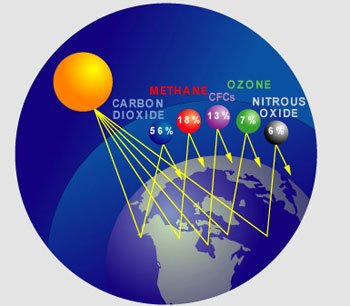
Greenhouse gases trap some of this heat in the atmosphere, causing the lower atmosphere to warm. There is a direct relationship between greenhouse gas levels and atmospheric temperature: Higher levels of greenhouse gases warm the atmosphere while lower levels of greenhouse gases cool the atmosphere.
Without the greenhouse effect, Earth’s average atmospheric temperature would be bitterly cold, about 0°F (-18°C). The planet would be frozen and have little life. As on the Moon, temperatures would be extremely variable: scorching when the Sun was out, and
frigid at night. But, thanks to the greenhouse effect, Earth’s average temperature is a moderate 59°F (15°C), and life is varied and bountiful.
The dominant greenhouse gases are naturally present in the atmosphere, and their levels can change due to natural processes. For example, CO2 is emitted into the atmosphere during volcanic eruptions. However, some greenhouse gases, for example, chlorofluorocarbons (CFCs), are man-made and have only recently entered the atmosphere.
Not all greenhouse gases have the same heat-trapping ability. For example, one CFC-12 molecule traps as much heat as 10,600 CO2 molecules. Methane traps 23 times as much heat as CO2. However, despite its lower heat-trapping ability, CO2 is so much more abundant than these other gases that it has a much greater impact on global temperature: It accounts for 80% of greenhouse gas emissions by humans.
Concentrations of particulates, which are sometimes called aerosols, vary in the atmosphere. Volcanic ash, wind-blown dust, and soot from fires or pollutants are common aerosols. Incoming sunlight is blocked by aerosols blown high into the atmosphere by large volcanic eruptions. In the lower atmosphere, wind-blown dust and pollutants reflect and scatter incoming sunlight, while other aerosols, such as smoky soot, absorb it. Aerosols have a variable effect on climate because of the way they react to sunlight: Those that reflect sunlight cool the atmosphere while those that absorb sunlight warm it.
Because gravity holds gases in Earth’s atmosphere, the gases are densest near the planet’s surface and become less dense at higher altitude. However, the makeup of atmospheric gases is nearly the same at all altitudes. But, despite its being similar in composition, the atmosphere is divided into layers, primarily according to how the temperature changes with altitude. The layer nearest to Earth’s surface, rising from sea level to about 6 miles (11 kilometers), is called the troposphere.
Its primary heat source is the Earth’s surface, so the troposphere generally displays a decrease in temperature with altitude. The stratosphere rises from the top of the troposphere to about 30 miles (45 km) up. Because this layer is heated by the Sun’s UV, the stratosphere gets warmer closer to the Sun. The stratosphere contains the ozone layer: This is the exception to the rule that the makeup of the atmosphere is the same at all elevations. This layer, which lies between 9 and 19 miles (15 and 30 km) up, contains a relatively high concentration of ozone molecules. Ozone in the stratosphere is known as “good” ozone because it serves as a protective shield for life on Earth by absorbing the lethal high-energy UV radiation.
Solar radiation is composed of a wide spectrum of wavelengths. Together, these wavelengths make up the electromagnetic spectrum. Greenhouse gases trap some of the heat that radiates off of the planet’s surface, creating the greenhouse effect.