Explaining climate change science & rebutting global warming misinformation
Scientific consensus: Earth’s climate is warming
GLOSSARY
Acidification The alteration of seawater so that it becomes more acidic due to increased atmospheric carbon dioxide that ends up in the ocean and creates carbonic acid.
Acid rain Rainfall with a pH of less than 5.0. This type of acid precipitation includes acid fog and acid snow.
Acids Solutions with free positively charged hydrogen ions that are sour to the taste. Acidic and alkaline solutions neutralise to form salts.
Adaptation One of two strategies (the other is mitigation) that can be used by humans to deal with climate change; in adaptation, human behaviour adjusts to inevitable changes.
Aerosols Solid or liquid pollutants also called particulates, that are small enough to stay suspended in the air. They can seriously reduce visibility and also cause global dimming, which reduces the amount of solar radiation that reaches the Earth’s surface.
Air pollution Contamination of the air by particulates and toxic gases in concentrations that can endanger human and environmental health. Some air pollutants are greenhouse gases, and some cause global dimming, which is the reduction of solar radiation that reaches the Earth’s surface.
Albedo The amount of light that reflects back off a surface; snow and ice have a high albedo, mud has a low albedo.
Algae A very diverse group of mostly aquatic organisms; they are not plants, although some look like plants, and all of them photosynthesize.
Alpine glacier A glacier that grows in the mountains and flows downhill; at its source, snowfall exceeds snowmelt, allowing the glacier to form.
Altitude Vertical distance above or below mean sea level.
Aquifer A rock or soil layer that holds useable groundwater.
Atlantic meridional overturning Ocean circulation pattern in which dense water in the North Atlantic sinks into the deep sea and pulls warm Gulf Stream waters northward and sends cold saline waters southward.
Atmosphere The gases surrounding a planet or moon.
Atom The smallest unit of a chemical element having the properties of that element.
Atomic weight The sum of an atom’s protons and neutrons (electrons have negligible weight).
Bacteria Microscopic single-celled organisms capable of living in an incredible number of environments.
Biodiversity The number of species in a given habitat.
Biofuel Fuel derived from biomass; wood, coal, and manure are natural biofuels; biofuels can also be created from biomass.
Biomass The mass of all the living matter in a given area or volume of a habitat.
Carbonate (CO3) The composition of the rock limestone used by corals and other animals to make their shells.
Carbon cycle The exchange of carbon between the atmosphere, geosphere (earth), fresh water, oceans, and living things.
Carbon dioxide (CO2) A molecule made of one carbon and two oxygen atoms that are an important component of the atmosphere and an extremely effective greenhouse gas.
Carbon economy The current economic structure of civilisation, which relies on the use of carbon-based fuels, primarily fossil fuels.
Carbon sequestration Storage of carbon in one reservoir so that it is no longer part of the carbon cycle; two natural reservoirs for carbon sequestration are forests and oceans.
Carbon tax A tax placed on energy sources that emit carbon dioxide into the atmosphere; the tax is designed to better pay for the costs of fossil fuel burning and inspire conservation and research and development of non-carbon-based technologies.
Chlorofluorocarbon (CFC) An anthropogenic gas that breaks down the stratospheric ozone and is a potent greenhouse gas; CFC use is being phased out.
Clean coal Coal that has undergone gasification to clean it of pollutants before it is burned.
Climate model A computer simulation of climate constructed by using available data and an understanding of the interactions of the atmosphere, the hydrosphere, and the biosphere; climate models can be used to predict future climate.
Climate proxies Biological or physical artefacts that preserve a record of past temperature; tree ring widths are an example of a biological artefact that reveals the temperature and precipitation conditions that occurred while the tree grew.
climate refugee A person who is displaced from his home due to climate change; at this time, some Pacific Islanders have been forced to leave their low-lying islands due to rising seas, but many more climate refugees will be created as the weather becomes more extreme and seas rise higher.
Commitment model A climate model that predicts what will happen if no additional greenhouse gases are added to the atmosphere and that shows how global and local temperatures will eventually reflect a number of greenhouse gases already released; these models are not at all realistic, but they provide a base-level idea of what to expect from climate change.
Condensation The change in state of a substance from a gas to a liquid.
Continental glacier A mass of ice, also called an ice cap, that moves outward from a centre of accumulation; currently, Earth has two ice caps: Greenland and Antarctica.
Convection cells Currents of air (or water) that rise when warm and sink when cool, forming a closed cell; the major movements of the atmosphere take place in convection cells.
Coral bleaching This results when coral, ordinarily colourful, turns white due to the loss of zooxanthellae; it happens mostly in response to elevated ocean temperatures.
Coriolis effect The tendency of a moving object to appear to move sideways due to the Earth’s rotation.
Cryosphere The portion of the Earth’s surface that is frozen water: snow, permafrost, sea ice and icebergs, and glaciers.
Dead zone An ocean region that is hostile to most life, due to a severe depletion of oxygen.
Deforestation The conversion of forest area to nonforest area, often agricultural land or settlements.
Desertification The change of semiarid landscapes into the desert, sometimes by a change in natural rainfall patterns but often by the misuse of soil or another human activity.
Ecosystem The interrelationships of the plants and animals of a region and the raw materials that they need to live.
El Niño A temporary warming of the Pacific Ocean that has implications for global weather patterns; part of the El Niño-Southern Oscillation climate variation.
El Niño-Southern Oscillation (ENSO) A short-term (in years) climate cycle that oscillates between cold water and low pressure in the eastern Pacific and warm water and high pressure in the western Pacific; the cycle also occurs in the opposite pattern.
Electromagnetic waves The form in which radiation travels; these waves have electrical and magnetic properties.
Electron A negatively charged particle usually found orbiting an atom’s nucleus.
Element A substance that cannot be chemically reduced to simpler substances.
Environmental refugees People who have been displaced from their homes by environmental changes; climate refugees are one category of this group.
Erosion The movement of sediments from one location to another by water, wind, ice, or gravity.
Ethanol Liquid biofuel that can be burned in an internal combustion engine; intended as an additive or replacement for gasoline; E85, which is currently on the market, is a mix of 85% ethanol and 15% gasoline.
Evaporate To change from a liquid to a gas, the change of state of a substance from a liquid to a gas, such as the change from liquid water to water vapour, is called evaporation.
Evapotranspiration The loss of water by evaporation from plants.
Feedback mechanism The magnified response of a system to a change; a feedback mechanism can be positive or negative.
Firn Partially compacted snow that has been recrystallized; also called a “névé.”
Flood basalt A giant volcanic eruption that coats the land surface with fluid lava that may emit enough gases and particles on a massive scale to bring about a mass extinction.
Food web The set of producer-consumer and predator-prey relationships that make up the biological portion of an ecosystem.
Fossil fuels Ancient plants that have decayed and been transformed into a useable fuel, especially coal and petroleum. These fuels are really stored ancient sunshine.
Fuel cell An energy cell in which chemical energy is converted into electrical energy.
Gasification Integrated gasification combined cycle (IGCC) technology cleans coal before it is burned, increasing efficiency and reducing emissions.
Geothermal energy Energy that comes from hot water; this water is heated in a volcano or in rocks heated in the deep Earth.
Glacier A moving mass of ice and snow that forms on land. Glaciers grow when the amount of snow falling in winter exceeds the amount that melts in spring and summer; they shrink when annual snowmelt exceeds snowfall.
Global dimming The blocking of incoming sunlight by pollutants so that the planet’s atmosphere undergoes cooling.
Global warming The worldwide rising of average global temperature; the term usually refers to the temperature increases that have taken place in the past one-and-a-half centuries.
The greenhouse effect The trapping of heat that is radiated from the Earth. Without the greenhouse effect, Earth’s average temperature would be much lower.
Greenhouse gases Gases that absorb heat radiated from the Earth. They include carbon dioxide, methane, ozone, nitrous oxides, and chlorofluorocarbons.
Groundwater Water found in soil or rock beneath the ground surface.
Gyre Five large ocean currents that travel in a circle around major portions of the ocean basins. They rotate clockwise in the Northern Hemisphere and counterclockwise in the Southern Hemisphere.
Habitat The environment in which an organism lives, including climate, resource availability, predators, and many other distinctive features.
Heat budget The amount of heat entering and leaving the Earth system; if the amount entering is greater than the amount leaving, the planet warms.
Heat capacity The ability of a substance to store heat as it changes temperature; the rate of change of the temperature of a body with the addition of heat.
Hurricane Deadly tropical storm characterised by high storm surge, abundant rainfall, and intense winds.
Hydrocarbon An organic compound composed of hydrogen and carbon; fossil fuels are hydrocarbons.
Hydrogen economy A theoretical system in which hydrogen-based energy, such as that in fuel cells, is used to fuel the economy rather than the fossil fuels used for the carbon economy of today.
Hydropower The potential energy of falling water; it can be harnessed by a water wheel, or at a waterfall or hydroelectric dam.
The ice cap A mass of ice, also called a continental glacier, that moves outward from a centre of accumulation; currently, Earth has two ice caps: Greenland and Antarctica.
Ice cores Layers of ice drilled from an ice sheet or glacier that contain an uninterrupted record of temperature, precipitation, the gas composition of the lower atmosphere, and sea surface productivity; these records can go back hundreds of thousands of years.
Ice sheet An enormous glacier that covers the land surface and that is greater than 19,305 square miles (50,000 sq. km) in the area; the only two ice sheets currently on Earth are the Greenland ice sheet in the Arctic and the much larger Antarctic ice sheet.
Ice shelf A floating sheet of ice that projects off a glacier or ice sheet onto coastal waters.
Infrared Word used to describe electromagnetic energy with wavelengths longer than red; infrared energy is also known as heat.
Insolation Incoming solar radiation that reaches the Earth’s atmosphere.
Ion An atom that has lost or gained an electron so that it has a positive or negative charge.
Isotopes Two or more atoms of the same element having the same number of protons but a different number of neutrons; that is, different atomic mass numbers.
Krill Crustacean zooplankton that makes up the greatest biomass of any multicellular creature on Earth; an important part of the diet of many marine organisms, particularly in the Antarctic.
La Niña The reverse of an El Niño, in which the surface of the Pacific Ocean off South America is especially cold.
Latitude The angular distance of any point on the surface of the Earth north or south of the equator.
Little Ice Age (LIA) The period from about a.d. 1550 to 1850 when temperatures dropped by about 0.9°F (0.5°C) and glaciers advanced. The LIA is loosely correlated with the Maunder Minimum, a period when few to no sunspots appeared on the Sun’s surface.
Mangrove A flowering tree that grows in dense forests along tropical shorelines and has its roots submerged for part of the day; mangrove ecosystems perform many important environmental services.
Mass extinction An evet where 25% or more of the planet’s species go extinct in a relatively short period of time; this opens many ecological niches for new species to fill and so is a driving force of evolution.
Medieval Warm Period (MWP) A period of time from about a.d. 900 to 1300 in which temperatures were relatively warm and dry; the average global temperature was not nearly as high as the average global temperature is today.
Methane A hydrocarbon gas (CH4) that is the major component of natural gas. Methane is also a natural component of the atmosphere and a greenhouse gas.
Methane hydrates Water molecules in an unstable icy cage, not held together by chemical bonds, that contain a methane molecule inside; the methane from these hydrates is useable as fuel.
Milankovitch theory The theory that Earth’s climate may be determined by the planet’s position relative to the Sun; the position varies with respect to the shape of the Earth’s orbit (eccentricity), the wobbling of its axis (precession), and the angle of the axis of rotation (tilt).
Mitigation One of two strategies (the other is an adaptation) that can be used by humans to deal with climate change; mitigation refers to making changes that result in the reduction of greenhouse gas emissions.
Molecule The smallest unit of a compound that has all the properties of that compound.
Monsoon A seasonally shifting wind pattern between a warm continent and relatively cool ocean in the summer, with a reverse pattern during the winter. Summer monsoons often bring abundant rain.
Natural gas Gaseous hydrocarbons, primarily methane.
Negative feedback mechanism A system response in which a change of variable in the system moves the system in the opposite direction of the variable; e.g., increasing atmospheric CO2 increases plant growth, which takes up CO2 and lowers atmospheric CO2.
Neutrons Uncharged subatomic particles found in an atom’s nucleus.
Nitrous oxides NO and N2O referred to collectively as NOx. They are natural components of the atmosphere and are greenhouse gases.
Nuclear energy The energy stored in the nucleus of an atom, which can be released by fission, fusion, or radioactivity.
Nuclear fission This occurs when the nucleus of an atom splits into smaller pieces, accompanied by the release of energy; fission is used in nuclear power plants and nuclear bombs.
Nuclear fusion This occurs when the nuclei of light elements combine to make a heavier element, accompanied by the release of an enormous amount of energy; fusion reactions are self-sustaining but so far are impossible to contain.
Nucleus The centre of an atom, composed of protons and neutrons.
Oil shale Sedimentary rock rich in oil that can be mined using heat and enormous quantities of water.
Ozone A molecule composed of three oxygen atoms and symbolised as O3. Ozone is a pollutant in the lower atmosphere; but in the upper atmosphere, it protects life on the Earth’s surface from the Sun’s deadly ultraviolet radiation.
Ozone hole A “hole” in the ozone layer where ozone concentrations are diminished; the term usually refers to the Antarctic ozone hole.
Ozone layer The layer, found between 9 and 19 miles (15 and 30 km) up in the stratosphere, where ozone is concentrated; the ozone shields us from the Sun’s ultraviolet radiation.
Paleocene-Eocene Thermal Maximum (PETM) A dramatic and rapid warming of climate that occurred 55 million years ago and is correlated with extremely high atmospheric methane concentrations; one favoured hypothesis is that warmer temperatures melted seabed methane hydrates that entered the atmosphere.
Paleoclimatology The study of climate in the prehistoric past; paleoclimatologists use information from ice cores, lake and ocean sediments, and tree rings, among other sources, to reconstruct past climate.
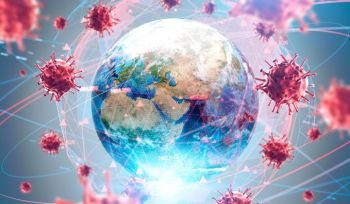
Pandemic A disease outbreak, or epidemic, that strikes the entire world or a large portion of it.
Particulates Solid or liquid pollutants, also called aerosols, that are small enough to stay suspended in the air. They can seriously reduce visibility and also cause global dimming, which reduces the amount of solar radiation that reaches the Earth’s surface.
Peak oil The concept that oil production forms a bell-shaped curve with a peak; on the downside of the curve, oil is more difficult to get and more expensive; the term is applicable for an individual oil field, a country’s oil reserves, or the entire planet; some scientists speculate that peak oil for the Earth will come (or has come) between 2005 and 2010.
Permafrost Permanently frozen soil; common in the polar regions.
PH Numbers from 0 to 14 that express the acidity or alkalinity of a solution. On the pH scale, 7 is neutral, with lower numbers indicating acid and higher numbers indicating base. The most extreme numbers are the most extreme solutions.
Phenology The science of the influence of climate on plant and animal life cycles, such as budding or springtime mating.
Photons Particles carried by electromagnetic waves that are discrete packets of energy.
Photosynthesis The process in which plants use carbon dioxide and water to produce sugar and oxygen. The simplified chemical reaction is 6CO2 + 12H2O + solar energy = C6H12O6 + 6O2 + 6H2O.
Photovoltaic cells Also known as solar cells, these cells convert sunlight to usable energy.
Phytoplankton Microscopic plantlike, usually single-celled, organisms
found at the surface of the ocean; they are the planet’s single greatest source of oxygen.
Plankton Tiny plants (phytoplankton) and animals (zooplankton) that live at the sea surface and form the lower levels of the ocean’s food web.
Plate tectonics The theory that the Earth’s surface is divided into plates that move on the planet’s surface; the movements are driven by mantle convection.
Pleistocene Ice Ages (Pleistocene Epoch) The most recent ice age in Earth history (also referred to as the Ice Age) that took place from between 1.8 million and 10,000 years ago; it consists of four glacial and three interglacial periods.
Polyp A small cup-shaped animal with a ring of tentacles, such as the coral polyp, that constructs a calcium carbonate structure around itself.
Positive feedback mechanism A system response in which a change of variable in the system reinforces that change so that the system moves even more in the same direction; e.g., warmer temperatures melt ice with a high albedo, which gives way to open water with a lower albedo, further increasing temperatures and causing more melting.
Precipitation Condensed moisture that falls to the ground as rain, sleet, hail, snow, frost, or dew.
Primary productivity The food energy created by producers.
Producer An organism that produces food energy from inorganic substances; usually referring to a photosynthesizing plant for food energy.
Protons Positively charged subatomic particles found in an atom’s nucleus.
Radiation The emission and transmission of energy through space or material; also the radiated energy itself.
Reflection The return of a light or sound wave from a surface.
Respiration The process by which an organism exchanges gases with the environment. Note that in the reaction, sugar and oxygen are converted into CO2 and water with the release of energy: C6H12O6 + 6O2 = 6CO2 + 6H2O + useable energy.
Saline Word used to describe water containing salt.
Scattering The diffusion or deflection of light as it strikes particles.
Sediments Fragments of rocks and minerals that range in size from dust and clay up to boulders.
Sedimentary rock One of the three major rock types; sedimentary rocks form from compaction and cementation of sediments or from precipitation of minerals.
Slash-and-burn agriculture A practice whereby rain forest plants in the tropics are slashed down and then burned to clear the land for agriculture.
Southern Oscillation The variation in the atmosphere between high and low-pressure cells in the eastern and western Pacific, related to the El Niño cycle.
Specific heat The amount of energy needed to raise the temperature of 1 gramme of material by 1°C.
Storm surge Abnormally high sea level due to water being raised up by low atmospheric pressure and by being blown up against land.
Stratosphere The upper atmosphere, which rises from the top of the troposphere to about 30 miles (45 km) up. The stratosphere contains the ozone layer.
Sunspot A magnetic solar storm on the Sun that is seen as a dark spot on Earth; sunspots vary in number on an 11-year cycle; the absence of sunspots during the Maunder Minimum may have caused the Little Ice Age.
Sustainable Word used to describe resource use that does not compromise the current needs for resources or those of future generations for present economic gain.
Tar sands Sands and rocky materials mixed with oil that can be mined using hot water and caustic soda.
Thermal expansion The addition of heat to a liquid causes molecules to vibrate more vigorously, which increases the distances between them and causes the liquid to expand; as the planet warms, thermal expansion will be a significant cause of sea level rise.
Thermal inertia The resistance of a substance to a change in temperature; water has higher thermal inertia than rocks.
Thermohaline circulation Vertical circulation in the oceans that is driven by density differences between surface and deeper water; seawater density is a function of temperature and salinity.
Threshold effect A value beyond which an abrupt response is observed; e.g., if enough Arctic ice melts, so much open water is present that new ice cannot form.
Tipping point The point of no return in climate change processes as a result of positive feedbacks.
Tree rings Annual layers of a tree’s growth that are affected by the temperature and precipitation of each year.
Troposphere The lowest layer of the Earth’s atmosphere, rising from sea level to about 11 km.
Ultraviolet radiation (UV) Short wave, high energy solar radiation; the highest energy wavelengths of UV are extremely harmful to life.
Urban heat island effect The phenomenon that urban areas have higher temperatures than nearby rural areas due to the absorption of sunlight and release of heat by ground coverings such as concrete and also to the collection of waste heat.
Urbanisation An increase in the extent or density of an urban area; the ground surface is covered with man-made substances such as concrete and asphalt that affect the albedo and penetrability of the region.
Water cycle The cycling of water between Earth’s atmosphere, oceans, and fresh water reservoirs such as glaciers, streams, lakes, and groundwater aquifers.
Water vapour Water (H2O) in its gaseous state.
Wavelength The distance from crest to crest or trough to trough in a light or sound wave.
Wetland A poorly drained region that is covered all or part of the time with fresh or salt water.
Zooplankton Tiny marine animals that are unable to swim on their own and drift with the currents.
Zooxanthellae Single-celled dinoflagellates (algae) that live in a symbiotic relationship with corals; the zooxanthellae supply oxygen and food to the corals, and the corals supply a home and nutrients (with their wastes) for the algae.