Biosphere Full – Director’s Extended Cut
National Geographic – Biosphere
Biosphere
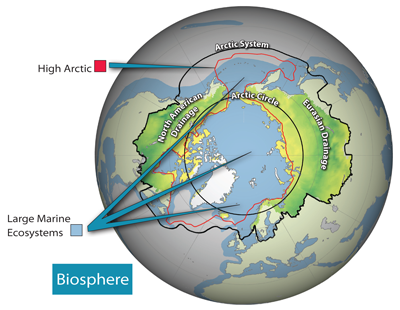
The biosphere is that part of Earth comprising the living ecosystem, which includes all living matter of the world and the inorganic components that they rely upon. The biosphere is a part of the world on par with the lithosphere (Earth’s rocky crust), the atmosphere (Earth’s gaseous envelope), and the hydrosphere (Earth’s water realm).
As scientists have come to know more about the deeper reaches of Earth’s crust and the sea floor, the depth of the biosphere has grown greater. The term biosphere was first used by Austrian geologist Eduard Suess (1831-1914), who said it was ‘‘the place on the Earth’s surface where life dwells.’’
Historical Background and Scientific Foundations
The biosphere may be divided into biomes, or subparts with respect to latitude (climate) and elevation (depth in the ocean, depth in the crust, and altitude on mountains).
Polar biomes are found at high latitude. Mid-latitude biomes and equatorial biomes are at lower latitudes respectively. In the ocean, biomes are found at shallow depths (for example, near shore or on continental shelves), at abyssal depths (for example on the sea floor), and in oceanic trenches, where water may be over 5 mi (8 km) in depth. In the crust, biomes exist at shallow depths (for example, soils and surface rocks) or up to 5.6 mi (9 km) or more in crustal rocks. In the atmosphere, some birds fly at heights up to 6.8 mi (11 km) or more. On land, microscopic biomes exist from sea level to the highest mountain areas. There are several main ecosystems within the biome of the land, including forests, deserts, grasslands, and wetlands.
No matter how the biosphere is subdivided, all living organisms are interrelated in some way. Within the biosphere and its biomes are regional and local ecosystems. Each of these ecosystems consists of living organisms and the non-living components upon which they depend. The living organisms depend upon one another as parts of the food web. The food web has a hierarchy: producers (organisms that make food), consumers (organisms that consume producers), and decomposers (organisms that recycle dead organisms). Local ecosystems are parts of the regional ecosystem and, in turn, are components in the biomes and global biosphere.
Biosphere and Earth History
The biosphere has existed and continued to expand, with brief lapses, over most of the 4.6-billion-year history of Earth. It is not known exactly when life arose on Earth, but it is a consensus view that life was probably in existence by about 3.8 billion years ago. The diversity of life has increased over time, both in the number of different groups of organisms and the complexity of some of the groups.
The biosphere has experienced some crises during Earth history in which large numbers of organic groups have been extinguished over a brief span of time. These events are called mass extinctions and represent episodes of reorganization of ecosystems and biomes of Earth. For example, the mass extinction that claimed the dinosaurs and many other species about 65 million years ago was such an event. There have been about four such other events in Earth history over the past 500 million years.
Impacts and Issues
Biosphere is a term associated with some biology experiments that have been conducted over the past few decades. Biosphere 2 (so named because the Earth is viewed as Biosphere 1) was a large laboratory experiment in Arizona. Bios-3 was an experimental facility operated by the government of the former Soviet Union in the late 1960s.
Biosphere J is a more recent Japanese experiment. The biospheres were restricted environments where a local Earth’s biosphere necessarily changes in response to climatic change. Climate change can spur migrations and relocations of many organisms. Likewise, climate change can spell doom for species that cannot adapt to such changes. The demise of species opens the way for new species to arise to fill those niches. As the fossil record shows, over the long span of geological time, many species have adapted, become extinct, or arisen as a result of climatic change.
Words to Know
Biome: Well-defined terrestrial environment (e.g., desert, tundra, or tropical forest). The complex of living organisms found in an ecological region.
Crust: The hard, outer shell of Earth that floats upon the softer, denser mantle.
Fossil Record: The time-ordered mass of fossils (mineralized impressions of living creatures) that is found in the sedimentary rocks of Earth. The fossil record is one of the primary sources of knowledge about evolution and is also used to date rock layers (biostratigraphy).
Hydrosphere: The totality of water encompassing Earth, comprising all the bodies of water, ice, and water vapor in the atmosphere.
Lithosphere: The rigid, uppermost section of Earth’s mantle, especially the outer crust.
Bibliography
Books
Lovelock, James. Gaia: A New Look at Life on Earth. Oxford, UK: Oxford University Press, 2000.
Parry, M. L., et al, eds. Climate Change 2007: Impacts, Adaptation and Vulnerability: Contribution of Working Group II to the Fourth Assessment Report of the Intergovernmental Panel on Climate Change. New York: Cambridge University Press, 2007.
Web Sites
Pidwirny, Michael. ‘‘Fundamentals of Physical Geography. Chapter 9: Introduction to the Biosphere.’’ PhysicalGeography.net, 2007. :
<http://www.physicalgeography.net/fundamentals/chapter9.html> (accessed May 12, 2015).