The Water Cycle
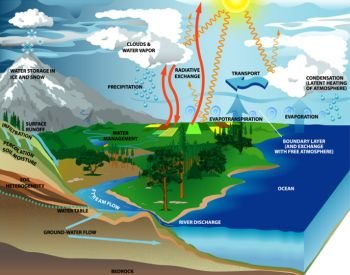
Water moves continually between Earth’s water reservoirs: the atmosphere, organisms, terrestrial water features (such as lakes and rivers), and the oceans. The movement of water between these reservoirs is known as the water cycle.
Much of Earth’s water is stored in the oceans, which cover 71% of the planet’s surface. (All seawater and a small amount of lake water is saline, or salty.) The Sun’s rays evaporate liquid water from the sea surface into the atmosphere, where it exists as water vapor gas. When conditions are right, water vapor undergoes condensation from gas into liquid droplets to form clouds. The droplets can come together to create precipitation in the form of rain, sleet, hail, snow, frost, or dew.
When precipitation falls as snow, it may become frozen into a glacier, which is a moving body of ice that persists over time. Glaciers form when annual snowfall exceeds annual snowmelt. Each winter snow falls and is compressed into firn, a grainy, ice-like material.
If summer temperatures stay below freezing, the firn remains to be buried by more snow the following year. The weight of many years of accumulating firn eventually squeezes the deeper firn into ice. The ice at the bottom of a glacier is older than the ice at the top. Glaciers and ice sheets may store water for hundreds or even thousands of years.
Today, glaciers are found only at high latitudes and at high altitudes, where the conditions are similar to the polar areas. Over 60% of the planet’s fresh water is trapped in glaciers. Alpine glaciers are also called mountain glaciers because of where they are found. Continental glaciers, also called ice caps, cover large regions of relatively flat ground. Only two ice caps, the Arctic in the north and the Antarctic in the south, exist today.
Together, they cover about 10% of the planet’s surface and hold 20% of its fresh water. Much of the Arctic ice cap lies on the Arctic Ocean and is less than 10 feet (3 meters) thick, on average. Its thinness means that it melts relatively easily. By contrast, the Antarctic ice cap, located on the Antarctic continent, is 10,000 feet (3,000 m) thick and is much slower to melt. Glaciers or ice sheets can release (or calve) an ice shelf, a thick, floating platform of ice that flows onto the ocean surface. Ice shelves are only found in Greenland, Antarctica, and Canada.
All frozen water, including snow, glaciers, and ice shelves, is part of the cryosphere. Permanently frozen ground, or permafrost, is also part of the cryosphere. Permafrost is found typically at high latitudes and some high altitude regions.
When the ice melts, the water may flow into a stream and then into a lake or pond. Some of the water infiltrates the soil and rock to join a groundwater reservoir beneath the ground. Groundwater moves slowly through a rock layer or aquifer and eventually emerges into a stream, lake, or the ocean. Water is also absorbed by living organisms.
Some of the water taken in by plants is returned to the atmosphere in a process known as evapotranspiration.
The overall amount of water present on Earth changes very little. What does change is its location. For example, when much of the planet’s water was trapped in glaciers during the ice age about 10,000 years ago, the sea level was lower. But once those glaciers started to melt, sea level began to rise.