
How Is the Earth’s Temperature Changing?
Recent History – The past 150 years
Direct thermometer-based readings from around the earth for the past 150 years show that the earth is getting warmer. This period is called the instrumental record because all the data are derived from direct thermometer measurements from locations around the world.
A hundred years ago, the average temperature of the earth was about 13.7°C (56.5°F); today, it is closer to14.4°C (57.9°F). At first, this may not seem like a very large change. But the earth’s temperature usually takes many centuries to change by as much as a degree. With the earth, small changes-or at least small changes from our perspective of day-to-day weather extremes-can have significant consequences.
The last ice age was, on average, only about 5°C (9°F) colder than present-day global averages. A past interglacial warm period, during which sea levels were about 4–6 m (13–20 ft) higher than present levels, was, on average, about 5°C (9°F) warmer than today. At the rate that the earth is warming currently, substantial global climate changes very well may have been set in motion.
During the past 150 years, the earth has slowly become warmer (with some ups and downs), mostly between the years 1910 and 1940. Not much change occurred prior to that, from 1850 to 1910, except for minor ripples primarily from small natural variations and possible inconsistent sampling. From 1940 to 1975, there was a slight cooling trend, probably related to increased sunlight reflecting from the atmosphere, as industrialization evolved along with the air pollution that it generated following World War II.
Beginning with the 1970s, the pace picked up. The average global temperature increased more rapidly-at a rate of 0.2°C (.36°F) per decade. The warmest years on record are the most recent.
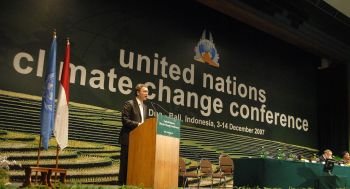
Because of the global nature of this problem, thousands of scientists from over 30 countries have formed an organization called the Intergovernmental Panel on Climate Change (IPCC). Members of the IPCC, coordinated through the United Nations, have been collaborating since 1988 to interpret data relating to climate change. In 2007 The IPCC, along with Al Gore, was awarded the Nobel Peace Prize for their efforts in studying climate change. Their most recent findings were released in a report called “Climate Change 2007, the IPCC’s Fourth Assessment Report” (AR4).
Some official results of that report are:
• The average global temperature has increased by 0.74°C (1.3°F) over the past century.
• Eleven of the warmest years on record have occurred during the most recent 12 years of the study (1995–2006). This indicates that not only is the earth’s average temperature raising but also that the rate of global warming is also increasing.
• The warming trend for the last 25 years is more than double that of the past century.
How much should we be concerned with a temperature rise of less than 1°C? The last ice age was, on average, only about 5°C (9°F) colder than present-day global averages.
The last time the global average temperature was about 5°C (9°F) warmer than today, sea levels were 4–6 m (13–20 ft) higher than present levels.