What is sustainability?
Let us now examine sustainability in more detail so that you can understand how to translate this abstract concept into meaningful action.
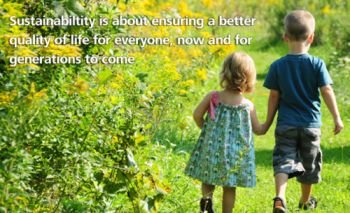
Sustainability or sustainable development has been described in many ways: ‘Meeting our needs while not compromising the ability of future generations to meet theirs’ (Bruntland Commission), ‘Living well within the limits of nature’ (Mathis Wackernagel, author of Sharing Nature’s Interest) or simply ‘Not cheating on our children’ (former UK Environment Minister John Gummer).
Regardless of the definition, those working in the field of sustainability generally all envision sustainability as having three realms: economic, social and environmental. Businesses have long referred to this as the ‘triple bottom line’. Instead of trading these realms off against one another (jobs or the environment; economic growth or environmental health; development or habitat), sustainability aims to optimize all three. In the long term, you can’t have one without the others.
China, for example, has been reporting 9 per cent economic growth or more over the past decade but is beginning to recognize that the environmental costs of that growth (eg flooding, pollution, health problems and resource depletion) wipe out most of those gains. Pan Yue, deputy director of China’s State Environmental Protection Administration, figures that environmental injury costs China 8 to 15 per cent of its annual gross domestic product.
These three realms are intimately intertwined. Without a healthy economy, unemployment is high, leading to a host of social problems; and without a healthy economy, governments don’t have the revenues to handle these increased social ills. Without a healthy environment, we deplete the resources upon which our economy depends and contribute to human illness. Without a vibrant community, we don’t have the employees to work in businesses, and people in crisis don’t have the luxury of being concerned about environmental degradation.
When we don’t understand these interdependencies, we often make poor decisions. We tend to focus on one realm over the others. As the Clinton/Gore presidential campaign put it, ‘It’s the economy, stupid.’ This may be true for voters and in the minds of many. However, the economy is not independent of the health of the environment and community.
Holding the other realms hostage to one ultimately backfires. For example, for decades, the US Congress has resisted raising the Corporate Average Fuel Efficiency (CAFE) standards for automobiles. They didn’t want to hurt the economy, and the automobile industry represents a significant portion of US gross domestic product. However, by not improving these standards, the US is more dependent on foreign oil, and now, during the Iraq War, economic health is being siphoned off to OPEC countries at the pump. Furthermore, US cities have higher air pollution levels, which are putting more people in hospital with lung disorders.
Pollution can trigger asthma, which, according to the Agency for Healthcare Research and Quality, cost the US economy $13 billion in 1998, driving up businesses’ healthcare expenses. The additional emissions also contribute to climate change, a debt the world is already beginning to pay through increased property damage, crop failures and coastal erosion.
Is the US economy really better off as a result of Congress’s decision? Probably not. At least, is the US automotive industry better off from this protection? You’d have to say no, since Toyota is now neck-and-neck with General Motors as the largest automaker and Michigan is experiencing a ‘one-state recession’. Notice that sustainability is different from the environmental movement in that it recognizes the need for a healthy economy. Nature does have certain limits that we must learn to live within or suffer the consequences. But Alan AtKisson, author of Believing Cassandra, makes a distinction between ‘growth’ (being bigger, having increased material throughput, having an increasingly negative impact on nature) with ‘development’ (moving forward, getting better, without having bigger impacts).
As AtKisson puts it, ‘Growth must cease. If human beings do not stop their growth willingly, Nature will stop it forcefully. Paradoxically, however, for Growth to cease, Development must accelerate.’7 we need to speed up the rate at which new, cleaner technologies are implemented. We need a healthy economy to have the money to invest in these innovations.
Once people reach a reasonable quality of life, they begin to demand a healthier environment. We just need to devise ways where their increasing affluence no longer exacerbates the pressure on the environment. We need to get better, not bigger. Sustainability is also no longer a fringe issue. Consider the fact that the fastest growing segment of the energy sector is wind power with solar in hot pursuit; in the travel industry, it’s eco-tourism; in the investment community, it’s socially responsible investments; in agriculture, it’s organic farming. In venture capital, clean-tech is in the top three. These trends all point in the same direction, towards sustainability. True, these segments may still make up a small fraction of their respective sectors, but assuming their exponential growth continues, they’ll soon become major contenders.
Hopefully you can see that it’s not just the usual idealistic suspects like Ben & Jerry’s, Seventh Generation and Patagonia that are interested in sustainability. And while none of these organizations is fully sustainable as yet (no organization to the best of our knowledge is), what is important is that sustainability is on their radar: they are developing strategies to respond to its threats and opportunities.
Some are doing a better job than others, of course. But they all recognize sustainability as a significant strategic issue. The organizations listed above are just the tip of the iceberg. According to a study released by KLD Research and Analytics in 2006, almost 80 per cent of the Standard and Poors 100 companies now have special website sections disclosing social and environmental performance, up from less than 60 per cent the year before.8 And many of them are pressuring their suppliers for related information, who must then pressure their suppliers down the supply chain.