Carbon Cycle
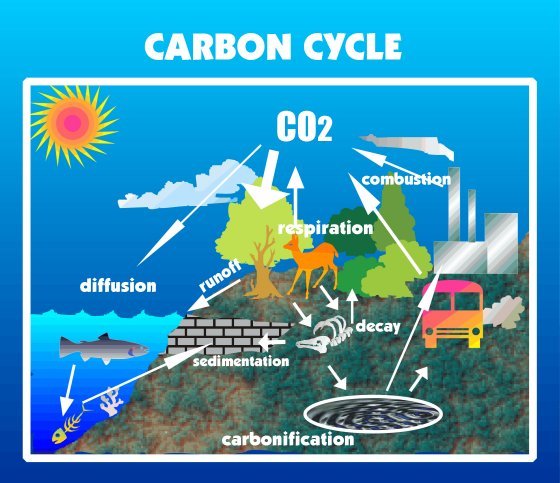
The carbon cycle describes the reservoirs and transformations that the atom carbon undergoes as it cycles through the atmosphere, lithosphere, biosphere, and hydrosphere (Earth’s air, land, water, and other areas that support life). The carbon cycle plays a key role in climate change because carbon dioxide is perhaps the most important gas contributing to global warming in the atmosphere. In addition, carbon is one of the most basic molecules used by organisms to store energy in chemical bonds.
Historical Background and Scientific Foundations
One of the largest reservoirs of carbon is carbon dioxide in the atmosphere. Plants on land and algae in water-based ecosystems incorporate carbon dioxide from the atmosphere into carbohydrates during photosynthesis. Some algae sink to the lakebed or seafloor, and over millennia, algal cells are converted into natural gas and oil. Similarly, plant material can be buried and converted into coal. These fossilized plants, or fossil fuels, represent a large carbon reservoir. When fossil fuels and plant biomass are burned, carbon dioxide is released from the chemical bonds of these materials and returned to the atmosphere.
Chemically mediated transformations of carbon within the larger carbon cycle described above also occur. Carbon dioxide from the atmosphere can be dissolved into water as carbonate and bicarbonate. Similarly, it can be released from its dissolved form back into the atmosphere. Biologically mediated cycles are also present within the larger carbon cycle. Plants and algae respire carbon dioxide directly into the atmosphere. When an animal consumes a plant, it incorporates the carbon from the plant’s carbohydrates into its own biomolecules. During animal respiration, carbon dioxide is released into the atmosphere.
Some marine organisms incorporate dissolved carbon into their shells. When these organisms die, they sink to the bottom of the ocean and leave their shells behind. Over long periods of time, these shells are transformed into limestone rock. When limestone is uplifted, it becomes land. As the limestone weathers, carbon is returned to the atmosphere and dissolved in water.
Impacts and Issues
Because of industrial dependence on fossil fuels, larger concentrations of carbon dioxide are input to the atmosphere than can be taken up by biologically and chemically mediated transformations. In addition, burning large sections of forests without replanting has released carbon dioxide into the atmosphere and decreased the size of a significant carbon reservoir.
Carbon dioxide has a property that allows it to trap heat. Most scientists agree that the increase in carbon dioxide in the atmosphere has caused an increase in the global temperature and will likely continue to do so for quite some time. Such an increase has significant impacts, including the melting of the polar ice sheets contributing to sea level rise, changes in the patterns and intensity of weather systems, the increased spread of insect-born disease, and challenges for agriculture.
Words to Know
Biosphere: The sum total of all life-forms on Earth and the interaction among those life-forms.
Carbon: Chemical element with atomic number 6. The nucleus of a carbon atom contains 6 protons and from 6 to 8 neutrons. Carbon is present, by definition, in all organic substances; it is essential to life and, in the form of the gaseous compounds CO2 (carbon dioxide) and CH4 (methane), the major driver of climate change.
Fossil Fuels: Fuels formed by biological processes and transformed into solid or fluid minerals over geological time. Fossil fuels include coal, petroleum, and natural gas. Fossil fuels are non-renewable on the timescale of human civilization, because their natural replenishment would take many millions of years.
Hydrosphere: The totality of water encompassing Earth, comprising all the bodies of water, ice, and water vapor in the atmosphere.
Limestone: A carbonate sedimentary rock composed of more than 50% of the mineral calcium carbonate (CaCO3).
Lithosphere: The rigid, uppermost section of Earth’s mantle, especially the outer crust.
Photosynthesis: The process by which green plants use light to synthesize organic compounds from carbon dioxide and water. In the process, oxygen and water are released. Increased levels of carbon dioxide can increase net photosynthesis in some plants. Plants create a very important reservoir for carbon dioxide.
Reservoir: A natural or artificial receptacle that stores a particular substance for a period of time
Transformation: The processes involved in the transfer of a substance from one reservoir to another.
Bibliography:
Books:
Raven, Peter H., and Linda R. Berg. Environment. Hoboken, NJ: John Wiley and Sons, 2006.
Web Sites:
‘‘Carbon Cycle.’’ Environmental Literacy Council,September 25, 2006. <http://www.enviroliteracy.org/article.php/478.html> (accessed April 5, 2016).
‘‘The Carbon Cycle.’’ NASA’s Earth Observatory.
<http://earthobservatory.nasa.gov/Library/CarbonCycle/> (accessed April 5, 2016).
‘‘Understanding the Global Carbon Cycle.’’ Woods Hole Research Center <http://whrc.org//?s=carbon+cycle&submit=> (accessed April 5, 2016).