
Earth’s Energy Balance
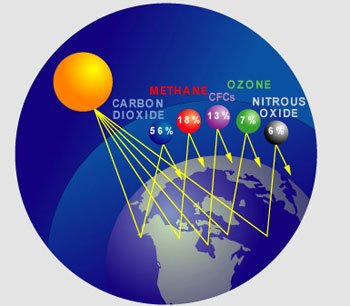
Solar energy arrives at the top of the atmosphere as UV or visible light. It passes through the atmosphere unimpeded by greenhouse gases, but about 50% of it is absorbed, scattered, or reflected by clouds. Scattering occurs when light strikes particles – atmospheric gases, water droplets, or dust – and then flies out in all directions.
Reflection occurs when light bounces from a surface. Some surfaces reflect light better than others: For example, a snowfield reflects much more light than a mud pit.
The measurement of the reflectivity of a surface is called its albedo. Objects that appear black absorb all visible wave-lengths, and those that appear white absorb none, meaning that black objects have much lower albedo than white objects.
Of the radiation that reaches Earth’s surface, 3% is reflected back and 47% is absorbed by water and land. After being absorbed, some of the light energy is converted to infrared energy and reemitted into the atmosphere as heat, some of which is trapped by greenhouse gases. If the process stopped there, the planet would just get hotter, but this does not happen because eventually the heat is radiated into space.
When the amount of shortwave energy entering the Earth’s system equals the amount of long wave radiation leaving, the planet’s heat budget is in balance. When the system is not in balance, it is because the input of heat is greater than the output, and the planet gets warmer; or the output is greater than the input, making the planet cooler.