VIDEO
National Geographic : The Human Footprint
How are our ecological footprints affecting the Earth?
Concept 1-3 As our ecological footprints grow, we are depleting and degrading more of the earth’s natural capital Some resources are renewable and others are not
From a human standpoint, a resource is anything obtained from the environment to meet our needs and wants. Conservation is the management of natural resources with the goal of minimizing resource waste and sustaining supplies for current and future generations.
Some resources, such as solar energy, fresh air, wind, fresh surface water, fertile soil, and wild edible plants, are directly available for use. Other resources such as petroleum, iron, groundwater (water found underground), and cultivated crops, are not directly available. They become useful to us only with some effort and technological ingenuity. For example, petroleum was a mysterious fluid until we learned how to find, extract, and convert (refine) it into gasoline, heating oil, and other products that could be sold.
Solar energy is called a perpetual resource because it is renewed continuously and is expected to last at least 6 billion years as the sun completes its life cycle.
On a human time scale, a renewable resource can be replenished fairly rapidly (from hours to decades) through natural processes as long as it is not used up faster than it is renewed. Examples are forests, grasslands, fisheries, fresh water, fresh air, and fertile soil.
The highest rate at which a renewable resource can be used indefinitely without reducing its available supply is called its sustainable yield. When we exceed a renewable resource’s natural replacement rate, the available supply begins to shrink, a process known as environmental degradation.
Nonrenewable resources exist in a fixed quantity or stock in the earth’s crust. On a time scale of millions to billions of years, geological processes can renew such resources. But on the much shorter human time scale of hundreds to thousands of years, these resources can be depleted much faster than they are formed. Such exhaustible resources include energy resources (such as coal and oil), metallic mineral resources (such as copper and aluminum), and nonmetallic mineral resources (such as salt and sand).
As such resources are depleted; human ingenuity can often find substitutes. For example, during this century a mix of renewable energy resources such as wind, the sun, flowing water, and the heat in the earth’s interior could reduce our dependence on nonrenewable fossil fuels such as oil and coal. Various types of plastics and composite materials can also replace certain metals. But sometimes there is no acceptable or affordable substitute.
Some nonrenewable resources, such as copper and aluminum, can be recycled or reused to extend supplies. Recycling involves collecting waste materials and processing them into new materials. For example, discarded aluminum cans can be crushed and melted to make new aluminum cans or other aluminum products.
Reuse is using a resource over and over in the same form. For example, glass bottles can be collected, washed, and refilled many times. But energy resources such as oil and coal cannot be recycled.
Once burned, their energy is no longer available to us. Recycling nonrenewable metallic resources takes much less energy, water, and other resources and produces much less pollution and environmental degradation than exploiting virgin metallic resources.
Reusing such resources takes even less energy and other resources and produces less pollution and environmental degradation than recycling.
Degradation of normally renewable natural resources and services in parts of the world, mostly as a result of rising population and resource use per person.
Our ecological footprints are growing
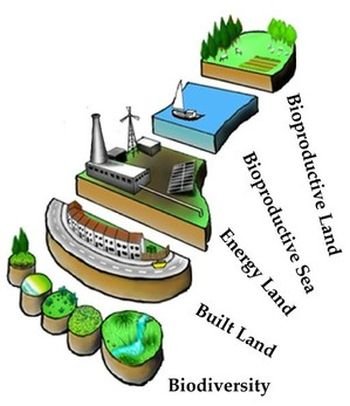
Supplying people with renewable resources and dealing with the resulting wastes and pollution can have a large environmental impact. We can think of it as an ecological footprint-the amount of biologically productive land and water needed to supply the people in a particular country or area with renewable resources and to absorb and recycle the wastes and pollution produced by resource use. The per capita ecological footprint is the average ecological footprint of an individual in a given country or area.
If a country’s, or the world’s, total ecological footprint is larger than its biological capacity to replenish its renewable resources and absorb the resulting waste products and pollution, it is said to have an ecological deficit. In 2006, the World Wildlife Fund (WWF) and the Global Footprint Network estimated that humanity’s global ecological footprint exceeded the earth’s biological capacity by about 25%. About 88% in the world’s high-income countries, with the United States having the world’s largest total ecological footprint. If the current exponential growth in the use of renewable resources continues, the Global Footprint Network estimates that by 2050 humanity will be trying to use twice as many renewable resources as the planet can supply.
The per capita ecological footprint is an estimate of how much of the earth’s renewable resources an individual consumes. After the oil-rich United Arab Emirates, the United States has the world’s second largest per capita ecological footprint. In 2003 (the latest data available), its per capita ecological footprint was about 4.5 times the average global footprint per person, 6 times larger than China’s per capita footprint, and 12 times the average per capita footprint in the world’s low-income countries.
According toWilliam Rees and MathisWackernagel, the developers of the ecological footprint concept, it would take the land area of about five more planet earths for the rest of the world to reach current U.S. levels of consumption with existing technology. Put another way, if everyone consumed as much as the average American does today, the earth’s natural capital could support only about 1.3 billion people-not today’s 6.7 billion. In other words, we are living unsustainably by depleting and degrading some of the earth’s irreplaceable natural capital and the natural renewable income it provides as our ecological footprints grow and spread across the earth’s surface.
For more on this subject see the Guest Essay by Michael Cain at ThomsonNOW™. See the Case Study that follows about the growing ecological footprint of China.
Case Study
China’s New Affluent Consumers
More than a billion super-affluent consumers in developed countries are putting immense pressure on the earth’s natural capital. Another billion consumers are attaining middle-class, affluent lifestyles in rapidly developing countries such as China, India, Brazil, South Korea, and Mexico. The 600 million middle-class consumers in China and India are twice the U.S. population, and the number is growing rapidly! In 2006, the World Bank projected that by 2030, the number of middle-class consumers living in today’s developing nations will reach 1.2 billion-four times the current U.S. population.
China is now the world’s leading consumer of wheat, rice, meat, coal, fertilizers, steel, and cement, and it is the second largest consumer of oil after the United States. China leads the world in consumption of goods such as television sets, cell phones, refrigerators, and soon, personal computers. By 2020, China is projected to be the world’s largest producer and consumer of cars and to have the world’s leading economy in terms of GDP-PPP.
Suppose that China’s economy continues growing exponentially at a rapid rate and its projected population size reaches 1.47 billion by 2031. Then China will need two-thirds of the world’s current grain harvest, twice the world’s current paper consumption, and more than the current global production of oil.
According to environmental expert Lester R. Brown: The western economic model-the fossil fuel–based, automobile-centered, throwaway economy-is not going to work for China. Nor will it work for India, which by 2031 is projected to have a population even larger than China’s, or for the other 3 billion people in developing countries who are also dreaming the “American dream.”
For more details on the growing ecological footprint of China, see the Guest Essay by Norman Myers for this chapter at ThomsonNOW.
Natural capital use and degradation is the total and per capita ecological footprints of some countries. In 2003, humanity’s total or global ecological footprint was about 25% higher than the earth’s ecological capacity and is projected to be twice the planet’s ecological capacity by 2050. Question: If we are living beyond the earth’s ecological capacity, why do you think the human population and per capita resource consumption are still growing exponentially? (Data from Worldwide Fund for Nature, Global Footprint Network)
Thinking About
Your Ecological Footprint
Estimate your own ecological footprint by visiting the website www.myfootprint.org/ (accessed 29 March, 2013). What are three things you could do to reduce your ecological footprint?
Thinking About
China and Sustainability
What are three things China could do to shift towards more sustainable consumption? What are three things the United States, Japan, and the European Union could do to shift towards more sustainable consumption?
Cultural Changes Have Increased Our Ecological Footprints
Evidence from fossils of past organisms and studies of ancient cultures suggests that the current form of our species, Homo sapiens, has walked the earth for perhaps 90,000-195,000 years-less than an eye-blink in the earth’s 3.7 billion years of life.
Culture is the whole of a society’s knowledge, beliefs, technology, and practices. Until about 12,000 years ago, we were mostly hunter–gatherers who lived in small groups and moved as needed to find enough food for survival. Since then, three major cultural changes have occurred: the agricultural revolution (which began 10,000-12,000 years ago), the industrial medical revolution (beginning about 275 years ago), and the information-globalization revolution (beginning about 50 years ago).
Each of these cultural changes gave us more energy and new technologies with which to alter and control more of the planet to meet our basic needs and increasing wants. They also allowed expansion of the human population, mostly because of increased food supplies and longer life spans. In addition, they each resulted in greater resource use, pollution, and environmental degradation as our ecological footprints expanded and allowed us to dominate the planet.