
VIDEO
Major Effect of Oceans On Climate
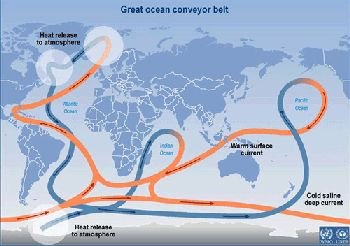
The effects of the ocean on climate
Ocean currents transport heat around the Earth and influence regional climate as they warm or cool the air above the seas.
The major surface ocean currents travel in the same direction as the major wind belts because the wind pushes the seawater. For example, the westerly winds drag North Pacific water from west to east, while the trade winds move surface currents from east to west both north and south of the equator.
When these currents run into continents, the Coriolis Effect causes them to turn right in the Northern Hemisphere and left in the Southern Hemisphere. The currents flow along the continents until they run into an east-west moving current going in the opposite direction.
The result is surface currents that travel in loops called gyres, which rotate clockwise in the Northern Hemisphere and counterclockwise in the Southern Hemisphere. The North Atlantic gyre has an enormous influence on the climate of northern Europe. At the southern part of this gyre, seawater is warmed by the Sun as it moves from east to west across the equator. When it hits the Americas, the current turns right (north) and becomes the Gulf Stream, swift warm water current that raises air temperatures along the eastern United States and southeastern Canada. At the northern part of the gyre, the Gulf Stream swings right, away from North America and toward Europe, where it divides into two segments. One segment moves south toward Africa, completing the gyre, while the other moves north, along Great Britain and Norway.
The northern current, called the North Atlantic Drift, brings fairly warm Gulf Stream water into the northern latitudes. This current creates air temperatures in the North Atlantic that are 5°F to 11°F (3° to 6°C) warmer than those of other regions at the same latitudes. As a result, although London is at 51° north latitude, several degrees farther north than Quebec, Canada, its climate is much more temperate: Rain instead of snow predominates in London during winter. Besides influencing air temperature, ocean currents also affect precipitation levels because warm water currents bring more moisture and therefore more rain to a region than do cold currents. Ocean currents also distribute heat from surface waters into the deep ocean.
North Atlantic water sinks into the deep sea because sea ice formation removes the fresh water and leaves behind water that is very saline and very cold. (Water density is a function of temperature and salinity; cold saline water is densest.) After sinking, the water flows toward Antarctica and circulates through the deep sea until it rises to the surface at various locations, mostly near continents.
The vertical movement of ocean currents is known as thermohaline circulation (thermo means heat and haline means salt), which is very sensitive to surface ocean temperatures and surface ocean salinity. Thermohaline circulation drives Atlantic meridional overturning, which brings warm surface waters (such as the Gulf Stream) north and pushes cold deep waters south. A region’s location relative to surface ocean currents strongly influences its climate. Simply being near an ocean also influences an area’s climate. A surface that is covered by earth materials (rock, sand, and soil) will become hotter than one that is covered with water, even if the two surfaces are exposed to the same amount of solar radiation.
This is because earth materials have higher specific heat, which is the amount of energy needed to raise the temperature of one gram of material by 1.8°F (1°C). Because land absorbs and releases heat more readily than water, the air temperature over land is much more variable: Summer temperatures and daytime temperatures are hotter, and winter and nighttime temperatures are colder. A climate in a region with no nearby ocean is considered a continental climate and will therefore experience a great deal of temperature variation.
A climate with a nearby ocean that moderates its temperatures, both daily and seasonally, is a considered a maritime climate. Maritime climates are even more moderate if the prevailing winds come off the sea. The mild summers and winters of San Francisco, California, when compared to the extreme seasons of Wichita, Kansas (both cities are at latitude 37°N), are testament to the moderating effects of the Pacific Ocean. Land can only store heat near the surface, but the oceans can store heat at great depth. This is why land temperatures appear to raise more than ocean temperatures.
Water has high heat capacity, which means that it can absorb large amounts of heat with very little temperature change Atlantic meridional overturning. Warm water from the equatorial region flows up eastern North America as the Gulf Stream.
The current splits, with a portion returning to the equator, and another portion flowing northward as the North Atlantic Drift and bringing warmth to Great Britain and northern Europe. In the North Atlantic, sea ice formation and low temperatures make the surface waters cold and dense so that they sink, becoming North Atlantic deep water.