
VIDEO
Global Warming Urban Heat Effect
Urbanization: The Heat Island Effect
The process of urbanization has led to concentration of population in cities.
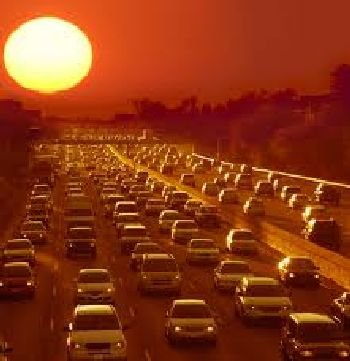
Structures in urban areas tend to trap heat, resulting in higher local temperatures on a given day in a process called the heat island effect. This causes urban air to be about 1-6. °C (2-10.°F) hotter than that in surrounding rural regions. However, according to the IPCC, heat island effects have a negligible influence on average global temperatures (less than 0.006 °C per decade over land and zero over the oceans).
The heat island effect may make people feel more uncomfortable on sultry summer evenings, but it is not considered to be a factor in accelerating the melting of the polar ice caps.
The heat island effect is caused by
• Reduction of nighttime radiation of heat absorbed during the day. The concrete and steel structures that constitute the city act as a blanket that keeps the heat in that otherwise would escape overnight.
• Concentration of light that reflects from vertical surfaces.
• Restriction of conductive and convective pathways for heat to escape in what are effectively urban canyons.
• Local concentration of greenhouse gases result in greater absorption of heat from the earth.
• Local heat generation from cars, air conditioners, and industry.
More than 50 percent of the world’s population lives in urban areas, with this number approaching 75 percent in Western countries. As a result, many people are experiencing an increase in local temperatures that may affect their health and comfort but that is unrelated to global warming.
To avoid corrupting global temperature measurements, temperature stations that are considered to be urban are excluded from the data set, and efforts are made to ensure that what is being looked at as a global phenomenon is truly global in nature.