
VIDEO
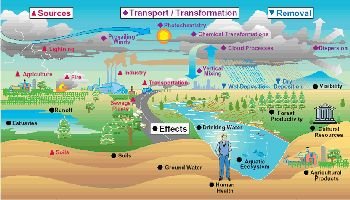
Air Pollution
The contamination of the atmosphere with undesirable solids, liquids, and gases. In a strict sense, air may be considered polluted when there is added to it any substance foreign or additional to its normal composition.
This definition of pollution is much too wide, however, for the purposes of practical air pollution control, and the term ‘air pollution’ is usually restricted to those conditions in which the general atmosphere contains substances in concentrations which are harmful or likely to be harmful, to humans and their environment.
A fuller definition, of American origin, is: ‘substances present in the atmosphere in concentrations great enough to interfere directly or indirectly with man’s comfort, safety or health, or with the full use or enjoyment of his property’. With respect to health, this reiterates the dictum that there are no such things as toxic substances, only toxic concentrations.
The concept of concentration cannot be divorced, however, from time or duration of exposure; or from the acute or chronic effects likely to arise from high short-term or low long-term exposures, respectively.
The degree of air pollution varies according to population density, industrial development, geographical situation, meteorological characteristics, social and economic structure, and local customs.
The contaminants arising from human activities (power production, the metallurgical and petrochemical industries, and transport) include sulfur oxides, nitrogen oxides, carbon monoxide, soot, and other compounds; they have clearly defined effects on vegetation, property, and local climate, and are also believed to have adverse effects on human health.
The history of air pollution has been characterized by a number of dramatic incidents, notably the Meuse Valley, 1930; Donora, Pennsylvania, 1948; London, England, 1952 and 1962; Poza Rico, Mexico, 1950; and Seveso, Italy, 1976. Yet some of the more spectacular long-term effects have received little publicity.
Air Quality Act, 1967, USA
An act to amend the Clean Air Acts, 1963 and 1965, revamping the whole US clean air program. It provided procedures for the issuance of air quality criteria, the delineation of atmospheric areas and air quality control regions, the setting of standards, and the adoption of implementation plans by the states. The act also authorized planning grants to air pollution control agencies. If the states failed to act, provision was made for federal intervention. The act also extended federal powers to control emissions from new motor vehicles, and promoted a national emission standard study for stationary sources; for the first time, national standards could be set for automotive emissions. In 1970, the National Air Pollution Control Administration established emission criteria for motor vehicle pollutants such as carbon monoxide, hydrocarbons, and nitrogen oxides. Following the designation of control regions, each state had to formulate ambient air quality standards (as opposed to emission standards) and an enforcement plan.
See also:
Clean Air Amendment Act, 1970, US.