
VIDEO
Projecting Future Climate Change
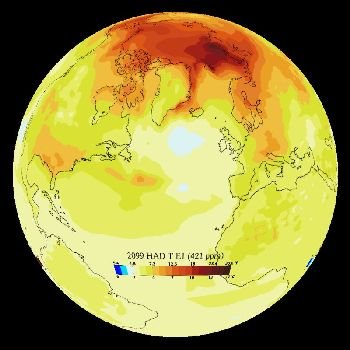
Earth -2099
How Scientists Learn
About Past, Present, and Future Climate
Earth formed about 4.55 billion years ago, but humans-the genus and species Homo sapiens-evolved only about 200,000 years ago. Indeed, nearly Earth’s entire past climate occurred before there were people around to witness it.
Only during the past millennium have people been chronicling important climatic events, and only in the past century have they kept accurate and consistent weather records. This chapter discusses some of what is known about past climate. Much of this knowledge is the result of the inventive use of the available evidence.
Measurements
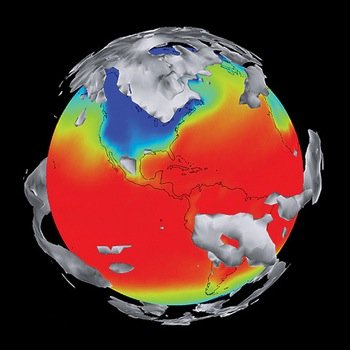
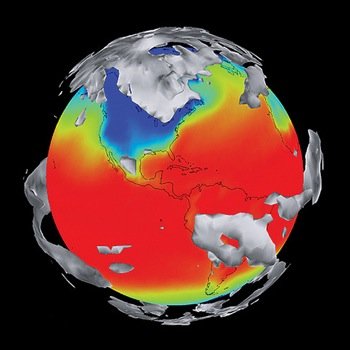
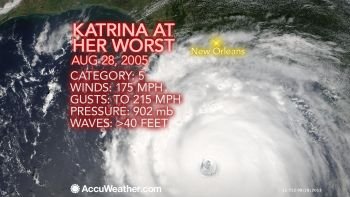
Meteorology is the study of Earth’s atmosphere with the goal of predicting the weather. Since the late 1800s, meteorologists have been measuring weather characteristics such as temperature, precipitation, and wind speed and direction from land-based stations and, more recently, from weather balloons. In 1960, meteorologists began to use satellites to gather weather data. Because satellites see a large and clear picture from high above Earth’s surface, they are extremely important for chronicling global climate change. Satellites have gathered decades’ worth of information on pollution, fires, ocean temperature, ocean current patterns, ice boundaries, volcanic ash clouds, and many other climate related features. For example, images gathered each year for two decades detail the loss of ice cover during Arctic summers over that time period.
Climate Proxies
Paleoclimatologists (paleoclimatology is the study of past climate) have developed many innovative techniques for getting information about the history of Earth’s climate. These scientists use biological or physical clues, known as climate proxies, to unravel past climate patterns over the entire planet or over specific regions. These clues are found in ice cores, tree rings, and sediments, for example, and can be used to reconstruct past climate with surprising depth and accuracy. Some climate proxies, for example, preserve evidence of past temperatures. Using these proxies, paleoclimatologists have reconstructed Earth’s climate history in differing amounts of detail that reach back millions of years.
Unique tools are used for different time scales. Ice cores yield climate data that cover hundreds of thousands of years. Sediments in the ocean floors go back millions of years. Sedimentary rocks from the surface of the earth are rocks that are made of sediments or that precipitate from water. These rocks can give general information about climate that goes back billions of years. Although tree ring cores taken from living trees are only useful for as many years as the tree has lived, logs that are preserved by becoming petrified in rock or sediments yield information about time periods that are much further back.
Ice Cores
The most powerful window into past climate is the ice contained in glaciers and ice caps. To collect an ice core, scientists drill a hollow pipe into an ice sheet or glacier. The cores taken from the Greenland and Antarctic ice caps supply data that span long periods of time: Two Greenland cores go back 100,000 years, while one Antarctic core goes back 420,000 years, through four glacial cycles. The European Project for Ice Coring in Antarctica (EPICA) about two miles (3,190 m) long, has cut through eight glacial cycles covering 740,000 years and is still being drilled. Mountain ice cores are thinner and have much shorter records, but they can be collected from regions scattered around the Earth.
Polar ice caps may contain as many as 100,000 layers of ice. Each layer yields age and weather data from the time when it was deposited. High up in an ice core, close to the surface, each layer represents one year: The age of the sample can be determined simply by counting backwards from the top of the core. Deeper in the core, where the layers have been compacted by overlying ice, only multiple year blocks can be distinguished. To determine the age of a deeper layer, events with known ages that have left evidence of their occurrence in the layer can be identified. Useful recent events are nuclear bomb tests that have left deposits of radioactive isotopes in the ice.
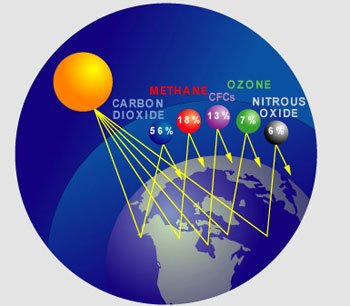
Volcanic ash is valuable for ice of any age because the ash can be correlated to specific eruptions far back in time. Age can also be determined by the chemistry of marine sediments. Gases and particles trapped in snowfall can be analyzed by examining ice layers. These substances represent atmospheric conditions at the time the snow fell. Scientists can analyze CO2 in the gases to determine the concentration of that greenhouse gas at the time and to ascertain its source, whether from volcanic eruptions or burning fossil fuels, for example.
The presence of Beryllium-10 in the ice core is evidence of the strength of solar radiation. Ash indicates a volcanic eruption, dust an expansion of deserts, and pollen the types of plants that were on the planet at the time. The amount of pollen found in the ice layer may be an indicator of the amount of precipitation that fell.
Paleoclimatologists can discern air temperature at the time the snow fell by measuring the ratios of different isotopes of oxygen and hydrogen. These isotope ratios also reveal global sea level.
By using isotopes and many other chemical and physical indicators trapped in the ice, scientists can reconstruct atmospheric temperature, ocean volume, precipitation, the composition of the lower atmosphere, volcanic eruptions, solar variability, the productivity of plankton at the sea surface, the extent of deserts, and the presence of forest fires. Most importantly for paleoclimatologists, they can construct a record of climate change through the period of time represented by the core.