
DOCUMENTARY
Sedimentary Rock
Sedimentary rock does not give as detailed a picture of past climate as ice cores and marine or lake sediments. Sedimentary rocks’ value is that they are widespread and are available from much further back in Earth history, even going back hundreds of millions of years. Sedimentary rocks contain the only remaining paleoclimate information for much of Earth history.
Many sedimentary rocks can only be deposited in a restricted range of climates. Modern coral reefs, for example, only grow in the tropics; therefore, fossil reefs indicate that the region was tropical at the time the coral reef grew. Rock that was formed from glacial deposits indicates a cold climate, while coal was formed in a warm and wet environment. Limestone forms in warm shallow seas. The ratio of 18O/16O in sedimentary rocks indicates how much rain was falling when the rocks were deposited and where the moisture may have come from. Scientists can use these data to reconstruct atmospheric circulation patterns.
Tree Rings
Each year a tree grows a new layer of wood under the bark. This creates a tree ring, which varies in size depending on the temperature and precipitation conditions at the time of growth. Narrow rings are from cool, dry years and wider rings represent warm, wet years. Tree rings are useful only in locations where there is an annual seasonal cycle of temperature and precipitation, such as in the temperate zones.
Trees do not live more than a few centuries, but evidence of past climate can be reconstructed from logs found in ice, permafrost, or glacial sediments. Tree ring data from petrified trees can yield information from much further back in time. The age of these trees can be determined using radiocarbon dating, which measures the abundance of carbon isotopes that undergo radioactive decay at a known rate.
Climate Models
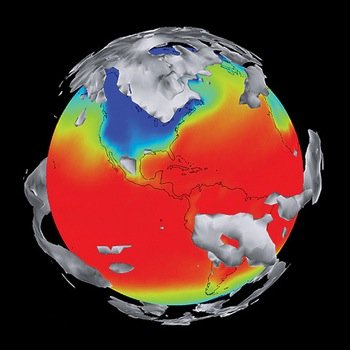
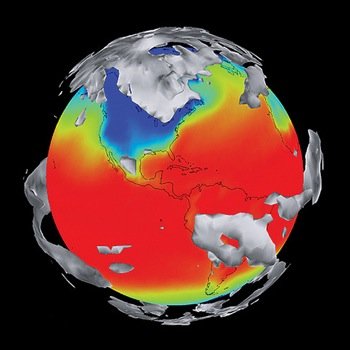
Scientists input the information gathered from modern measurements, paleoclimate data, and current ideas on how land, atmosphere, oceans, and ice interact into a supercomputer to construct climate models. A climate model can be created for a local area or for the entire Earth.
Climate is very complex, and climate models are difficult to construct. Many aspects of climate are not well understood. Simple climate models look at a single atmospheric characteristic and its effect on a single condition, such as the effect of rising carbon dioxide levels on surface air temperatures. Simple models can be combined to generate more complex models. For example, the effect of rising temperature on separate layers of the atmosphere can be combined into a model of the changes in temperature and circulation expected for the entire atmosphere. The more factors that are put into the model, the more complex it is, and the less certainty scientists may have regarding the accuracy of the outcome.
To check the validity of a new model, scientists try to replicate events that have already occurred. For example, they might construct a model to predict the effect of increased air temperature on sea How Scientists Learn About Past, Present, and Future Climate surface temperature (SST) since 1980. They begin with air and ocean temperatures from 1980 and then input the increased air temperatures measured since that time. The scientists then run the model to see whether it correctly predicts current SST. If it does, the model can then be used to predict the future with some degree of confidence. Models are also continuously updated.
The success of a model depends in part on the scientists’ ability to account for the interactions of land, atmosphere, ocean, and living things. Yet, some factors are not well understood. Clouds, for example, have two competing effects on climate: They reflect sunlight back into space (as when a cloud passes overhead) and they trap heat (as on a cloudy night). If warmer temperatures increase cloud cover, the effects are unclear and so are not easy to model.
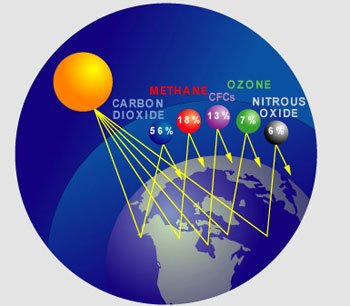
Models must take into account feedback mechanisms, situations in which a small change in something in the system magnifies the original effect and therefore causes a much greater effect. Feedback mechanisms can go in either direction: With a positive feedback mechanism, one action leads to a set of events that increase that action. For example, as the Earth warms, water evaporates, which increases the amount of water vapor in the atmosphere. Because water vapor is a greenhouse gas, air temperature increases even more. The increase causes more water to evaporate and consequently causes air temperature to rise.
With a negative feedback mechanism, one action leads to a set of events that weaken that action. For example, as the temperature warms, more water vapor in the atmosphere causes more clouds to form. Low clouds reflect a large percentage of incoming sunlight, which slows warming. This would be an example of negative feedback. Positive and negative feedback mechanisms show the complexity of the climate system. Threshold effects are also important when modeling climate. An example of a threshold effect is that a rise in temperature of 1.8°F (1°C) from 29.3° to 31.1°F (-1.5° to -0.5°C) will not have much effect on a local glacier. However, the same magnitude of temperature increase will have an enormous effect if the rise is from 31.1° to 32.9°F (–0.5° to 0.5°C) because that temperature increase crosses the threshold for ice to melt. Important temperature thresholds are different for specific locations, for biological systems, and for the planet as a whole.
WrapUp
Scientists have developed ingenious ways to reconstruct Earth’s climate history. Using a wide variety of techniques, paleoclimatologists can know something of the climate of the far distant past and much more about the climate of the more recent past. Ice cores are the most valuable tool and allow scientists to understand the climate on timescales of up to hundreds of thousands of years. Ocean sediments reveal similar data for timescales of up to tens of millions of years. Sedimentary rocks yield climate secrets from even further back. Local climate information can be determined using many other techniques, such as tree rings. After scientists compile all of the relevant climate information, they create climate models that describe the past and attempt to predict the future.
Some Positive and Negative Feedbacks from Warming Temperatures
Positive feedback mechanisms – Negative feedback mechanisms
Transition of snow and ice to water and plants decreases albedo – Increased pollution, emitted from same sources as greenhouse gases, reflects sunlight
Melting permafrost releases methane and other hydrocarbon greenhouse gases into the atmosphere – Increased CO2 stimulates plant growth, which absorbs atmospheric CO2
Increasing greenhouse gases – Increased cloud cover reflects sunlight, cooling the atmosphere and surface
Increased cloud cover: Clouds absorb heat radiating from Earth’s surface – Warmer winter temperatures cause people to use less heat, so less fossil fuel is burned
Breakdown of carbonates releases CO2
Oceans warm and release CO2
Water warms and atmospheric water vapor increases
Warmer summer temperatures stimulate the use of more air conditioning, which uses more fossil fuels
Warmer spring and summer temperatures instigate more wildfires, which burn trees, releasing their carbon into the atmosphere
Warmer temperatures bring on drought, which reduces plant growth and reduces the amount of CO2 the plants take in