Global warming-defined as the long‑term increase in Earth’s average surface temperature-has become an immediate and measurable force shaping natural systems and human societies. By January 2026, global temperatures remain significantly above historical norms, with widespread warming across continents and persistent anomalies in the Arctic.
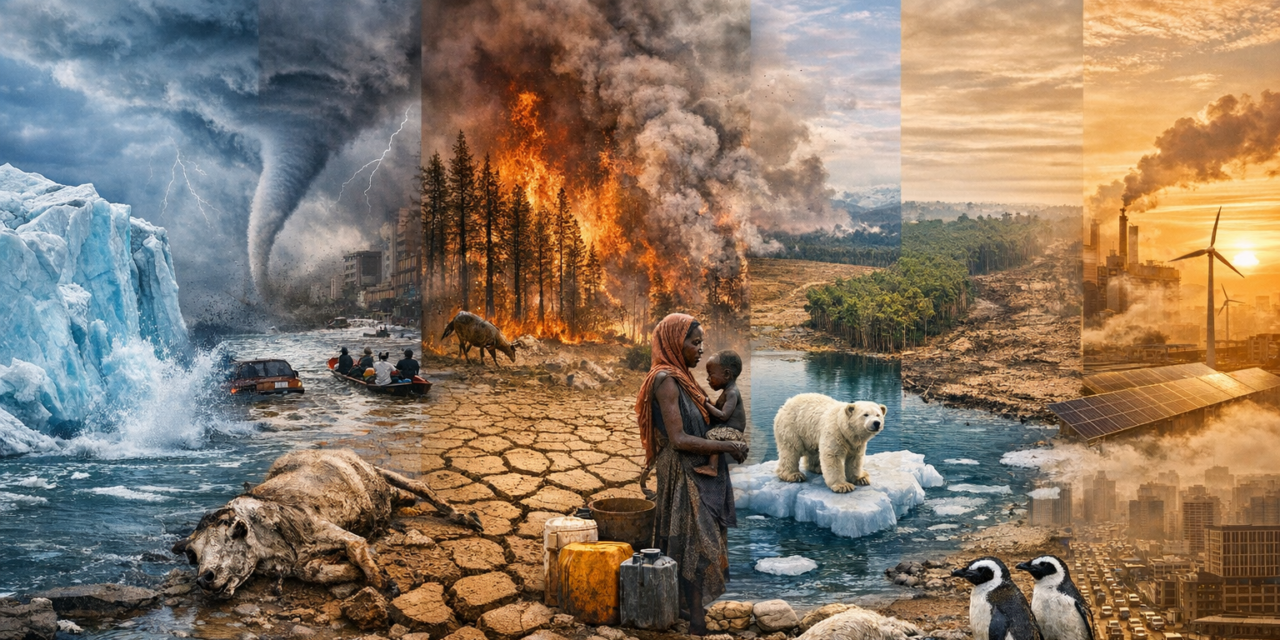
Although often reduced to the idea of “rising temperatures,” global warming expresses itself through a wide spectrum of interconnected effects. These can be grouped into ten conceptual dimensions that reveal the full scale of the climate crisis. Each dimension reflects a different expression of the same underlying imbalance in the planet’s energy system, driven primarily by human‑generated greenhouse gas emissions.
Primary Physical Dimensions
1. Rising Global Temperatures
Recent years have ranked among the warmest ever recorded. Early 2026 continues this trend, with heat anomalies especially pronounced in the Arctic, equatorial Africa, and parts of South America. These temperature increases intensify other climate impacts and push ecosystems beyond their historical limits.
2. Altered Precipitation Patterns
Shifts in atmospheric circulation are producing more extreme rainfall variability. Some regions face prolonged droughts, while others experience heavier and more destructive rainfall. These changes disrupt agriculture, water supplies, and infrastructure.
3. Cryosphere Collapse
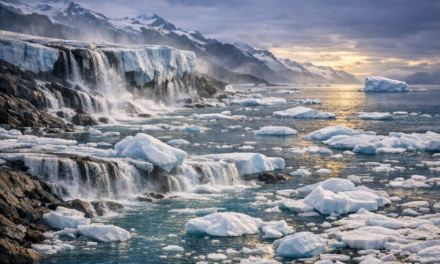
Glaciers, ice sheets, and sea ice continue to melt at accelerated rates. Arctic sea ice remains far below historical averages, and the Greenland ice sheet shows sustained mass loss. Reduced ice cover decreases the planet’s reflectivity, amplifying warming.
4. Sea Level Rise
Rising seas result from both melting ice and the expansion of warmer ocean water. Coastal cities face increasing risks of flooding, erosion, and saltwater intrusion into freshwater systems. Low‑lying regions are especially vulnerable.
Ecological and Biological Dimensions
5. Ocean Acidification
As oceans absorb more carbon dioxide, their acidity increases. This process weakens coral reefs, harms shell‑forming species, and disrupts marine food webs. Coral bleaching events are now frequent across major reef systems.
6. Shifts in Species Distribution and Phenology
Plants and animals are altering their ranges and seasonal behaviors in response to warming. Earlier flowering, shifting migration routes, and mismatches between predators and prey are becoming more common, destabilizing ecosystems.
7. Extreme Weather Events
Heatwaves, wildfires, hurricanes, and severe storms are growing more intense and less predictable. Compound events-such as simultaneous drought and heat-are increasingly common, placing enormous stress on emergency systems and natural landscapes.
Socioeconomic and Geopolitical Dimensions
8. Food and Water Insecurity
Agricultural systems struggle under rising temperatures, soil degradation, and erratic rainfall. Water scarcity affects billions of people, and food production becomes more vulnerable to climate‑driven shocks, especially in tropical and arid regions.
9. Climate Migration
As sea levels rise, deserts expand, and extreme weather intensifies, more people are forced to leave their homes. Climate‑driven displacement places pressure on cities, infrastructure, and social systems, creating humanitarian challenges.
10. Geopolitical Instability
Competition over diminishing resources-such as freshwater, fertile land, and fisheries-can heighten tensions within and between states. Climate stress amplifies existing vulnerabilities, contributing to instability in regions already facing political or economic fragility.
Conclusion
As of January 2026, global warming is best understood as a multidimensional crisis. These ten dimensions-spanning physical systems, ecological processes, and human societies-illustrate the interconnected nature of climate change. Addressing this challenge requires reducing greenhouse gas emissions while strengthening resilience across all sectors. Only a holistic approach can respond effectively to the varied and increasingly unavoidable expressions of a warming planet.
Bibliography (General, Academic, No References or Citations)
- Intergovernmental Panel on Climate Change (IPCC). Climate Change: Assessment Reports.
- United Nations Environment Programme. Global Environment Outlook.
- World Meteorological Organization. State of the Global Climate.
- National Oceanic and Atmospheric Administration. Global Climate Indicators.
- NASA Earth Observatory. Climate Change and Global Warming Overview.
- European Environment Agency. Climate Change Impacts and Adaptation.
- Rockström, Johan. Planetary Boundaries and Earth System Stability.
- Steffen, Will et al. The Anthropocene and Climate Dynamics.
- Klein, Naomi. This Changes Everything: Climate and Society.
- McKibben, Bill. The Climate Crisis and Global Responses.
References:
Osman Sayid Hassan & Mohamud Ahmed & Abdikarim Abdullahi & Bile Abdisalan (2025). The multifaceted impact of climate change on agricultural productivity: a systematic literature review of SCOPUS-indexed studies (2015–2024) | Discover Sustainability. link.springer.com. Retrieved from https://link.springer.com/article/10.1007/s43621-025-01229-2
Unknown Author (n.d.). Untitled. www.tandfonline.com. Retrieved from https://www.tandfonline.com/doi/full/10.1080/00049182.2025.2551932
Unknown Author (n.d.). Just a moment…. academic.oup.com. Retrieved from https://academic.oup.com/pnasnexus/article/3/4/pgae106/7638480
Unknown Author (n.d.). Untitled. pmc.ncbi.nlm.nih.gov. Retrieved from https://pmc.ncbi.nlm.nih.gov/articles/PMC12237696/
Yubin Zhao & Shuguang Liu (2023). Effects of Climate Change on Economic Growth: A Perspective of the Heterogeneous Climate Regions in Africa. www.mdpi.com. Retrieved from https://www.mdpi.com/2071-1050/15/9/7136
Unknown Author (n.d.). Untitled. www.sciencedirect.com. Retrieved from https://www.sciencedirect.com/science/article/pii/S254251962500141X
Unknown Author (n.d.). Untitled. b.tellusjournals.se. Retrieved from https://b.tellusjournals.se/articles/10.3402/tellusb.v45i4.15732
von Bloh (2024). ESD – The long-term impact of transgressing planetary boundaries on biophysical atmosphere–land interactions. esd.copernicus.org. Retrieved from https://esd.copernicus.org/articles/15/467/2024/