
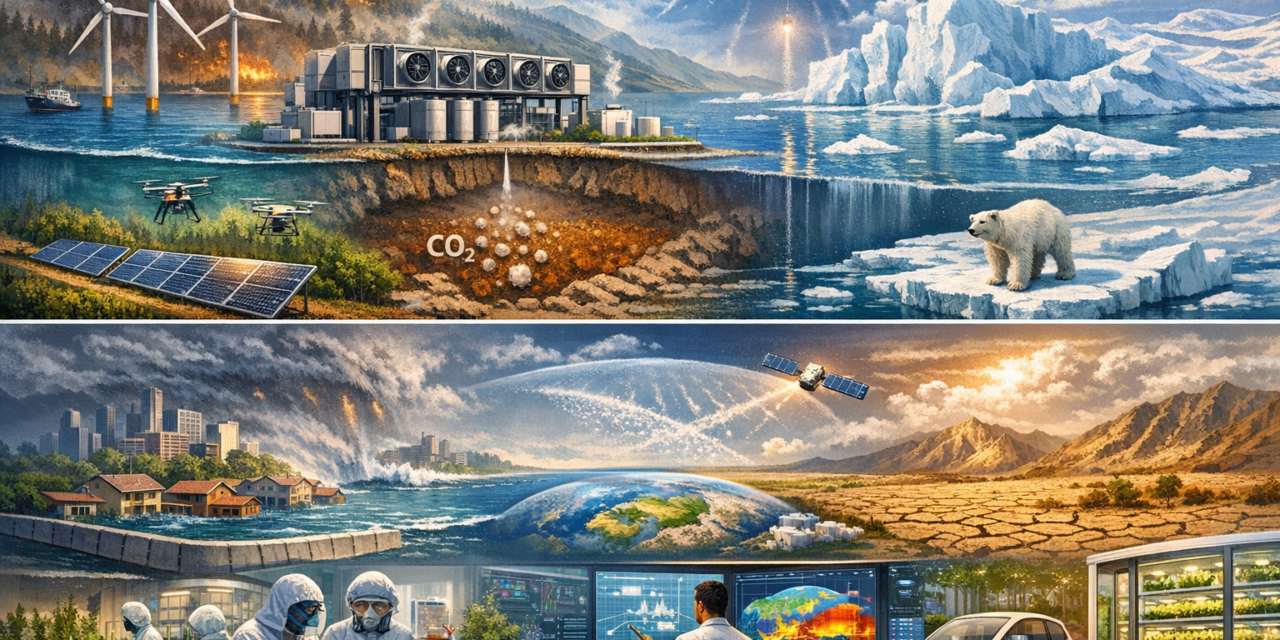
Climate change represents the most pressing, complex, and multifaceted challenge confronting humanity in the twenty-first century. As global temperatures continue to rise, driven primarily by anthropogenic greenhouse gas emissions, the need for rigorous, actionable scientific understanding becomes ever more critical. While significant progress has been made in climate modeling and renewable energy technology, substantial gaps remain in our knowledge base, particularly regarding regional impacts, mitigation effectiveness, and adaptation strategies. For research funding bodies in 2026, strategic investment must prioritize areas that offer the highest potential for immediate, scalable, and equitable solutions. This essay outlines ten critical research areas demanding robust financial support to effectively navigate the accelerating climate crisis.
- Advancements in Direct Air Capture and Carbon Utilization Technologies
While reducing emissions remains paramount, achieving net zero will inevitably require removing legacy carbon dioxide already present in the atmosphere. Current Direct Air Capture (DAC) technologies are energy intensive and expensive. Funding in 2026 should target next-generation DAC materials, focusing on novel sorbents that function efficiently at lower energy inputs, potentially utilizing waste heat from industrial processes. Furthermore, research must accelerate into economically viable carbon utilization pathways. Instead of simply storing captured CO2, finding ways to chemically transform it into durable goods, fuels, or building materials at scale offers a pathway toward a circular carbon economy, moving beyond simple sequestration challenges.
- High-Resolution Regional Climate Impact Modeling
Global climate models provide essential macro-level projections, but policymakers and local communities require localized, granular data for effective adaptation planning. Research funding must prioritize downscaling current models to provide high-resolution projections (e. g. , 1 to 4 kilometer grids) for specific vulnerable regions, such as coastal megacities, arid agricultural zones, and glacial melt basins. This includes modeling the precise impacts on local hydrology, extreme weather event frequency, and localized sea level rise, allowing for targeted infrastructure investment and early warning systems. For example, understanding the exact rate of glacial melt in the Himalayas is crucial for the water security of hundreds of millions in South Asia.
- Climate Change and Human Health Nexus Studies
The intersection of climate change and public health is insufficiently funded relative to the looming crisis. Research is urgently needed to quantify the direct and indirect health burdens associated with rising temperatures, altered pathogen distributions, and increased air pollution from wildfires. This includes developing predictive models for the geographic spread of vector-borne diseases like Dengue and Malaria as temperature envelopes shift, and studying the long-term neurological and cardiovascular effects of chronic heat exposure on outdoor workers and the elderly. Funding should support epidemiological studies that link localized climate variables to hospital admission rates.
- Ocean Carbon Cycle Feedbacks and Deep-Sea Ecosystem Vulnerability
The ocean acts as the planet’s largest carbon sink, but its capacity is finite and influenced by warming and acidification. Critical research must focus on quantifying the tipping points of the biological and solubility pumps. Specifically, funding is needed to deploy advanced sensor networks deep into the ocean to monitor changes in microbial communities that drive carbon sequestration. Furthermore, understanding how deep-sea ecosystems, which may store vast amounts of carbon, respond to slight temperature and pH variations is vital before irreversible changes occur, potentially releasing stored carbon.
- Sustainable Land Use and Agroecology for Resilience
Food security faces dual threats from climate volatility and the need to reduce agriculture’s carbon footprint. Research funding should pivot towards applied agroecology, moving beyond incremental improvements in existing industrial farming methods. This involves rigorous field testing of regenerative agricultural practices, such as optimized no-till farming, enhanced soil carbon sequestration through specific cover cropping regimes, and the development of climate-resilient, locally adapted crop varieties that require less water and fertilizer. Case studies demonstrating successful transitions from conventional monocultures to diverse, resilient farming systems need wider scientific validation.
- Advanced Energy Storage Solutions Beyond Lithium-Ion
The transition to renewable electricity grids relies entirely on cost-effective, long-duration, and environmentally benign energy storage. While lithium-ion batteries dominate short-duration storage, the grid requires storage solutions capable of balancing supply over days or weeks. Research funding in 2026 must heavily support alternative chemistries, such as sodium-ion, solid-state batteries, or advanced flow battery systems. Equally important is funding for non-electrochemical storage, including compressed air energy storage (CAES) or thermal storage, assessed for feasibility in diverse geographic and regulatory environments.
- Climate Justice, Equity, and Managed Retreat Economics
Adaptation measures, such as building seawalls or relocating communities, are expensive and often disproportionately affect marginalized populations. A crucial and often underfunded area is the social science of climate equity. Research must develop robust economic models for “managed retreat,” ensuring relocations are handled justly, fairly compensating property owners, and preserving cultural heritage. Funding should support participatory research methods that integrate indigenous and local knowledge into adaptation planning, ensuring solutions are culturally appropriate and do not exacerbate existing social inequalities.
- Methane and Nitrous Oxide Mitigation in Industrial and Waste Sectors
While CO2 receives the most attention, short-lived but potent greenhouse gases like methane (CH4) and nitrous oxide (N2O) offer significant near-term warming reduction potential if controlled. Research is needed to develop cost-effective technologies for capturing methane leaks from oil and gas infrastructure, landfills, and livestock operations. For N2O, primarily from fertilizer use and industrial processes, funding should support catalyst development to destroy these gases in industrial flue streams and to optimize precision nitrogen application in agriculture to minimize soil emissions.
- The Impact of Climate Extremes on Critical Infrastructure Resilience
Modern society depends on interconnected infrastructure: power grids, transportation networks, and communication systems. Climate change increases the frequency of compound events, like simultaneous heatwaves and droughts, or intense flooding coinciding with high winds. Research funding must focus on developing physics-based models to stress-test existing infrastructure standards against future climate projections, moving beyond historical data. This includes developing “smart grid” technologies capable of self-healing after climate shocks and researching novel, bio-inspired, or self-healing materials for transportation assets exposed to extreme weather.
- Permafrost Thaw Dynamics and Carbon Release Quantification
The thawing of Arctic permafrost represents a massive, largely unaccounted-for carbon bomb. As the ground thaws, ancient stores of carbon and methane are released, creating a powerful positive feedback loop that could drastically accelerate warming. Research in 2026 must prioritize comprehensive, standardized monitoring across the circumpolar north to accurately map the rate and depth of thaw, and quantify the resulting flux of CH4 and CO2 across different tundra types. Crucially, funding needs to support the development of early-warning indicators for abrupt thaw events and study the feasibility of small-scale, localized interventions to stabilize vulnerable zones.
Conclusion
The research landscape concerning climate change must evolve from general problem identification toward targeted, solution-oriented investigation. The ten areas outlined-spanning deep technological innovation in carbon removal and storage, refinement of localized impact modeling, critical health research, and the development of equitable adaptation frameworks-represent the most strategic investments for 2026. Funding decisions made today will directly dictate the resilience and sustainability of human civilization over the next several decades. A dedicated, multi-disciplinary financial commitment to these frontiers of knowledge will be essential in transforming climate science from a field of prediction into a domain of effective global response.
Bibliography
- IPCC. Sixth Assessment Report (AR6): Synthesis Report. Intergovernmental Panel on Climate Change, 2023.
- United Nations Environment Programme (UNEP). Emissions Gap Report 2024.
- International Energy Agency (IEA). World Energy Outlook 2024.
- World Bank. Climate Change Action Plan 2021–2025: Supporting Green, Resilient, and Inclusive Development.
- NASA Goddard Institute for Space Studies. Global Climate Change: Vital Signs of the Planet.
- National Oceanic and Atmospheric Administration (NOAA). State of the Climate Reports.
- European Environment Agency (EEA). Climate Change Adaptation and Resilience in Europe.
- Lancet Countdown. Health and Climate Change Report 2024.
- FAO. Climate-Smart Agriculture Sourcebook.
- OECD. Financing Climate Futures: Rethinking Infrastructure.
References:
https://www.nature.com/articles/s43247-025-02454-3
https://www.nature.com/articles/s44168-024-00142-0
https://www.sciencedirect.com/science/article/pii/S0921800924002490
https://pmc.ncbi.nlm.nih.gov/articles/PMC10918186/
https://pmc.ncbi.nlm.nih.gov/articles/PMC7708567/
https://www.nature.com/articles/s44168-024-00142-0
https://www.the-innovation.org/article/doi/10.59717/j.xinn-geo.2023.100015
https://www.frontiersin.org/journals/climate
https://www.mdpi.com/2073-445X/14/11/2189
https://pmc.ncbi.nlm.nih.gov/articles/PMC8978769/
https://pmc.ncbi.nlm.nih.gov/articles/PMC7708567/
https://www.nature.com/articles/s44168-024-00142-0
https://pmc.ncbi.nlm.nih.gov/articles/PMC8297308/
https://www.nature.com/articles/s44168-024-00142-0