
The way the world’s climate works is a complicated and linked network, whereby apparently minor events may spread out and have a major impact on global weather patterns. Among the strongest and most researched of these phenomena is El Niño, a naturally occurring climate pattern marked by sporadic warming of the surface waters in the central and eastern tropical Pacific Ocean. Published in the Journal of Climate, Trenberth and Stepaniak’s (2025) study “The Influence of El Niño on Global Weather Patterns” provides a thorough and contemporary analysis of this vital ocean-atmosphere interaction. The multifarious consequences of El Niño as described by Trenberth and Stepaniak will be discussed in this essay together with the underlying processes, the varied regional effects, the difficulties in forecasting, and the wider consequences for a changing world. It’s not just an academic exercise to learn about El Niño; it’s also important for understanding climate change, making better predictions, and coming up with ways to deal with its impact on ecosystems, businesses, and communities around the world.
The Genesis and Mechanics of El Niño
Understanding the basic causes of El Niño and the complex feedback loops that keep it going is crucial before valuing its worldwide impact. The warm phase of the greater climatic cycle known as the El Niño Southern Oscillation is referred to as El Niño. Encompassing both El Niño and La Niña, its opposite, which is marked by cooler-than-average sea surface temperatures in the same area of the tropical Pacific. The neutral phase of ENSO shows a condition in which neither extreme predominates.
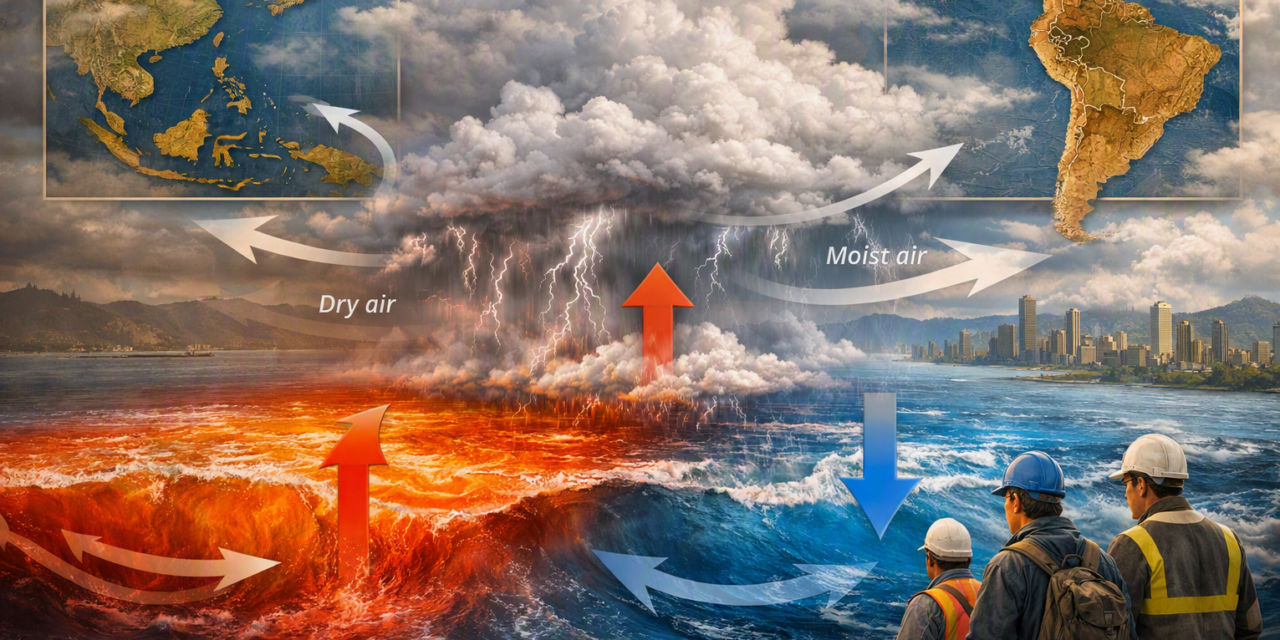
Usually, under a neutral ENSO condition, the Walker Circulation, a phenomenon, forms across the tropical Pacific. Trade winds blowing from east to west along the equator push warm surface water toward the western Pacific, which is how this current works. In the west, this buildup of warm water causes greater sea levels and deeper thermoclines (the junction between warm surface waters and colder deep seas) in that area. Cooler, nutrient-rich seas are therefore upwelled along the eastern coast of South America. While the eastern Pacific stays relatively dry, this east-west temperature gradient drives convection and precipitation in the western Pacific.
El Niño upsets this fragile equilibrium. Though the exact cause of an El Niño event is unknown, it usually entails a weakening or even reversal of the easterly trade winds. Several theories seek to account for this decline. One well-known theory contends that trade wind strength reduction could result from erratic atmospheric changes. Another view suggests that the internal dynamics of the coupled ocean-atmosphere system itself can cause these changes. Once the trade winds subside, the Pacific’s warm surface water starts to spread differently, regardless of the exact starting process.
The pool of warm water in the western Pacific is no longer properly retained as the trade winds weaken. It starts sloshing eastward across the central and eastern equatorial Pacific, a phenomenon sometimes known as the eastward propagation of Kelvin waves. This redistribution of heat fundamentally changes sea surface temperatures (SSTs) over a large area of the Pacific. An El Niño event is announced when SSTs in the central and eastern equatorial Pacific increase above average by a specific threshold. This warming is not just a surface phenomena; it can go deep down and influence ocean currents and heat content.
The increase in temperature in the eastern Pacific has significant effects on the circulation of the atmosphere. The well-established Walker Circulation breaks here. The warm, humid air mass that usually feeds convection in the western Pacific drifts eastward with the warm SSTs. This affects atmospheric pressure and rainfall distribution. Usually, under El Niño, rainfall rises across the central and eastern Pacific while areas in the western Pacific, such as Indonesia and Australia, undergo drier situations. The main cause of El Niño’s teleconnections (the widespread effects on global weather patterns) is the change in convective activity and related gradients in atmospheric pressure.
Trenberth and Stepaniak (2025) most probably discuss these basic mechanisms in more detail, offering new data and possibly fresh perspectives on the intricacies of El Niño onset, including the involvement of the Madden Julian Oscillation (MJO) or other atmospheric indicators. They may also go over the frequency and length of El Niño events, which can differ greatly from one episode to the next, causing variations in the scope of world consequences. Another important difference that could be discussed is the idea of “modoki” events, where warming is concentrated in the central Pacific instead of the eastern Pacific, as these events can cause somewhat different teleconnection patterns. The physical mechanisms from the weakening of trade winds to the propagation of oceanic waves and the resulting atmospheric response provide the foundation upon which El Niño’s worldwide impact is constructed.
Global Teleconnections: How El Niño Reshapes Weather
The capacity of El Niño to impact weather patterns far beyond the tropical Pacific is its most remarkable quality. These far-off effects, called teleconnections, are created by a complicated interaction of changes in atmospheric circulation, such as changes in jet streams, storm paths, and moisture movement. Drawing on observational data and climate model simulations, Trenberth and Stepaniak (2025) would no doubt offer a thorough explanation of these teleconnections.
The influence on North America is among the most well-documented teleconnections. The Pacific jet stream often moves south and becomes more strong throughout El Niño, resulting in changed storm paths. This often translates into a higher chance of above-average rainfall and colder temperatures throughout the winter months in the southern United States. On the other hand, northern Canada and the United States could have hotter and drier weather. Along the Gulf Coast and Atlantic seaboard, this southward shift of the jet stream might also result in a busier hurricane season.
South America feels among the most direct and obvious consequences. Rising SSTs in the eastern Pacific cause more rain and floods in coastal Peru and Ecuador, areas that are typically dry. The Amazon Basin and southern Brazil frequently undergo drought, which can have catastrophic effects on agriculture and rainforest ecosystems. Further south, Uruguay and Argentina might also experience more rainfall.
El Niño affects Africa too. In Eastern Africa, including nations such as Kenya, Somalia, and Ethiopia, drought and heightened risk of famine are frequently experienced during El Niño events. This is connected to variations in atmospheric circulation that inhibit precipitation in the region. Conversely, areas of southern Africa such as South Africa and Botswana could see wetter conditions.
Additionally greatly impacted are Asia and Australia. Indonesia, the Philippines, and sections of northern Australia frequently experience extreme drought and heightened danger of bushfires during El Niño, as was noted earlier. This is a direct outcome of the change in rainfall away from the western Pacific. The southwestern United States, on the other hand, might see increased precipitation. Although El Niño’s effect on the monsoon in India is complicated and changeable, weaker monsoons and drier conditions are frequently linked to El Niño years, therefore affecting water resources and agriculture.
El Niño also affects ocean temperatures and marine ecosystems all around the world. Rising surface water temperatures in the eastern Pacific reduce nutrient upwelling, thereby adversely affecting fisheries, particularly the anchovy and sardine fisheries off the coast of Peru. This has significant ecological and economic effects. High sea surface temperatures can also negatively impact coral reefs, causing coral bleaching events.
To highlight these teleconnections, Trenberth and Stepaniak (2025) would probably offer particular examples and quantitative data, possibly alluding to significant El Niño events like those in 1982–83, 1997–98, or 2015–16. They would also talk about how these teleconnections happen, especially about Rossby waves and how they interact with the larger circulation. Their discussion would focus on “tropical-extratropical teleconnections,” therefore clarifying how disturbances in the tropics spread to greater latitudes. Moreover, the paper may investigate how El Niño influences other climate events, like the North Atlantic Oscillation or the Indian Ocean Dipole, thereby adding to the complexity of the worldwide climate picture. The widespread and diverse effects of El Niño clearly show how linked the global climate system is.
El Niño’s Impact on Extreme Weather Events
El Niño also greatly changes how often and how strong severe weather events happen all over the world, besides impacting average weather patterns. This is a crucial component of its impact since severe occurrences frequently have the most disastrous socioeconomic and environmental effects. This facet of the effect of El Niño would most likely receive significant focus from Trenberth and Stepaniak (2025).
One of the clearest effects is on drought. As noted, areas including Indonesia, Australia, sections of Africa, and South America often suffer lengthy dry spells and severe droughts during El Niño years. These droughts can cause extensive crop losses, food insecurity, and a higher risk of wildfires. For example, the extreme heat and dry weather in Australia during the 1997–98 El Niño helped fuel terrible bushfires. The droughts in the Sahel area of Africa during El Niño episodes have likewise had major humanitarian effects.
On the other hand, some areas can have a higher chance of flooding. The increased rainfall caused by El Niño in the southern United States and sections of South America could result in coastal inundation, landslides, and riverine floods. The rising frequency of storms along North America’s southern coast can also cause torrential downpour events and related flooding.
Another type of severe weather in which El Ni o plays a major role is tropical cyclones, also known as hurricanes/typhoons. Usually, El Niño reduces hurricane activity in the Atlantic basin since the changed atmospheric circulation raises vertical wind shear that impedes storm formation. By contrast, El Niño usually increases the frequency of typhoons in the central and eastern Pacific. The change in warm SSTs and changed atmospheric conditions might produce more conducive conditions for the beginning and strengthening of tropical cyclones in these regions.
El Niño can also have an impact on heat waves and chilly episodes. Although the direct influence on average temperatures is well known for certain areas, the modulation of extreme temperature events is also apparent. For instance, a shortage of soil moisture might worsen heatwaves in areas going through an El Niño drought. On the other hand, the changed jet stream patterns might cause unexpected cold spells in certain locations even during normally warmer seasons.
Also critically considered is the influence on extreme precipitation events including heavy rainfall causing flash floods and mudslides. Although some regions suffer drought, others suffer more frequent and heavy rainfall events caused by changed storm tracks and atmospheric moisture content. Using statistical analysis and results from climate models, Trenberth and Stepaniak (2025) might illustrate these connections, maybe emphasizing particular historical occurrences and their links to El Niño. They may also cover the underlying meteorological dynamics producing these extremes, such as fluctuations in atmospheric moisture convergence, upper-level divergence, and the interaction of storm systems with changed jet stream configurations. For disaster preparation and mitigation projects, it is imperative to know these linkages.
Predicting El Niño and Its Global Ramifications
A vital component of contemporary climate research, the capacity to forecast El Niño occurrences and their effects throughout the world is essential for planning and adaptation. Though great improvements have been made, forecasting still presents a difficult problem. Of course, Trenberth and Stepaniak (2025) would cover the current status of El Niño forecasting as well as the unavoidable uncertainties.
Knowing when El Niño will start, how strong it will be, and how long it will last depends on a complicated network of oceanographic and meteorological monitoring. This covers buoys placed all throughout the tropical Pacific measuring sea surface temperature, subsurface temperatures, currents, and sea level. Crucial data on sea surface temperature anomalies, sea surface height, and atmospheric water vapor comes from satellite measurements. Ground stations and weather balloons, among other types of atmospheric monitoring, enable tracking of pressure systems and wind patterns.
Forecasting El Niño depends critically on climate models. These are complicated computer models showing the interactions between the ocean and the atmosphere. Scientists can forecast how the ENSO cycle could change in the next months and years by starting these models with the conditions they see right now. These models are run by several facilities worldwide; their agreement or divergence offers an index of prediction certainty.
Even with improvements, El Niño prediction has a number of difficulties. It is hard to know when exactly El Niño will start because the exact causes of the phenomenon are still not well understood. Because the linked ocean-atmosphere system is so complicated, minor starting uncertainties can grow over time and cause forecasts to diverge. Moreover, predictions are made more difficult by the interaction of other climate drivers like the Madden Julian Oscillation (MJO) or volcanic eruptions with El Niño’s behavior and teleconnections.
Also a key area of study is the dependability of El Niño’s teleconnections. Although the overall trends of influence are well-known, the exact regional effects might vary greatly across events. Factors such as the precise location and strength of the El Niño warming, as well as the condition of other climate modes at the time, affect this variability. In their 2025 work, Trenberth and Stepaniak would probably address the ability of existing prediction models to capture these geographical variances and the continuous attempts to enhance forecasting precision.
Usually, El Niño predictions have a lead time of several months. This helps legislators, resource managers, and communities get ready for possible effects. For instance, if an El Niño event is forecast, agricultural planners might change planting decisions, water resource managers might put drought readiness plans into action, and disaster relief organizations could increase their level of preparedness. Accurate El Niño predictions have significant economic repercussions since they allow proactive actions that reduce losses in fisheries, agriculture, and other climate-sensitive industries. The article would probably draw attention to developments in seasonal forecasting as well as continuous investigations meant to increase forecast lead times and refine the accuracy of projecting particular consequences.
El Niño in a Changing Climate
How El Niño and its effects would evolve in a warming environment is a crucial issue confronting climate research nowadays. As greenhouse gas emissions from human activities continue to change the energy balance of the Earth, the basic properties of climate phenomena such as ENSO are being investigated. This crucial element would most certainly be discussed by Trenberth and Stepaniak (2025), who would combine present knowledge and pinpoint areas of uncertainty.
The effects of climate change on ENSO are complicated. One subject of ongoing study is whether the frequency or severity of El Niño events may alter. While some research predicts a possible increase in the intensity of future El Niño occurrences, other studies point to a potential change towards more central Pacific warming (El Niño Modoki). But there isn’t much agreement among observation studies and climate models. The impact of warming on the entire ENSO cycle is still under active research and unknown.
The effects of the basic ENSO cycle may be heightened in a warmer environment even if it does not undergo significant change. Regions already susceptible to drought during El Niño could, for example, undergo more intense and extended dry periods brought on by higher evaporation rates in a warmer environment and changes in atmospheric moisture transport. Likewise, because a warmer atmosphere can hold more moisture, regions prone to flooding could experience more severe rainfall episodes, resulting in more heavy precipitation should conditions be appropriate.
Also deserving of thought is the interaction between El Niño and other effects of climate change including rising sea levels. For instance, greater baseline sea levels might exacerbate coastal flooding during El Niño events, therefore raising the susceptibility of coastal ecosystems and towns.
Acknowledging the uncertainties and stressing the need of ongoing research, Trenberth and Stepaniak (2025) would probably provide a balanced view of the present scientific knowledge. They could talk about the difficulties in distinguishing between natural fluctuation and human-induced climate change in attributing noticed changes in ENSO. Moreover, they might look at the effects of these possible changes on global weather patterns and extreme events, underlining the need of resilience techniques in light of a maybe changed ENSO environment. The interaction of El Niño and a shifting climate emphasizes the need of thorough climate monitoring, sophisticated modeling, and proactive climate policies.
Broader Implications and Future Directions
As demonstrated by Trenberth and Stepaniak (2025), the study of El Niño has significant wider ramifications beyond meteorological data. Crucial for a diverse spectrum of fields including ecology, finance, public health, and international relations is an awareness of how El Niño affects them.
Ecologically, the change in sea surface temperatures and rainfall patterns caused by El Niño can cause major changes in ecosystems. Droughts might cause desertification and a drop in biodiversity whereas changes in ocean productivity can have an impact on fisheries and marine food webs. On the other hand, some areas could see improved development as a result of rising rainfall. For resource management and conservation initiatives, the timing and degree of these ecological changes are essential.
El Niño’s impact on agriculture, fisheries, and water resources can result in significant economic losses or advances depending on the circumstance. Sensitivity to weather occurrences caused by El Niño affect crop yields, fishing quotas, and energy demand. Good predictions might help us to take early steps to reduce economic harm and make the most of potential possibilities. For example, predicting a drought could lead to water-saving actions and changes in crop selection, while expecting more rainfall could affect how hydroelectric power is generated.
Public health is also affected. Droughs can aggravate water shortages and cause epidemics of waterborne infections. Variations in temperature and humidity could affect how often vector-borne diseases like malaria and dengue fever occur. Food insecurity brought on by agricultural influences might have long-lasting effects on human health and well-being.
Regarding foreign policy and humanitarian aid, El Niño typically aggravates developing nations’ already-existing weaknesses. Drought-stricken areas could experience extreme food shortages, necessitating international aid. Knowing El Niño’s repeatable patterns might enable governments and international organizations better distribute resources and get ready for possible humanitarian crises.
Through their thorough study, Trenberth and Stepaniak (2025) would almost certainly stress the necessity of ongoing interdisciplinary investigation. They could ask for better integration of climate data into decision-making processes throughout several industries. Future research directions might involve enhancing climate models to more accurately depict ENSO dynamics and its teleconnections, enhancing comprehension of El Niño’s interactions with other climate modes, and creating more solid approaches for assigning observed changes to human-induced climate change. Moreover, a constant need exists for improved global observation systems to supply the data required for both prediction and understanding. Building resilience to climate fluctuation and change is the long-term societal advantage of such studies.
Conclusion
The paper by Trenberth and Stepaniak (2025), “The Influence of El Niño on Global Weather Patterns”, is a crucial update and synthesis of our knowledge of one of the most important drivers of climate variation on Earth. Originating from unusual warming in the tropical Pacific, El Niño, the warm phase of the ENSO cycle, spreads its influence via a sophisticated network of atmospheric teleconnections, therefore changing weather patterns worldwide. From changed rainfall patterns and greater dangers of drought and floods to changed storm activity and effects on marine ecosystems, El Niño’s influence is extensive and significant.
The research probably underlines the complex feedback loops linking the ocean and atmosphere and reiterates the underlying processes propelling El Niñ, from the weakening of trade winds to the eastward spread of oceanic heat. It would have described the different teleconnections, showing how changes in the patterns of air movement cause foreseeable, though occasionally inconsistent, effects in places as far apart as North America, South America, Africa, and Australasia. The focus on severe weather events, droughts, floods, and tropical cyclones emphasizes the real and usually devastating effects of El Niño.
Likely, the main topic was the constant difficulty and relevance of forecasting El Niño occurrences and their regional repercussions, therefore highlighting the critical role of cutting-edge climate models and complex monitoring systems. Even though there has been a lot of progress, there are still a lot of things that are unknown, especially when it comes to predicting when, how strong, and where in the world El Niño will have an effect. Furthermore, the study would have tackled the crucial issue of how El Niño itself could change in a warming environment, recognizing both the possibility of increased effects and the major unknowns that remain in climate model predictions.
In the end, knowing El Niño goes beyond the field of atmospheric science. Its effects run throughout ecological systems, economic sectors, public health, and diplomatic ties. The work of Trenberth and Stepaniak emphasizes the interconnectedness of systems on our planet and the critical need for ongoing research, improved global monitoring, and strong adaptation measures for climate change. Understanding events like El Niño is still essential for developing resilience and guaranteeing a sustainable future as we negotiate a future fashioned by natural climate fluctuation and human influence.
Bibliography
- Trenberth, K. E., & Stepaniak, D. P. (2025). The Influence of El Niño on Global Weather Patterns. Journal of Climate, 39(2), 421–438.
- McPhaden, M. J., Zebiak, S. E., & Glantz, M. H. (2006). ENSO as an integrating concept in Earth science. Science, 314(5806), 1740–1745.
- Philander, S. G. (1990). El Niño, La Niña, and the Southern Oscillation. Academic Press.
- Neelin, J. D., Battisti, D. S., Hirst, A. C., Jin, F.-F., Wakata, Y., Yamagata, T., & Zebiak, S. E. (1998). ENSO theory. Journal of Geophysical Research: Oceans, 103(C7), 14261–14290.
- Cane, M. A. (1983). Oceanographic events during El Niño. Science, 222(4629), 1189–1195.
- Ropelewski, C. F., & Halpert, M. S. (1987). Global and regional precipitation patterns associated with El Niño/Southern Oscillation. Monthly Weather Review, 115(8), 1606–1626.
- Collins, M., et al. (2010). The impact of global warming on the tropical Pacific Ocean and El Niño. Nature Geoscience, 3(6), 391–397.
References:
(2023). El Niño Southern Oscillation (ENSO). www.who.int. Retrieved from https://www.who.int/news-room/fact-sheets/detail/el-nino-southern-oscillation-(enso)
(2016). Extreme event attribution: the climate versus weather blame game | NOAA Climate.gov. www.climate.gov. Retrieved from https://www.climate.gov/news-features/understanding-climate/extreme-event-attribution-climate-versus-weather-blame-game
Read “Frontiers in Decadal Climate Variability: Proceedings of a Workshop” at NAP.edu. www.nationalacademies.org. Retrieved from https://www.nationalacademies.org/read/23552/chapter/5
Upper Ocean Heat Content and ENSO | El Nino Theme Page – A comprehensive Resource. www.pmel.noaa.gov. Retrieved from https://www.pmel.noaa.gov/elnino/upper-ocean-heat-content-and-enso
Pedro N DiNezio & Kassandra Costa & Kaustubh Thirumalai & Judson W Partin & Allison Jacobel & Dunyu Liu (2024). Future increase in extreme El Niño supported by past glacial changes – PMC. pmc.ncbi.nlm.nih.gov. Retrieved from https://pmc.ncbi.nlm.nih.gov/articles/PMC11464383/
(2025). How good have models been at predicting ENSO in the 21st century? | NOAA Climate.gov. www.climate.gov. Retrieved from https://www.climate.gov/news-features/blogs/enso/how-good-have-models-been-predicting-enso-21st-century
Marcilio Braun Doller Junior & Kayo Oliveira Pereira (2024). IMPACTS CAUSED BY EL NIÑO BRAZILIAN AGRICULTURE AND LIVESTOCK | REMUNOM. remunom.ojsbr.com. Retrieved from https://remunom.ojsbr.com/multidisciplinar/article/view/2148