
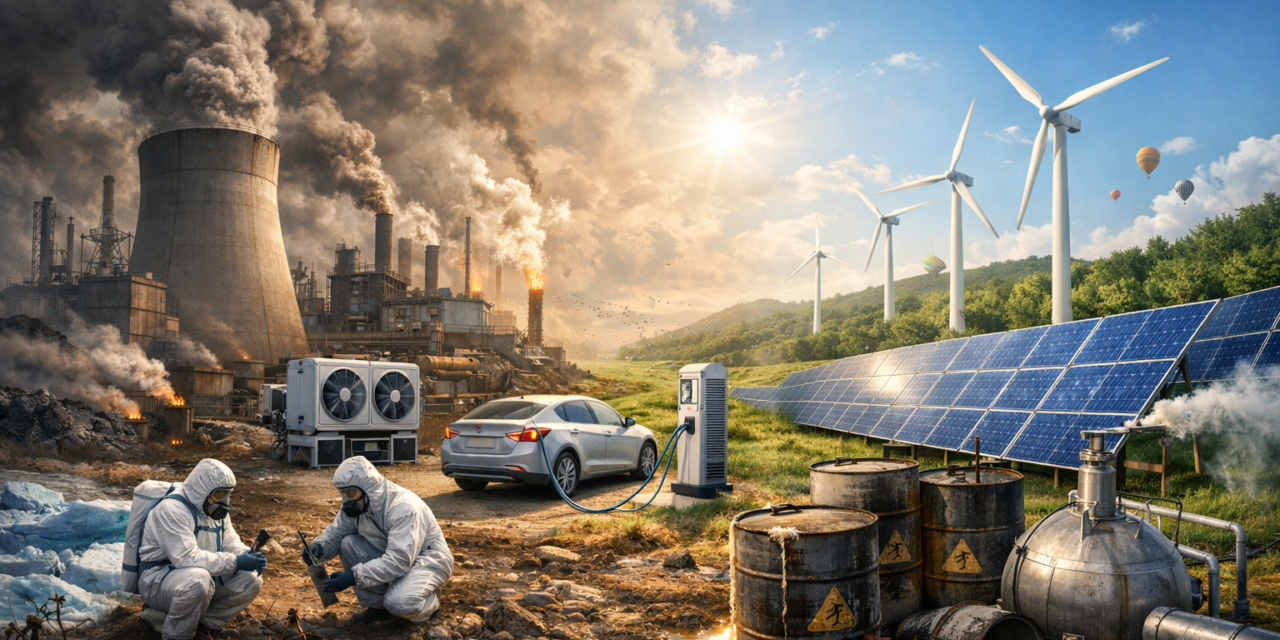
The contemporary discussion on climate policy has been shifting from an approach centred exclusively on carbon dioxide to a broader understanding of the role played by other gases and particles with high warming potential. Among these, hydrofluorocarbons (HFCs), black carbon and nitrous oxide (N₂O) assume particular relevance due to their disproportionate impact on the climate system, despite representing a relatively small fraction of global emissions in terms of volume. The term “super pollutants” has thus become a useful analytical category to describe substances whose global warming potential, especially when measured over short time horizons, far exceeds that of CO₂. Reducing these compounds constitutes a strategic opportunity to achieve rapid climate gains, strengthen environmental resilience and complement long‑term decarbonisation policies.
HFCs emerged as substitutes for chlorofluorocarbons following the implementation of the international regime for the protection of the ozone layer. Although they do not destroy stratospheric ozone, they possess an extremely high global warming potential, ranging from hundreds to thousands of times that of CO₂. Their use has become widespread in sectors such as refrigeration, air conditioning, insulating foams and industrial processes. The growing demand for cooling systems-driven by rising average temperatures and economic expansion in tropical and subtropical regions-has contributed to the rapid intensification of emissions. Reducing HFCs therefore requires a technological transformation that replaces these compounds with low‑climate‑impact alternatives, such as natural refrigerants, new‑generation synthetic refrigerants or cooling systems that reduce the need for chemical substances. This transition implies significant investment, but it offers immediate mitigation benefits, since the progressive elimination of HFCs can prevent a substantial increase in global temperature in the coming decades.
Black carbon, in turn, is not a gas but an aerosol resulting from the incomplete combustion of fossil fuels, biomass and waste. Its physical nature gives it particular properties: it absorbs solar radiation intensely, contributing to atmospheric warming, and alters the reflectivity of surfaces when deposited, accelerating melting in snow‑ and ice‑covered regions. Its presence is especially problematic in dense urban areas and in regions where biomass burning is a daily practice. Beyond its climatic impact, black carbon is associated with serious public health problems, affecting air quality and increasing the incidence of respiratory and cardiovascular diseases. Reducing this pollutant requires interventions ranging from the modernisation of diesel engines to the replacement of traditional stoves with clean technologies, as well as improvements in industrial systems and the elimination of open burning. Its short atmospheric lifetime means that any reduction produces almost immediate effects, making it a priority target for short‑term mitigation policies.
Nitrous oxide presents a different dynamic. Although less discussed in public debate, it is one of the gases with the longest atmospheric lifetime and has a global warming potential far higher than that of CO₂. Its main source is agriculture, particularly through the use of nitrogen fertilisers and the management of livestock waste. Agricultural intensification-necessary to feed a growing global population-has significantly increased N₂O emissions, creating a dilemma between food security and environmental sustainability. Reducing this gas requires an integrated approach combining technological innovation, regenerative agricultural practices and policies that encourage nutrient‑use efficiency. Optimising fertilisation, adopting nitrogen‑fixing crops, developing nitrification inhibitors and improving soil management are essential strategies to reduce emissions without compromising agricultural productivity.
A joint analysis of these three super pollutants reveals a common characteristic: all require sector‑specific interventions but offer climate benefits that manifest across different temporal scales. HFCs and black carbon produce rapid mitigation effects, while N₂O operates over a longer horizon but with significant cumulative impact. This temporal diversity allows for the construction of a balanced climate strategy capable of combining immediate actions with deep structural transformations. Reducing super pollutants does not replace the need for decarbonisation; rather, it complements it, functioning as an acceleration mechanism that slows the pace of warming while societies advance in the energy transition.
Implementing effective policies to reduce these pollutants, however, faces considerable challenges. In the case of HFCs, the technological transition entails high costs for companies and consumers, especially in countries with limited financial capacity. Replacing refrigeration and air‑conditioning equipment requires economic incentives, clear regulation and technical support mechanisms. International cooperation plays a crucial role, as the production and consumption of these compounds are globally distributed and depend on complex value chains. Harmonising standards, sharing technologies and financing substitution projects are essential elements to ensure that HFC reduction is equitable and effective.
Regarding black carbon, the main obstacle lies in the diversity of its sources. Its reduction requires coordinated urban, industrial, agricultural and social policies. Modernising transport, for example, demands investment in infrastructure and incentives for adopting less polluting vehicles. Replacing traditional stoves with clean alternatives requires community support programmes and cultural change. Eliminating waste burning depends on adequate collection and treatment systems. This multiplicity of interventions makes black carbon reduction a multidimensional challenge requiring coordination across different levels of governance and economic sectors.
Nitrous oxide presents challenges of a different nature. Agriculture is a sector highly sensitive to changes in practice due to the need to ensure productivity and the variability of climate and soil conditions. Adopting more efficient techniques depends on training, access to technologies and economic incentives. Moreover, monitoring agricultural emissions is complex, making it difficult to implement policies based on precise metrics. Reducing N₂O therefore requires an approach that combines agronomic science, public policy and direct engagement with farmers, recognising the importance of food security and the economic sustainability of agricultural operations.
Despite these challenges, reducing super pollutants offers significant opportunities to promote innovation, improve public health and strengthen international cooperation. The transition to low‑impact refrigerants stimulates the development of new technologies and creates economic opportunities in emerging sectors. Reducing black carbon improves air quality, lowers health‑related costs and increases labour productivity. Optimising fertiliser use contributes to soil health and the resilience of agricultural systems. These co‑benefits reinforce the importance of integrating super pollutant reduction into national and international sustainable development strategies.
Addressing these pollutants also requires reflection on climate justice. The most vulnerable communities are often the most affected by air pollution and climate change, yet they have the least capacity to implement advanced technological solutions. Reducing super pollutants must therefore be accompanied by support mechanisms ensuring that benefits are distributed equitably. Financing programmes, technology transfer and local capacity‑building are essential to ensure that the climate transition does not deepen existing inequalities.
At a conceptual level, the growing attention to super pollutants reflects a shift in how the climate system is understood. An exclusive focus on CO₂ has proven insufficient to capture the complexity of atmospheric interactions and short‑term dynamics. Including pollutants with high warming potential enables a more comprehensive vision that integrates different temporal scales and economic sectors. This multidimensional approach reinforces the need for flexible policies adapted to the specificities of each substance and each socio‑economic context.
In summary, reducing HFCs, black carbon and nitrous oxide constitutes a fundamental pillar of contemporary climate action. These super pollutants represent a unique opportunity to achieve rapid and significant gains, complementing decarbonisation efforts and contributing to stabilising the climate system at a critical moment. Their mitigation requires technological innovation, robust public policies, international cooperation and social engagement. The complexity of the challenge does not diminish its urgency; on the contrary, it underscores the need for an integrated approach that recognises the interdependence between climate, health, agriculture, energy and development. By addressing these pollutants strategically, societies can move towards a more stable, resilient and sustainable future, reducing the risks associated with global warming while promoting tangible benefits for present and future generations.
Bibliography
Intergovernmental Panel on Climate Change (IPCC). Climate Change 2023: Mitigation of Climate Change. Cambridge University Press, 2023.
United Nations Environment Programme (UNEP). Integrated Assessment of Short-Lived Climate Pollutants. UNEP, 2022.
Climate and Clean Air Coalition (CCAC). Strategies for Reducing HFCs and Other Super Pollutants. CCAC Secretariat, 2023.
Montzka, S. A., Dutton, G. S. et al. “Hydrofluorocarbons and Their Climate Forcing.” Nature Climate Change, 2022.
Bond, T. C., Doherty, S. J. et al. “Bounding the Role of Black Carbon in the Climate System.” Journal of Geophysical Research: Atmospheres, 2013.
Davidson, E. A. “The Global Contribution of Nitrous Oxide to Climate Change.” Science, 2020.
Food and Agriculture Organization (FAO). Nitrogen Management and Agricultural Emissions. FAO, 2021.
International Energy Agency (IEA). The Future of Cooling: Pathways for a Low-Carbon Transition. IEA, 2023.
World Health Organization (WHO). Black Carbon, Air Pollution and Health. WHO, 2022.
OECD. Agricultural Sustainability and Nitrogen Efficiency. OECD Publishing, 2023.
References:
https://www.sciencedirect.com/science/article/pii/S2950138525000178
https://www.sciencedirect.com/science/article/pii/S0301479725006310
https://www.sciencedirect.com/science/article/pii/S2772694025000342
https://www.sciencedirect.com/science/article/pii/S1674927822000636
https://www.sciencedirect.com/science/article/pii/S0959652625006134
https://pmc.ncbi.nlm.nih.gov/articles/PMC10836163/
https://www.nature.com/articles/s43247-022-00555-x
https://www.frontiersin.org/journals/environmental-science/articles/10.3389/fenvs.2023.1294039/full
https://www.bc.edu/bc-web/centers/schiller-institute/sites/masscleanair/articles/econ.html
https://pmc.ncbi.nlm.nih.gov/articles/PMC12008138/
https://pmc.ncbi.nlm.nih.gov/articles/PMC7783541/
https://www.mdpi.com/2674-0389/5/1/7
https://gspp.berkeley.edu/berkeley-carbon-trading-project/repository-of-articles
https://sciencesources.eurekalert.org/news-releases/1114552
https://www.eurekalert.org/news-releases/1122152
https://pubs.rsc.org/en/content/articlelanding/2026/su/d5su00912j