
Climate Change Cause and Effect
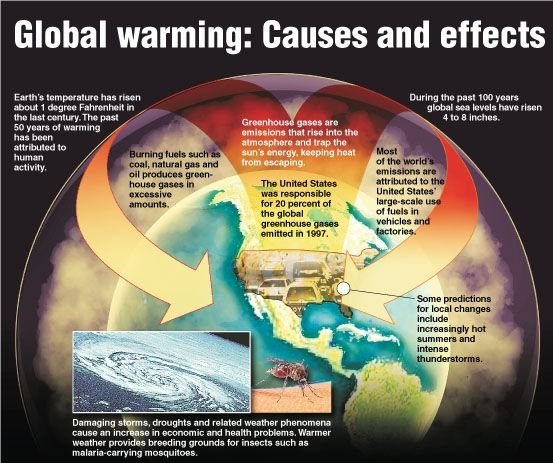
Causes of Recent Climate Change
The rate of temperature increase is faster than it has been in at least one millennium and most likely faster than in two or more. When scientists construct climate models to reproduce the changes that are taking place, inputting only natural causes of climate change is not sufficient to replicate current conditions.
Models that input only human generated causes of climate change are also not sufficient. To reconstruct recent warming trends, models must take into account both natural climate variations and the rise in greenhouse gas levels due to human activities.
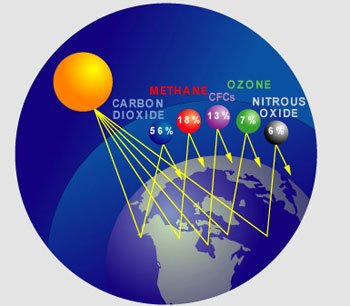
Greenhouse gases have carried far more weight in determining modern climate than any other factor in the warming seen since 1950. Due to increased fossil fuel and biomass burning, atmospheric CO2 has been rising sharply since the Industrial Revolution. The total increase for that time period is 27%, from the preindustrial value of 280 ppm to the January 2007 value of 382 ppm. Nearly 65% of that rise has been since CO2 was first measured on Mauna Loa volcano in Hawaii in 1958, when the value was 316 ppm. In fact, the rate of increase in CO2 has doubled from 30 years ago. One of the largest single-year increases on record – rise of 2.6 ppm was in 2005.
The increase in atmospheric CO2 measured above Mauna Loa since 1958 is known as the Keeling curve. The up and-down annual cycle s the result of the seasons. Most of the planet’s land masses lie in the Northern Hemisphere. In spring, when the North Pole points toward the Sun, trees sprout leaves and grasses multiply. The growing plants absorb CO2 from the atmosphere. In autumn, as the plants die back, the CO2 is rereleased into the atmosphere. Like CO2, methane amounts have risen since the Industrial Revolution; in this case, 151%, mostly from agricultural sources.
Scientists studying Greenland ice cores discovered in 2006 that there is more CO2 in the atmosphere now than at any time in the past 650,000 years. During all that time, in fact, CO2 had never risen above 300 ppm. Analyses of Antarctic ice cores show that levels of the three most important greenhouse gases (CO2, methane, and nitrous oxide) were never as high as they are today. It is important to note that greenhouse gases remain in the atmosphere for centuries.
When modeling recent climate change, scientists must take into account global dimming, which has the opposite effect on the climate from greenhouse warming. Global dimming causes a decrease in warming equal to about one-third the increase caused by greenhouse gases.
The abundance of sulfate aerosols over the developed nations may explain why the Northern Hemisphere has warmed less than Southern Hemisphere; why the United States has experienced less warming than the rest of world; and why most global warming has occurred at night and not during the day, especially over polluted areas.
Of course, air pollution has harmful effects on the environment and human health. As a result, people in developed nations now regulate emissions so that the air above them and downwind is much less polluted. However, a decrease in air pollution also brings about a decrease in global dimming, and a decrease in global dimming is likely to increase global warming. Global dimming researchers think that recent improvements in the air quality of Western Europe may be responsible for recent temperature increases and even for the deadly European heat wave of the summer of 2003.