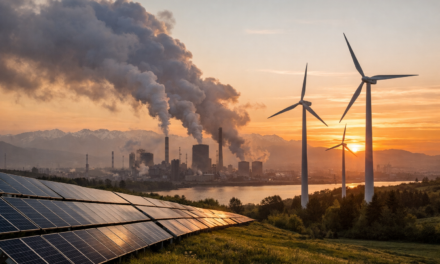
Global warming is an average increase in the temperature of the atmosphere near the Earth’s surface and in the Troposphere, which can contribute to changes in global climate patterns.
Global warming can occur from a variety of causes, both natural and human induced. In common usage, “global warming” often refers to the warming that can occur as a result of increased emissions of greenhouse gases from human activities.
The Earth’s climate has changed many times during the planet’s history, with events ranging from ice ages to long periods of warmth.
Historically, natural factors such as volcanic eruptions, changes in the Earth’s orbit, and the amount of energy released from the Sun have affected the Earth’s climate.
Beginning late in the 18th century, human activities associated with the Industrial Revolution have also changed the composition of the atmosphere and therefore very likely are influencing the Earth’s climate.
For over the past 200 years, the burning of fossil fuels, such as coal and oil, and deforestation have caused the concentrations of heat-trapping “greenhouse gases” to increase significantly in our atmosphere. These gases prevent heat from escaping to space, somewhat like the glass panels of a greenhouse.
Greenhouse gases are necessary to life as we know it, because they keep the planet’s surface warmer than it otherwise would be. But, as the concentrations of these gases continue to increase in the atmosphere, the Earth’s temperature is climbing above past levels.
According to NOAA and NASA data, the Earth’s average surface temperature has increased by about 1.2 to 1.4¬∫F in the last 100 years. The eight warmest years on record (since 1850) have all occurred since 1998, with the warmest year being 2005. Most of the warming in recent decades is very likely the result of human activities. Other aspects of the climate are also changing such as rainfall patterns, snow and ice cover, and sea level.
If greenhouse gases continue to increase, climate models predict that the average temperature at the Earth’s surface could increase from 3.2 to 7.2ºF above 1990 levels by the end of this century.
Scientists are certain that human activities are changing the composition of the atmosphere, and that increasing the concentration of greenhouse gases will change the planet’s climate. But they are not sure by how much it will change, at what rate it will change, or what the exact effects will be.
Second, in the “long emergency” ahead leaders will need an uncommon clarity about our best economic and energy options. Some choices being proposed by well-funded and highly organized lobbies would commit the nations and the world to courses of action that will lead to unfortunate and irreversible consequences.
They will need to understand their relative costs, risks, and benefits, including those over the long term, to avoid making decisions that lock us in to policies that we or our children‚ will someday sorely regret.
There are better possibilities that would go a long way toward solving the underlying causes of our problems. But knowing which is which requires that they recognize the difference between the structure of problems and their coefficients the rate at which they get worse. In other words, they need to understand the difference between Band-Aids and authentic cures, and that requires that we better understand otherwise obscure concepts like feedback loops, leads, and lags, which is to say how the world works as a unified system.