VIDEO
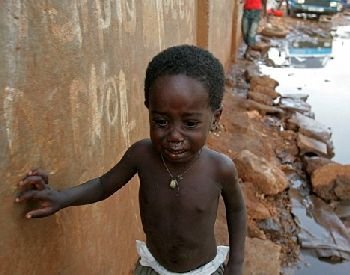
Global connections: one in every three children under age 5, such as this child in Lunda, Angola, suffers from severe malnutrition caused by a lack of calories and protein. According to the World Health Organization, each day at least 13,700 children under age 5 die prematurely from malnutrition and infectious diseases, most from drinking contaminated water and being weakened by malnutrition.
Why Do We Have Environmental Problems?
Concept 1-5A: Major causes of environmental problems are population growth, wasteful and unsustainable resource use, poverty, excluding the environmental costs of resource use from the market prices of goods and services, and trying to manage nature with insufficient knowledge.
Concept 1-5B: People with different environmental worldviews often disagree about the seriousness of environmental problems and what we should do about them.
Experts Have Identified Five Basic Causes of Environmental Problems
As we run more and more of the earth’s natural resources through the global economy, in many parts of the world, forests are shrinking, deserts are expanding, soils are eroding, and rangelands are deteriorating. In addition, the lower atmosphere is warming, glaciers are melting, seas are rising, and storms are becoming more destructive. And in many areas, water tables are falling, rivers are running dry, fisheries are collapsing, coral reefs are disappearing, various forms of life are becoming extinct, environmental refugees are increasing, and outputs of some pollutants and wastes are rising.
According to a number of environmental and social scientists, the major causes of these and other environmental problems are population growth, wasteful and unsustainable resource use, poverty, failure to include in market prices the environmental costs of producing and using goods and services, and too little knowledge of how nature works. (Concept 1-5A).
Poverty Has Harmful Environmental and Health Effects
Poverty occurs when people are unable to meet their basic needs for food, water, shelter, health, and education. The daily lives of half of the world’s people, who trying to live on the equivalent of less than $2 a day, are focused on getting enough food, water, and cooking and heating fuel to survive. Desperate for land to grow enough food, some of these people are increasingly depleting and degrading forests, soil, grasslands, fisheries, and wildlife for short-term survival.
They do not have the luxury of worrying about long-term environmental quality or sustainability.
Poverty affects population growth. To many of the poor, having more children is a matter of survival. Their children help them gather fuel (mostly wood and animal dung), haul drinking water, and tend crops and livestock. The children also help care for them in their old age (which is their 40s or 50s in the poorest countries) because they do not have social security, health care, and retirement funds.
While poverty can increase some types of environmental degradation, the reverse is also true. Pollution and environmental degradation have a severe impact on the poor and can increase poverty. Consequently, many of the worlds desperately poor die prematurely from several preventable health problems.
One such problem is malnutrition, or a lack of protein and other nutrients needed for good health. The resulting weakened condition can increase the chances of death from normally nonfatal diarrhea and measles. A second problem is limited access to adequate sanitation facilities and clean drinking water. More than 2.6 billion people (39% of the world’s population) have no decent bathroom facilities. They are forced to use fields, backyards, ditches, and streams. As a result, more than 1 billion people-one of every seven-get water for drinking, washing, and cooking from sources polluted by human and animal feces. A third problem is severe respiratory disease and premature death from inhaling indoor air pollutants produced by burning wood or coal in open fires or in poorly vented stoves for heat and cooking. According to the World Health Organization, these factors cause premature death for at least 7 million people each year. This premature death for about 19,200 people per day is equivalent to 96 fully loaded 200-passenger jet planes crashing every day with no survivors! Two-thirds of those dying are children younger than age. The daily news rarely covers this ongoing human tragedy.
The great news is that we have the means to solve the environmental, health, and social problems resulting from poverty within 20–30 years if we can find the political will to act.
Affluence Has Harmful and Beneficial Environmental Effects
The harmful environmental effects of poverty are serious but those of affluence are much worse top). The lifestyles of many affluent consumers in developed countries and in rapidly developing countries such as India and China are built upon high levels of consumption and unnecessary waste of resources. Such affluence is based mostly on the assumption-fueled by mass advertising-that buying more things will bring fulfillment and happiness.
This type of affluence has an enormous harmful environmental impact. It takes about 27 tractor-trailer loads of resources per year to support one American, or 7.9 billion truckloads per year to support the entire U.S. population. Stretched end-to-end, this number of trucks would reach beyond the sun! While the United States has far fewer people than India, the average American consumes about 30 times as much as the average citizen of India and 100 times as much as the average person in the world’s poorest countries. As a result, the average environmental impact or ecological footprint per person in the United States is much larger than the average impact per person in developing countries. On the other hand, affluence can lead people to become more concerned about environmental quality.
It also provides money for developing technologies to reduce pollution, environmental degradation, and resource waste. In the United States and most other affluent countries, the air is cleaner, drinking water is purer, and most rivers and lakes are cleaner than they were in the 1970s. In addition, the food supply is more abundant and safer and the incidence of life-threatening infectious diseases has been greatly reduced.
Affluence financed these improvements in environmental quality, and education spurred citizens to insist that businesses and elected officials improve environmental quality. Affluence and education have also helped reduce population growth in most developed countries. However, a downside to wealth is that it allows the affluent to obtain the resources they need from almost anywhere in the world without seeing the harmful environmental impacts of their high-consumption life styles.
Thinking About
The Poor, the Affluent, and Exponentially Increasing Population Growth
Some see rapid population growth of the poor in developing countries as the primary cause of our environmental problems. Others say that the much higher resource use per person in developed countries is a more important factor. Which factor do you think is more important? Why? Prices Do Not Include the Value of Natural Capital
When companies use resources to create goods and services for consumers, they are generally not required to pay the environmental costs of such resource use. For example, fishing companies pay the costs of catching fish but do not pay for the depletion of fish stocks. Timber companies pay for clear-cutting forests but not for the resulting environmental degradation and loss of wildlife habitat. These companies reasonably seek to maximize their profits, so they do not voluntarily pay these costs or even try to assess them, unless required to do so by government laws or regulations.
As a result, the prices of goods and services do not include their harmful environmental costs. Thus consumers are generally not aware of them and have no effective way to evaluate the harmful effects of the goods and services they buy on the earth’s life-support systems.
Another problem is that governments give companies tax breaks and payments called subsidies to assist them with using resources to run their businesses. This helps create jobs and stimulate economies, but it can also result in degradation of natural capital, again, because the value of the natural capital is not considered.
According to a 2006 study by the World Business Council for Sustainable Development and three conservation organizations, corporations that do not begin attaching economic value to the natural resources and natural services they use will face higher operating costs as a result of problems such as water scarcity, climate change, species and habitat loss, and increasing environmental degradation. According to this study, companies that recognize the links between healthy ecosystems and their business interests can profit from developing new, more sustainable technologies and products that reduce waste, pollution, and environmental degradation and restore parts of the world that we have damaged.
People Have Different Views about Environmental Problems and Their Solutions
Differing views about the seriousness of our environmental problems and what we should do about them arise mostly out of differing environmental worldviews. Your environmental worldview is a set of assumptions and values reflecting how you think the world works and what you think your role in the world should be. This involves environmental ethics, which are our beliefs about what is right and wrong with how we treat the environment. Here are some important ethical questions relating to the environment:
• Why should we care about the environment?
• Are we the most important beings on the planet or are we just one of the earth’s millions of different forms of life?
• Do we have an obligation to see that our activities do not cause the premature extinction of other life forms? Should we try to protect all life forms or only some? How do we decide which ones to protect?
• Do we have an ethical obligation to pass on to future generations the extraordinary natural world in at least as good condition as we inherited?
• Should every person be entitled to equal protection from environmental hazards regardless of race, gender, age, national origin, income, social class, or any other factor?
This is the central ethical and political issue for what is known as the environmental justice movement.
Thinking about our Responsibilities
How would you answer each of the questions above? Compare your answers with those of your classmates. Record your answers and, at the end of this course, return to these questions to see if your answers have changed. People with widely differing environmental worldviews can take the same data, be logically consistent, and arrive at quite different conclusions because they start with different assumptions and moral, ethical, or religious beliefs (Concept 1-5B).
The planetary management worldview holds that we are separate from nature, that nature exists mainly to meet our needs and wants, and that we can use our ingenuity and technology to manage the earth’s life-support systems, mostly for our benefit, indefinitely.
The stewardship worldview holds that we can and should manage the earth for our benefit but that we have an ethical responsibility to be caring and responsible managers, or stewards, of the earth. It says we should encourage environmentally beneficial forms of economic growth and discourage environmentally harmful forms.
The environmental wisdom worldview holds that we are part of and totally dependent on nature and that nature exists for all species, not just for us. It also calls for encouraging earth-sustaining forms of economic growth and development and discouraging earth-degrading forms. According to this view, our success depends on learning how the earth sustains itself and integrating such environmental wisdom into the ways we think and act.
Environmental worldviews play a role in the causes of environmental problems, and in how serious they get, because people with different environmental worldviews often disagree about the seriousness of environmental problems and what we should do about them (Concept 1-5B). For example, in an area where water pollution is not recognized by most people as an issue, it will likely grow to be a serious problem.
We Can Work Together to Solve Environmental Problems
Making the shift to more sustainable societies and economies involves building what sociologists call social capital. This involves getting people with different views and values to talk and listen to one another, find common ground based on understanding and trust, and work together to solve environmental and other problems. This means nurturing openness, communication, cooperation, and hope and discouraging close-mindedness, polarization, confrontation, and fear.
Solutions to environmental problems are not black and white, but rather all shades of gray because proponents of all sides of these issues have some legitimate and useful insights. This means that citizens can strive to build social capital by finding trade-off solutions to environmental problems-an important theme of this book. They can also try to agree on shared visions of the future and work together to develop strategies for implementing such visions beginning at the local level, as citizens of Chattanooga, Tennessee (USA), have done.
Case Study
The Environmental Transformation of Chattanooga, Tennessee
Local officials, business leaders, and citizens have worked together to transform Chattanooga, Tennessee (USA), from a highly polluted city to one of the most sustainable and livable cities in the United States. During the 1960s U.S. government officials rated Chattanooga as having the dirtiest air in the United States. Its air was so polluted by smoke from its coke ovens and steel mills that people sometimes had to turn on their vehicle headlights in the middle of the day. The Tennessee River flowing through the city’s industrial center bubbled with toxic waste. People and industries fled the downtown area and left a wasteland of abandoned and polluting factories, boarded-up buildings, high unemployment, and crime.
In 1984, the city decided to get serious about improving its environmental quality. Civic leaders started a Vision 2000 process with a 20-week series of community meetings in which more than 1,700 citizens from all walks of life gathered to build a consensus about what the city could be at the turn of the century. Citizens identified the city’s main problems, set goals, and brainstormed thousands of ideas for solutions. By 1995, Chattanooga had met most of its original goals. The city had encouraged zero-emission industries to locate there and replaced its diesel buses with a fleet of quiet, zero-emission electric buses, made by a new local firm.
The city also launched an innovative recycling program after environmentally concerned citizens blocked construction of a new garbage incinerator that would have emitted harmful air pollutants. These efforts paid off. Since 1989, the levels of the seven major air pollutants in Chattanooga have been lower than those required by federal standards.
Another project involved renovating much of the city’s low-income housing and building new low-income rental units. Chattanooga also built the nation’s largest freshwater aquarium, which became the centerpiece for downtown renewal. The city developed a 35-kilometer-long (22-mile-long) riverfront park along both banks of the Tennessee River running through downtown. It draws more than 1 million visitors per year. As property values and living conditions have improved, people and businesses have moved back downtown. In 1993, the community began the process again in Revision 2000. Goals included transforming an abandoned and blighted area in South Chattanooga into a mixed community of residences, retail stores, and zero-emission industries where employees can live near their workplaces. Most of these goals have been implemented.
Chattanooga’s environmental success story, based on people working together to produce a more livable and sustainable city, is a shining example of what other cities can do by building their social capital.
Thinking about Chattanooga
What are three things you would do to model the area where you live after the example of Chattanooga?
Individuals Matter
Chattanooga’s story shows that a key to finding solutions to environmental problems and making a transition to more sustainable societies is to recognize that most social change results from individual actions and individuals acting together to bring about change by bottom-up grassroots action. In other words, individuals matter-an important theme of this book. Research by social scientists suggests that it takes only 5-10% of the population of a community, country, or the world to bring about major social change. Such research also shows that significant social change can occur in a much shorter time than most people think. Anthropologist Margaret Mead summarized our potential for social change: “Never doubt that a small group of thoughtful, committed citizens can change the world. Indeed, it is the only thing that ever has.”