
VIDEO
Climate Change through Earth History
Constructing a history of Earth’s climate is easiest when examining more recent time periods because there are more tools available and better recordkeeping. Nonetheless, climatologists have been able to construct a detailed record of the planet’s more distant climate history, going back thousands of years. This paper discusses how climate has played an important role in the evolution of life and has even guided the course of human history.
Ancient Climate
During much of Earth’s history, the planet has been relatively warm and wet, with no glaciers or ice sheets. These steamy periods were punctuated by ice ages, when much of the planet’s surface was coated in ice. On average, over Earth’s history, the planet’s temperature was between 14°F and 27°F (8°C and 15°C) warmer than the temperature today. Scientists speculate that a temperature variance of only 18°F
(10°C) makes the difference between a fully glacial earth and an ice-free planet, in part because high temperatures are more extreme at high latitudes where the presence or absence of ice sheets plays an important role in global climate. Conditions now are relatively cool because the planet is coming off the extreme cold of the Pleistocene Ice Ages, which ended about 10,000 years ago.
Atmospheric greenhouse gas concentrations have also varied in Earth history. CO2 has fluctuated from between less than 200 ppm to greater than 5,000 ppm a high concentration reached hundreds of millions of years ago. Ice core and other samples show that greenhouse gas levels correlate with temperatures: When CO2 or methane levels are high, temperatures are also high.
Paleocene-Eocene Thermal Maximum
After the mass extinctions at the end of the Cretaceous Period, 65 million years ago, the planet was relatively warm and ice free. Temperatures rose until they became so high they triggered an even greater warming event around 55 million years ago. This period is known as the Paleocene-Eocene Thermal Maximum (PETM), a time when the Arctic was swampy and Antarctica was covered with forests.
Paleoclimatologists are piecing together the story of the PETM, mostly from the chemistry of forams collected from ocean sediment cores. The PETM arose over a very short period of time geologically. About half of the warming, 3.6°F (2°C), took place over no more than a few hundred years, with the rest occurring over less than 5,000 years.
Sea surface temperatures increased by between 9° and 14°F (5° and 8°C), with a striking rise of 15°F (8.3°C) occurring in the polar regions. The deep sea warmed dramatically as well.
Forams show a major decline in the ratio of heavy carbon (13C) to light carbon (12C) across the Paleocene-Eocene boundary. The explanation favored by scientists is that a load of methane, which is rich in light carbon, flooded the atmosphere. The most likely source of such vast amounts of methane is the methane hydrate deposits buried in seafloor sediments. According to this scenario, the PETM was triggered when ocean temperatures rose above a critical threshold: the temperature at which methane hydrates melt. Melting released the methane trapped inside the hydrates, and the greenhouse gas deluged the atmosphere. Such large increases in atmospheric methane explain the rapid and extreme global warming seen during the PETM.
The high temperatures of the PETM had many consequences. Warm surface waters caused ocean currents to switch direction, a condition that lasted for about 20,000 years. Because warm water cannot hold as much gas as cold water, oceanic oxygen levels were very low. In the atmosphere, methane broke down and formed CO2, which then formed carbonic acid. The evidence for this is that the deep ocean sediments are very rich in clays, suggesting that the carbonate shells of many organisms dissolved. High acidity and low oxygen caused 50% of deep sea forams and possibly other deep sea animals to die out. While there was no mass extinction on land or in the surface ocean, fossil evidence supports changes in the abundance of some life forms and in their evolutionary pathways. This is the time when modern mammals, from rodents to primates, first evolved and flourished. The PETM lasted for about 200,000 years, likely ending when all the available methane had been released into the atmosphere. Over time, the CO2 that the methane broke down into was sequestered in forests and plankton and dissolved into the oceans.
The Pleistocene Ice Ages
After the end of the PETM, temperatures fell, ultimately bottoming out during the Pleistocene Ice Ages, which began 1.8 million years ago and ended 10,000 years ago. The Pleistocene was not a time of relentless cold: Glaciers advanced and retreated many times. At the height of the most recent glacial advance, between 18,000 and 22,000 years ago, glaciers covered much of Eurasia and North America, from New York City northward. Average global temperatures were about 10°F (5.5°C) colder, and sea level was about 395 feet (125 m) lower than today. The low sea level exposed the Bering land bridge, allowing humans and large animals to migrate from Asia into North America. The bountiful forests south of the ice sheets were home to giant ice age mammals such as cave bears, saber-toothed cats, and wooly mammoths.
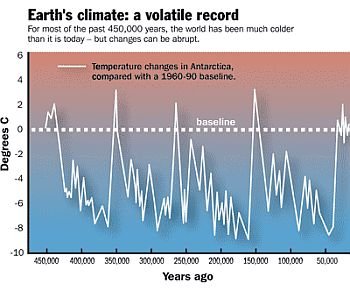
During the warm periods, known as interglacial’s, temperatures were more than 2°F (1.1°C) higher, and sea level was about 16 feet (4.8 m) higher than today. CO2 was higher than during the glacial periods but never rose above 300 ppm. Interglacial periods lasted about 10,000 years (although one of them lasted as long as 27,000 years). Even the interglacial periods were broken up by relatively short cold spells. CO2 was stable at or below 280 ppm for at least 400,000 years.
CO2 and temperature show the same pattern in the Vostok ice core from Antarctica over the past 400,000 years. Temperature and CO2 are high during interglacial periods and low during glacial periods. CO2 does not drive the initial rise in temperature during an interglacial, but it is a major contributor later. The rise in CO2 since 1958 has been picked up by the Mauna Loa monitoring station; temperature has not kept up with CO2.
The glacials and interglacial’s of the Pleistocene were caused by the Milankovitch and other natural cycles. Greenhouse gas levels also played a role. At the beginning of each glacial advance, CO2 and methane plunged and then resurged at the end. Ice cores from Greenland and Antarctica exhibit CO2 values that are 30% lower during glacial periods than during interglacial periods.
Climate changed quickly during the Pleistocene, with rapid transitions between glacial and interglacial periods. One especially dramatic temperature change took place early in the interglacial period that began 12,700 years ago. At about 10,500 years ago, as glaciers
were retreating, the warming trend suddenly reversed. Temperatures in parts of the Northern Hemisphere fell as much as 20°F (11°C) in as little as 10 to 100 years. The summit of Greenland was 27°F (15°C) colder, and Great Britain was 9°F (5°C) colder than they are now. This climatic period, which lasted about 1,400 years, is called the Younger Dryas. At the end of the Younger Dryas, temperatures returned to normal in only about 10 years.
Such rapid and dramatic cooling was likely the result of a massive influx of freshwater from North America. When an enormous lake of glacial melt water that was held back by an ice dam was breached, freshwater flooded the North Atlantic. The freshwater was light and floated on the sea surface, shutting down thermohaline circulation. As a result, warm equatorial waters were stopped from flowing northward.
Climate Change in Human History
In the past 10,000 years, since the end of the Pleistocene Ice Ages, average global temperature has risen 7°F (4°C). Glaciers have been in retreat since then and are now found only in high mountains and at high latitudes. Despite ups and downs, climate over the past 10 millennia has been milder and more stable than at any time since the Emiam interglacial of 130,000 years ago. Perhaps not surprisingly, this favorable climate period is the one during which human civilization developed. In his 2006 book, The Winds of Change: Climate, Weather, and the Destruction of Civilizations, Eugene Linden connects
climate change with the rise and fall of civilizations. Linden cites scientists who say that climate does not shift from consistently warm to consistently cold but flickers rapidly between warm and cold and wet and dry over several decades. “Rapid shifts between warm and cold throw ecosystems out of balance, unleashing pests and microbes, and ruining crops,” says Linden. Just a few of the fascinating scenarios he presents, linking climatic shifts with cultural development, are presented below.
The generally upward temperature trend since the end of the Pleistocene has been punctuated by periods of more rapid warming and of rapid cooling. The most severe cooling was a freshwater influx into the North Atlantic around 8,200 years ago that caused a plunge in temperatures of 9°F (5°C). This event was similar to the Younger Dryas but lasted between 60 and 200 years. This cooling event interrupted the emergence of civilization in Turkey, where agriculture and cities had been developing. The return of cold, dry, and windy weather necessitated that people devote their energy not to innovation but to survival.
Ice core data show that the period from 8,000 to 5,200 years ago was relatively warm, allowing the development of irrigated agriculture and permanent settlements. An abrupt cooling that occurred about 5,200 years ago again derailed cultural advances. Conditions were very cold and very wet, although this period seems to correspond with the beginning of cities in Mesopotamia and the Nile Valley and with the start of calendars.
Climate again stabilized, and the Bronze Age began, although at different times in different parts of Europe and the Middle East. This stable climatic period was the time of the Akkadian empire, which emerged around the city of Akkad in Ancient Mesopotamia, beginning about 4,350 years ago? The Akkadians had a written language, an accounting system, and religious practices that suggest a sophisticated social organization. A heavy dust band in ice cores on Mount Huascarán in Peru and on Mount Kilimanjaro in Africa provides evidence of a disastrous drought that brought on massive starvation and brought an abrupt end in to the Akkadian Empire 4,200 years ago. The dust band was discovered by Professor Lonnie Thompson of the Byrd Polar Research Center of Ohio State University. Global patterns of droughts and flooding from that time period suggest that the climate was dominated by an extremely strong El Niño that lasted for more than two centuries.
Climate sometimes wreaks destruction on humans (or organisms) by creating the conditions that promote the spread of disease. The Justinian Plague, which occurred in a.d. 541 to 542, was the first pandemic, an outbreak of infectious disease that spreads over a large region of the world. This plague may have originated in a rapid freeze that came in a.d. 536. No one knows what caused temperatures to plummet, but the rapid change indicate that the event was catastrophic, such as an asteroid impact. The cold snap brought on a cycle of floods and drought, which increased the food supply for East African rodents and caused their populations to increase faster than their predators’ populations. The rodents harbored fleas (Xenopsylla cheopis) that contained the bubonic plague bacterium Yersinia pestis.
The rodents are not susceptible to the disease, but the plague bacteria block the fleas’ digestive tracts. The fleas bite everything to try to slake their hunger, spreading the infection as they go.
The plague bacteria migrated northward on fleas that eventually infected Rattus rattus, the black rat, which has lived in close proximity with humans for millennia. The Justinian Plague laid waste to Constantinople, Alexandria, and other major world cities, killing millions of people during the following two centuries.
The Medieval Warm Period (MWP) lasted from about a.d. 900 to 1300. Although its cause is not yet well understood, it seems to be related to a strengthening of Atlantic meridional overturning. The MWP was a time of relatively warm, dry temperatures (although it is worth noting that temperatures during the MWP were never as high as during the 1990s). In Europe, crops thrived, and the people were healthy and prosperous. Europe’s population quadrupled and life expectancy increased to about 48 years of age. These favorable conditions allowed people to focus on art and religion, erecting extraordinary cathedrals and castles.
MWP climate was not nearly as advantageous in western North America and Central America: That part of the world suffered near permanent drought. The Maya civilization, centered in the Yucatan Peninsula of Mexico and the highlands of Guatemala, was in full swing when the drought began. Over a period of about 1,200 years, the Maya had built a remarkable civilization. They had constructed glorious pyramids, such as those located at Chichen Itza and Tikal.
The Maya were advanced in astronomy, the calendar, and in a skill that was extremely important for their drought prone location: water management. Mayan farmers depended
on annual rains from late spring to early fall for maize production, and on their rulers for drinking and household water during the annual dry season. Water was the means by which the Mayan elite maintained their rule because only they had the resources to store water in reservoirs and maintain its quality.
Despite its accomplishments, the Mayan civilization collapsed around a.d. 900. Many hypotheses have been offered, but new seafloor sediment analyses and tree ring data point to extreme drought as the primary cause. Because reservoirs could store water only for a year or two, when Mayan rulers were no longer able to supply their subjects with water, the civilization failed.
Farmers moved to other areas or, more likely, died of starvation and thirst. People weakened by famine are also more prone to disease. The MWP was far kinder to the Vikings (Norse), who spread across the northern portion of Europe. The Norse had thriving colonies on Greenland and on Iceland, where they grew crops, raised farm animals, and hunted. But in the fourteenth century, Europe plunged into the Little Ice Age (LIA), which ebbed and flowed over the next 500 years, though scientist’s debate
the exact dates of this period. This temperature drop came at somewhat different times in different locations: It struck Greenland in 1343. Archaeological evidence shows that at least one household slowly starved over the years until the inhabitants finally died out in 1355, the worst winter in 500 years.
During the LIA, global temperatures dropped between 0.9°F and 1.8°F (0.5°C and 1.0°C), a minor amount compared to those frigid periods of early civilization discussed on pages 53–56. Because the LIA was likely caused by a slowing of Atlantic meridional overturning, the largest temperature change was in the North Atlantic region, where the average temperature dropped 5.4°F (3°C). In Europe, weather during the LIA was often frigid, but it could also be warm, stormy, or dry in any combination. The extremely variable weather led to failed crops. Famine killed millions of people and triggered social conflict and war.
The LIA struck Great Britain earlier than Greenland. The River Thames, which flows through London, froze in 1309, but then the weather warmed up and brought in large storms. Crops rotted or failed to ripen, and livestock froze. Beginning in 1332, the cycle of floods and drought in Mongolia and China brought about the bubonic plague. After killing 35 million people in China, the Black Death spread to Europe, where it killed between one quarter and one-half of the population: 20 to 50 million people who were already weakened by famine and other diseases. Bubonic plague came and went over the
next few centuries. Still, the LIA was not a time of constant cold: Between 1400 and 1550, the climate became more moderate. This mild period correlates with the Renaissance, a time of great technological and artistic advances. Then, from 1550 to 1850, winters again turned long and severe, and summers were short and wet. In the seventeenth century, in Switzerland, glaciers advanced down mountain valleys and crushed villages. In North America, in the winter of 1780, New York Harbor froze solid, allowing people to walk from Manhattan to Staten Island. Superimposed on the LIA was the Maunder Minimum, a period with extremely low sunspot activity. This period corresponds with the deepest cold of the LIA, from 1645 to 1715.
WrapUp
Scientists can learn about many important things from studying past climate. Evidence from ice cores, ocean sediments, and other sources has shown paleoclimatologists that climate change was not always gradual and sometimes was extremely rapid. As climate changes from hot to cold or cold to hot, it does not do so abruptly, but flickers between the two states. Periods of great climatic change have generally been difficult during human history. Times such as the MWP and the LIA took enormous tolls on civilizations: Famine, thirst, and disease sometimes caused the deaths of tens of millions of people.
Lonnie Thompson: Constructing Earth’s Climate from the World’s High Peaks
Lonnie Thompson’s life began far from the tropical mountain peaks where he now spends much of his time. As a boy on a farm in rural West Virginia, he was fascinated with meteorology. He attended Marshall College, where he studied to become a coal geologist. Thompson married the only woman studying physics at Marshall, Ellen Mosely, and the couple moved to Ohio State University for graduate school. Thompson’s life took a fateful turn when he secured a research job working with the first ice cores ever collected.
The young geologist was entranced by the immense possibilities that ice cores held for the reconstruction of past climate and was inspired to switch his studies to glaciology.
After one field season in Antarctica, Thompson decided to study tropical mountain glaciers, ignoring the prevailing idea that mountain glaciers were too active to contain a usable climate history. In 1974, he became the first scientist to drill a mountain glacier, the Quelccaya ice cap, at an elevation of 18,600 feet (5,670 m) in the Peruvian Andes, and he has worked on mountain glaciers ever since.
Gathering ice on tropical mountain glaciers presents unique difficulties. Tropical mountain glaciers are at very high altitudes. At those heights, people are susceptible to acute mountain sickness, pulmonary edema, frostbite, and other ills, all of which have plagued members of Thompson’s ice coring team. The sample sites are inaccessible to aircraft and other vehicles, so people (sometimes with the help of yaks) must maneuver six tons (5.4 metric tons) of equipment over the jagged and crevassed glacial surface, while avoiding avalanches, altitude sickness, frigid temperatures, and windstorms.
Cores are retrieved in one-meter sections and stored in insulated boxes. When drilling is complete, about four tons (3.6 metric tons) of cores must be quickly carried down the mountain, transported overland, and then placed aboard an airplane. These cores must be shipped to the OSU center before they melt.
Once they reach the research center, they are stored in refrigerated vaults that are maintained at Arctic temperatures of -22°F (-30°C). Thompson braves these adverse conditions because of the important story that tropical mountain glaciers have to tell about regional climate and environmental change. Tropical glaciers contain a thorough record of El Niño events and, he says, understanding the natural variability of these natural climate events is essential for assessing the degree to which human activities are now inducing climate change.
Tropical regions are also extremely sensitive to greenhouse gas levels: If rising CO2 causes tropical oceans to evaporate, the added water vapor will raise atmospheric greenhouse gas levels even higher and increase global temperatures. Thompson is now the world’s foremost expert in the study of paleoclimate using ice cores from mountain glaciers. Over the past 30 years, he has led more than 50 expeditions to 11 high-elevation ice fields on 5 continents. He has cored about 23,000 feet (7,000 m) of ice reaching as far back in time as 750,000 years. The scientist is now in a race against time to gather as many ice cores as he can before the ice record melts away. He estimates that the Peruvian Andes, which contain the world’s largest concentration of tropical glaciers, have lost about 20% of their mass since 1972. For example, in the years 1991–2005, Qori Kalis glacier retreated about 10 times faster (200 feet [61 m] per year) than during the years from 1963 to 1978 (20 feet [6.1 m] per year).
As Thompson stated in Ohio State Research in 2006, “What this [research] is really telling us is that our climate system is sensitive, it can change abruptly due to either natural or to human forces. If what happened 5,000 years ago were to happen today, it would have far-reaching social and economic implications for the entire planet. The take-home message is that global climate can change abruptly, and with 6.5 billion people inhabiting the planet, that’s serious.”