

Green House Effect and Global Warming
STRATEGIES YOU CAN USE (4)
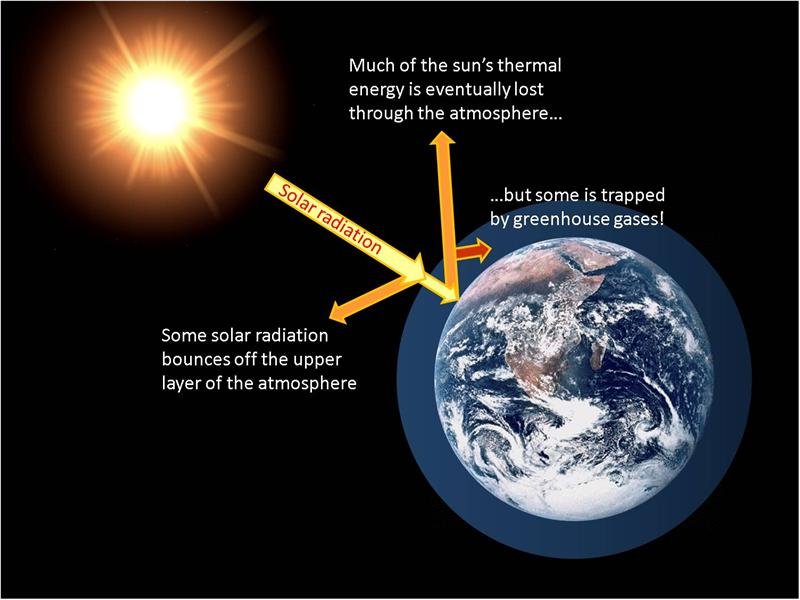
Energy and greenhouse gases
A few years ago, we were asked by the Oregon Department of Energy and the Portland Office of Sustainable Development to do research on resource efficiency strategies for certain manufacturing sectors. We interviewed many local plant managers and engineers.
We were shocked to find that many did not understand the connection between energy use and greenhouse gases. When asked about carbon dioxide (CO2) emissions and greenhouse gases, the interviewees often said they had none. It was as if they expected to find a tank out back with CO2 written on the side. So let’s get this straight, if you don’t already understand: if you use energy made from oil, natural gas, or coal, you emit greenhouse gases, indirectly perhaps, but it still counts.
Your process may also directly create CO2 (as in the manufacture of cement), or you may emit methane, which is 21 times more powerful as a greenhouse gas per molecule, through anaerobic processes (cows, rice paddies, landfills and forest practices that increase the population of termites). Then there are designer, man-made greenhouse gases such as per fluorocarbons, mostly from aluminum smelting, and sulphur hexafluoride (SF6), used in utility switchgear and substations and, for a while, Nike Air Jordans.
The Kyoto Protocol lists six greenhouse gases and the Intergovernmental Panel on Climate Change has assigned each a factor to make their molecules equivalent to CO2:
• Carbon dioxide (CO2);
• Methane (CH4; 21 times CO2);
• Nitrous oxide (N2O; 310 times CO2);
• Hydrofluorocarbons (HFCs; 1300 times CO2);
• Perfluorocarbons (PFCs; 6500 times CO2); and
• Sulphur hexafluoride (SF6; 23,900 times CO2).
For most, however, your biggest climate contribution is likely to be energy: transportation, space heating and cooling, and energy related to producing your products. Of course, every organization is convinced that they are extremely lean and mean. Most carried out energy efficiency measures back in the 1970s and 1980s and now assume that they’ve already achieved all the efficiencies they can.
Dow’s experience would suggest otherwise. In 1982 their Louisiana Division started a contest to find energy-saving projects with a high rate of return. In the first year, 27 winners, with projects requiring capital expenditures of $1.7 million, provided an average annual rate of return of 173 per cent. For the next six years, during a period of declining fuel prices, the ideas kept rolling in and, by 1988; productivity gains from the ideas were exceeding the environmental gains. After ten years and over 700 project winners, one might think all the best ideas had been tapped, but the contests in 1991–1993 yielded over 100 ideas per year with an average return on investment of 300 per cent, saving Dow over $75 million a year just for the projects in those years.
Over the years, employees became increasingly sophisticated in their ability to identify and fix inefficiencies.
You’d think at least an energy company would be wise enough not to waste energy. In the past few years, during which BP formally changed their name to no longer stand for British Petroleum, and also branded them ‘Beyond Petroleum’, they set a goal of becoming Kyoto compliant, meeting the goals of the international climate change agreement for reductions in greenhouse gas emissions. They gave themselves ten years, but reported having achieved the goal in only two years at no net cost to the company. The ease with which they met the Kyoto goals shows how unnecessarily wasteful their practices had been in the past. They achieved their target by creating an internal carbon trading system similar to that proposed in the Kyoto Protocol.
Sometimes you can not only save money by eliminating inefficiencies, you can also tap into new funding sources. For example, the Gerding/Edlen Development Company in Portland, Oregon is developing a number of blocks in an old industrial district. Passionate about the environment, they invested in extra green features in their Brewery Block project.
The extra construction costs they incurred for green design were around $600,000–700,000, but this was offset twice over by grants, technical assistance, and tax credits. Now they benefit from the reduced operations and maintenance costs. Some of the funding may be linked to energy so, in the US, check out both the Environmental Protection Agency and your state energy department; elsewhere similar grants are almost certainly available. Other sources may come from the developing market in carbon credits and carbon offsets.
Even without the ratification of the Kyoto Protocol, these markets are developing, for example in Australia, the European Union and in Chicago. If you have a project that can be audited to show a significant reduction in greenhouse gases (eg through energy reduction or carbon sequestration), you may be able to sell carbon credits, usually to a middleman/broker such as The Climate Trust or Climate Neutral Network, or through one of the emerging regional or national exchanges. Other organizations may then purchase these carbon offsets, often as a way of hedging against future carbon cap-and-trade regulations or merely to take responsibility for their impacts.
Some of the largest purchasers of carbon offsets include Johnson and Johnson as the second and HSBC Bank as the seventh largest purchaser of US credits. Even government can get in on the act, with the US General Services Administration coming in fifth.