The Early Earth and Plate Tectonics
Plates
So what is a plate anyway? Sounds like something set out on the dinner table. In the study of the Earth, the science of geomorphology is connected with the study of landforms, all the bumps, and grooves on the surface of the Earth. Several continental plates make up these landforms.
Geologists know that the original supercontinent broke up into large pieces of land like the size of the North American or African landmasses. These lumps of land are called plates.
How were land and ocean plates discovered? Well, there were lots of good clues to plate locations, since collision and grinding cause a lot of pressure buildup between plates.
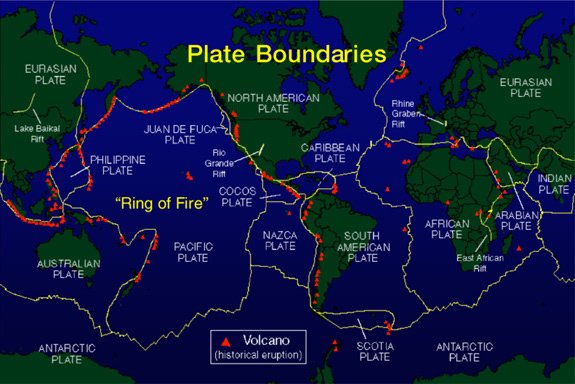
Volcanoes that occur along plate edges offer active and dramatic fireworks to signal plate margins. Earthquakes and eruptions are concentrated along the boundaries of rigid lithospheric plates. The plates rimming the Pacific Ocean have so many active volcanoes that the area is known as the Ring of Fire.
A geological plate is a layer of rock that drifts slowly over the supporting, upper mantle layer (asthenosphere) below it.
Continental and ocean plates are huge. They range in size between half a million to about 97 million km in area. Plates can be as much as 200 miles thick under the continents and beneath the ocean basins. Plates as much as 100km thick fit loosely together in a mosaic of constantly pushing and shoving landforms. At active continental plate margins, land plates ram against other continental plates causing rock to pile up into towering mountains.
The border between the Eurasian and Indian-Australian plates is a good example of where plates clash. Along this plate margin, the Himalayan range is forming with the world’s tallest mountain (Mount Everest). Where the Nazca ocean plate and South American continental plate collide, the Andes Mountains are forming. Similarly, where two ocean plates collide, one dives downward beneath the other and deep ocean trenches are formed. Like two stubborn bulls, the margin where the Pacific and Philippine plates meet created the Mariana trench (over 5 times as deep as the Grand Canyon).
All together, there are 15–20 major plates that make up the jigsaw puzzle of the Earth’s crust. Of these, geologists consider that a few are small, some are medium sized, and several are massive. The 15 medium and massive plates are the most commonly studied plates. Figure 4-2 shows a United States Geological Survey illustration of the major oceanic and continental plates.
Some of these plates are divided differently depending on the latest geology information; this gives a general idea of the main plates and their size. The plates found across the face of the Earth are unique to this planet. If plates were thicker, they would surround the core like a pressure cooker until the temperatures and pressures became so extreme as to melt everything. Thisis the kind of thing that went on in the early forming of the planet. But the Earth is unique in that the story did not end there. It continued to cool, change, regenerate, and develops with a beauty and perfection that leaves earth scientists scratching their heads and most people of the world in openmouthed wonder.
The main evidence that continents were originally all one piece comes from the discovery of rock formations that match from one continent to another. For example, the eastern edge of South America fits like a puzzle piece into the western border of Africa. Fossils found on the once connected edges of North America, Europe, and northwestern Africa all match.