

Supply Chain, Sustainability and Transformation
STRATEGIES YOU CAN USE (5)
Collaborate with the supply chain
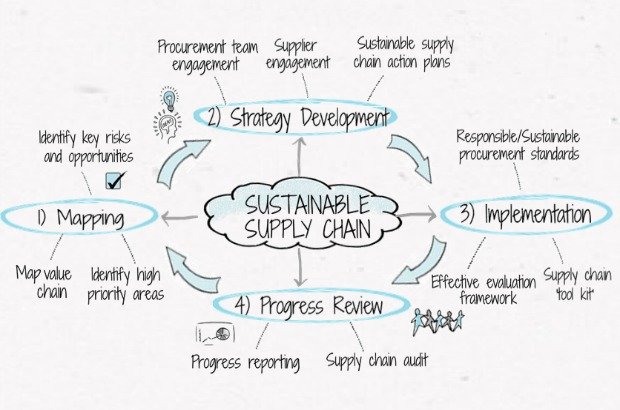
Managing your supply chain has become increasingly important as a business strategy, not only to reduce environmental impacts but also to manage costs and uncertainty.
In ‘The Supply-Chain Management Effect’ Kopczak and Johnson identify six different shifts in thinking in supply chain management, all of which imply or require collaboration across organizational boundaries:
1. From functional integration to cross-enterprise integration (ie outside your own organization);
2. From physical efficiency to market mediation (eg matching market demand with supply);
3. From supply focus to demand focus;
4. From single-company product design to collaborative, concurrent design;
5. From cost reduction to breakthrough business models (eg Dell, IKEA); and
6. From mass market to tailored offerings.
Because manufacturers are now being asked about and held responsible for what is in their product, many organizations are trying to ‘green’ their supply chain. Sometimes this takes the form of sending questionnaires to suppliers or switching to more environmentally preferable vendors. Some organizations require first-tier suppliers to have an environmental management system or to be ISO 14000 certified. These actions help a business understand what risks they are assuming when they buy components.
Furthermore, in this age of just-in-time manufacturing and sole-sourcing, these actions help build confidence that the suppliers have robust management systems to prevent environmental disasters which could disrupt the supply chain and reflect poorly on their own company.
One of the most powerful and profitable practices are often overlooked: sitting down face to face to explore opportunities to improve the overall supply chain process to address quality, environmental or other concerns. According to a study done by Business for Social Responsibility, waste and inefficiencies across organizational boundaries can be staggering: Inefficiencies across the supply chain can waste up to 25 per cent of a company’s operating costs and a 5 per cent reduction in waste throughout the supply chain can double a typical company’s profit margin.
General Motors, for example, discovered that by requiring their supplier of ignition sets to manufacture different versions for different cars, they inadvertently had added significant costs for themselves and their supplier.
You don’t have to be a large corporation to initiate or benefit from supply chain changes. NACHI Technology in Greenwood, Indiana manufactures ball bearings for the automotive industry. Though tiny by comparison, with only 115 employees, they approached GM about greening the supply chain. They eventually focused on making changes in their packaging. It took some convincing and some testing, but eventually they were able to get GM to agree to a smaller, standardized pallet size (so they could use the pallets they got from their own vendors) and reusable shipping containers. This has saved them about $55,000 per year.