
The Earth 3D: Convection Currents and Tectonic Plates
CONVECTION, PLATE BOUNDARIES & TRENCHES
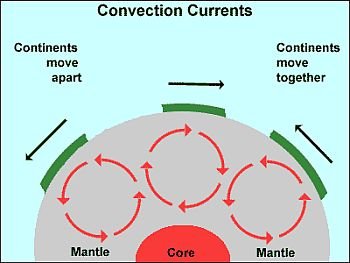
The circulation of material caused by heat is called convection. In the Earth system, convection is affected by gravitational forces within the planet as well as heat and radioactive recycling of elements in the molten core.
All tectonic processes within the Earth involve movement of solid or malleable matter. Convection in the mantle, driven by the thermal gradient between the core and lithosphere, takes place by deformation (creep) of the rocks and minerals that comprise the upper/lower mantle and the transition zone. Think of it like those square, hand-held puzzle games where one piece is left out and you can only slide one square into the open place at a time. In order to complete a number sequence or picture, you must keep sliding the squares around (one-at-a-time) until you are able to slide all of them around to their correct spots to complete the puzzle.
Mantle creep is like that. Because of imperfections in the crystalline structures of minerals and rocks, there are gaps. When pressure is applied, the atoms in the structure shift (creep), one atom at-a-time to a new position.
Plate tectonics, as seen in mountain building, earthquakes, and volcanoes, takes place by plastic (malleable) or brittle bending of the rocks and minerals that make up the oceanic and continental lithosphere. Temperature, pressure, and rate of deformation to a large extent define the nature of deformation for most minerals and rocks in the interior of the Earth. However, the chemical environment (presence or absence of water, oxygen, silica, and other elements) may also have a big impact. By understanding the mechanisms by which rocks and minerals move and change shape under extreme temperature and pressures, we will add to our understanding of the processes that shape our planet.
The steady movement of magma deep within the Earth depends on differences in temperature and differences in density within large ‘‘pockets’’ of molten matter. Depending on conditions, magma rises in the pockets of hotter temperatures and falls in pockets of cooler temperatures. Since the Earth’s center is still hot, this endless thermal activity keeps the tectonic process going. On a smaller scale, convection happens in liquids or gases, like the swirling currents of a pot of boiling soup. In the depths of the Earth, convection moves flowing magma that is heated from below by the core and then pushed upward over time and cooled from above.
This solid flow movement is much slower than the liquid flow we saw earlier. Remember the lava lamp?
Convection is the process of heat transfer that causes hot, less dense matter to rise and cool matter to sink.
Convection affects rocks of different densities as well. Lighter density lithospheric rock tends to ride along above sea level, while denser asthenospheric rock sinks below sea level. The hard, rigid lithosphere is an unyielding outer shell, while the softer, wax-like asthenosphere is moldable and fluid when pushed.
When hot matter is forced up and out, it cools and adds to the outer crustal rock. As more material moves up, the earlier matter is pushed out of the way. The pressure from underlying rock is removed as it comes to the surface and the material in the magma chamber, a ‘‘crystalline mush’’ heats as it gets closer to the surface. This activity expands the area between the plates by a few centimeters per year. After a while, this new surface rock comes to another plate that will not yield. When this happens, plates argue and new rock gets pushed back down by subduction to be melted over again. Subduction occurs between opposing plates (mountains and magma chamber are not to scale), while cooling, rising magma causes spreading at ocean ridges.
PLATE BOUNDARIES
Convection causes plates to meet and separate. When this happens, there are three main types of plate boundaries that form.
These boundaries include:
Convergent boundaries – plates clash and one is forced below the other, pulling older lithosphere to the depths of the mantle.
Divergent boundaries – plates pull apart and move in opposite directions making room for new lithosphere to form at the lip from outpouring magma.
Transform fault boundaries – plates slide past each other parallel to their shared boundaries.
Since the Earth’s core is hot in the extreme, roughly 60008C, the malleable mantle beneath the brittle crust is always hot too. This constant heat production by the core keeps the cycle of convection going. The heat transfer from rising and sinking convection currents provides the power that moves plates around the globe.
The rate of plate movement varies a lot depending on location. In Africa, there is very little movement from year to year, while the active Pacific plate has sections that move as much as 10 cm/year relative to the hot spots.
TRENCHES
A long, thin ocean valley, sometimes less than 100km wide, with steep sides and caused by the descent of a plate’s edge back into the mantle, is called an ocean trench. Some of the deepest points on Earth are found within ocean trenches. The Java trench in the West Indies and the Mariana trench in the Pacific average between 7450m and 11,200 m.
A trench is formed along the convergent boundary of two plates. Subduction digs ocean trenches when one plate collides with another, pushing it down underneath the first and causing a deep trench. The front edge of the top plate is crumbled and pushed up like snow in front of a snow plow. The clashing forces and constant pushing action along the border between two plates form towering mountain ranges parallel to the trench like the Andes range along the Peru–Chile trench.
Before the idea of global plate tectonics was accepted, marine geologists were stumped over the formation of ocean trenches. They didn’t understand what was causing the ever deepening valleys in the ocean floor. They kept trying to figure out why the core or lower mantle seemed to be pulling down the asthenosphere. They didn’t know much about convection currents at that point and so had no energy source for the movement of the landmasses.
Because most subduction zones are found in the Pacific Ocean, the edges of the Pacific plate, where surface rock is constantly being pulled down and destroyed, has the most deeply grooved trenches. The Pacific Ocean is ringed by these trenches because of the constant plate action of the Pacific oceanicplates against the North American, Eurasian, Indian-Australian, Philippine, and Antarctic plates.
Trenches are found at both continental margins and at ocean–ocean convergence zones along island plate lines. The Java trench, also known as the Sunda trench is a deep depression in the Indian Ocean, 305km from the coasts of the islands of Sumatra and Java, Indonesia. The trench is 2600km long and is the deepest point in the Indian Ocean, the site of the massive Dec. 26, 2004 earthquake (9.0) and tsunamis, which killed over 200,000 people.
Twenty-two trenches have been identified though not all are major trenches. Of these, 18 are in the Atlantic and one (Java trench) is in the Indian Ocean. The depths of the major trenches are greater than 5.5km deep and between 16 and 35km in width. The deepest trench is the Challenger Deep (11km deep) found in the Marianas Trench. The Peru-Chile trench, off the coast of South America, is the longest trench at 1609km in length, while the Japan Trench at 241km is the shortest.