
Ridges
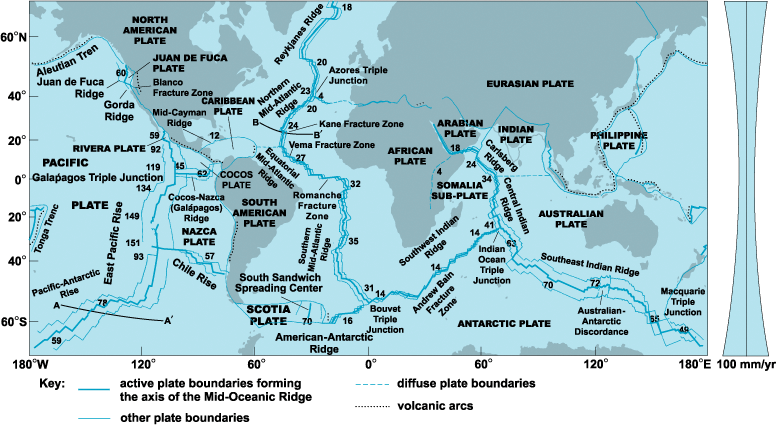
A rift or upgrowth of the ocean floor, where plates are slowly edged apart by the filling of hot magma, is known as an ocean ridge. Ridges are formed along divergent boundaries where plates move slowly away from each other.
Magma then rises into the crack between them, filling it, and hardening into rock. Most of the magma exiting the mantle today is found at ridges in the ocean floor and along plate edges. When magma pours out of cracks in the ocean floor, they build up a lip along the crack and form mid-ocean ridges. Ridges thousands of miles long can be found in the Atlantic Ocean, and around the plate borders of the Pacific plate.
Cooled magma (lava) also flows horizontally forming more ocean floor and piling up around vertical vents to form volcanic cones and islands like the Hawaiian Islands and the Galapagos chain. These are hot spots. The unending creation of solidified magma (rock) creates new seafloor and widens the ocean basins, a process called seafloor spreading.
When British geologists, Drummond Matthews and Fred Vine sampled rocks along the edges of ocean ridges, they found that the farther away they were from the ridge crest, the older the rocks. When this information was added to the idea of continental drift and seafloor spreading, it helped explain the puzzling increase of crustal landmass and supported the plate tectonics theory.
Nearly all of the ocean ridges are at the bottom of the oceans, but the Mid-Atlantic Ridge that stretches up the center of the Atlantic Ocean, emerges in a few places including Iceland, where geologists can measure its growth and characteristics.
Below the waves, photographs from submarines at great ocean depths show that rocks near ridge edges are clean and sharp. As the distance from the ridge increased, rocks became covered with sediment. At about 10km (6 miles) from a ridge, the rocks are completely obscured from sight by layer upon layer of sediment dusted over them for millions of years.
Transform Fault Boundaries
A fault is simply an opening between two plates caused by plate pressure that builds up until the surrounding rock can’t take it anymore and splits. A fault is a fracture or zone of fracture in the crust, where some type of movement happens.
Some plates don’t clash head to head, but instead slide past each other horizontally in what is known as a transform fault. The rock on either side is moved in opposite directions as the buildup of pressure between the plates provides the energy for movement. Fault blocks or sections of rock on either side of the fault can be lifted up on one side or both. They can have faults on one or more sides and can be lifted up on one side and dug in on the other depending on the surrounding rock type. The well-known San Andreas Fault in California where the North American and Pacific plates meet is a transform fault boundary. Along this fault, the Pacific Ocean plate is sliding north while the continental plate is moving southward. Since these two plates have been at it for millions of years, the rocks facing each other on either side of the fault are of different types and ages. From the air, sharp differences in color and texture are obvious.
The ‘‘Big Bend’’ area of the San Andreas Fault is responsible for a lot of the intricate faulting in southern California. A fault bend is often found in a confined area of plate collision. A tremendous amount of compressional pressure is created. To release this stress a bit, additional faults form over time. Commonly, crustal shortening happens as a response to intense compression. Crustal shortening allows compression to continue by packing rocks tighter in a compressional zone. When this occurs, shorter thrust faults are created.
Thrust faults are the low-angle reverse faults that pack crust sections over one another to create a thicker mound of crust with a shorter (horizontal) length. Not all the pressure generated by the bend of the San Andreas Fault goes into thrust faults. The collision margin is at an angle, so that some of the in-between rock is able to move sideways out of the way. Large regions of sideways faulting have formed in order to relieve some of the stress created by the fault bend.
As with most plate collisions, transform faults do not slide along smoothly at a constant rate, but in fits and starts. Extreme grinding friction is causedby the buildup of pressure between the two clashing plates. This pressure is usually released by earthquakes and a sideways slip between the transform ault fractures. The 1906 and 1989 earthquakes near San Francisco were caused by side-slip transform fault movement.
Following a slip, pressure builds up for many years until it again reaches a critical pressure point, like the straw that broke the camel’s back. One day, when the ‘‘last straw’’ is added by pressure buildup from the mantle, everything shifts violently again. This sudden movement causes millions of dollars in damages to populated areas: breaking roads, building foundations, bridges, and gas lines. Fires are also common following earthquakes when gas, freed from lines broken during the side-slipping of two grinding plates, ignites.