USDA Reports Say Climate Change Will Affect Agriculture, Forests
Effects of Climate Change on the Biosphere
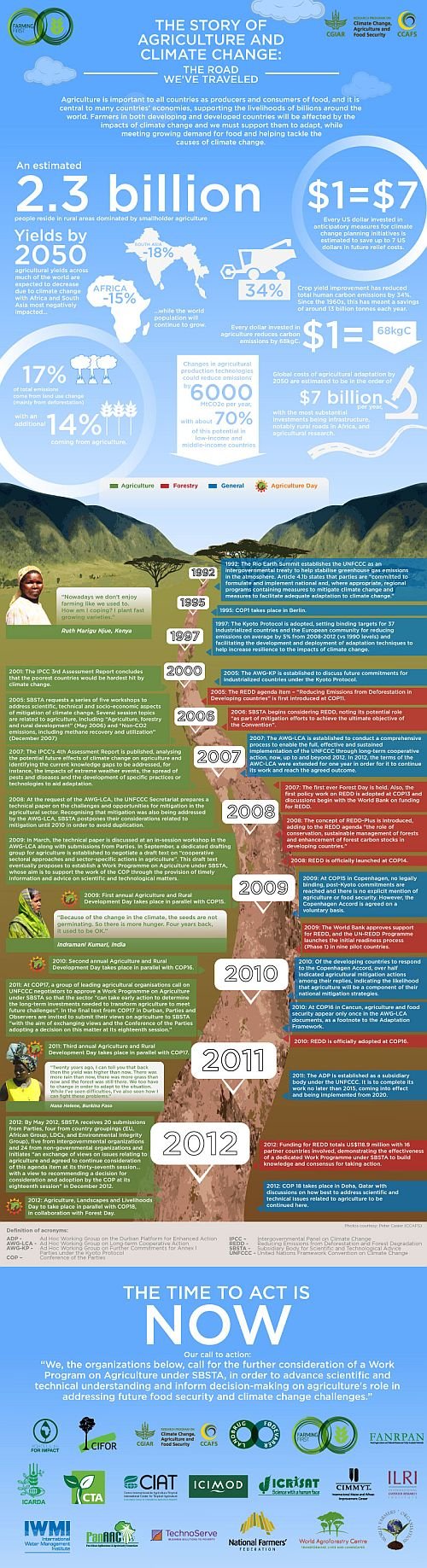
Agriculture
Agricultural technology has increased so much in the past few decades that any changes that have resulted from rising temperatures and CO2 levels are not easily discernable. Small adjustments that farmers make due to temperature increases have likely been absorbed by all the other changes. Yet some recent adaptations to warmer temperatures have been seen in agriculture.
The number of frost-free nights has increased in the temperate regions, resulting in a one week longer growing season in parts of North America relative to a few decades ago. Crop yields in the temperate regions, where developed nations are largely located, have increased.
In Europe, particularly at high latitudes, farmers have adapted to environmental changes by planting their crops earlier. In Germany, for example, the advance has been 2.1 days per decade between 1951 and 2004. However, longer growing seasons are not uniformly good.
In the south of France, apricot trees now flower one to three weeks earlier than in past decades, putting them at risk for spring frost and bud necrosis.
Arid regions have tended to become warmer and drier, and wet regions have become even wetter. As a result, crop yields have grown in wet regions but shrunk in arid regions. The loss of crops due to a reduction in rainfall is intensified by the expansion of insect ranges and increased forest fires. Another hazard in the drier areas is desertification, the process by which dry air evaporates moisture from the soil and the land turns to desert. Where possible, farmers in arid lands increase the amount of irrigation, but where this is not possible; land that was once farmable is lost.
More extreme weather events are affecting agriculture, even in the developed nations. In the United Kingdom, drought has caused farmers to increase the percentage of crops they irrigate. The Europeanheat wave of 2003 decreased crop yields by up to 30% in some nations, including Greece, Portugal, Italy, and especially France.
Little is known about the effects of climate change on subsistence agriculture. In the Sahel in sub-Saharan Africa, where farming is extremely marginal, higher temperatures and lower rainfall have reduced the chance that the strains of plants that are currently being grown are able to complete their life cycle. Some rice-growing regions in Southeast Asia appear to be undergoing a slight decrease in productivity.
Forests
The Intergovernmental Panel on Climate Change (IPCC) says that up to one-third of forests have already been affected by climate change. On average, forest productivity has increased slightly. Thriving and expanding forests absorb more CO2, which is a negative feedback for global warming. Of course, enough tropical forests are being cut down that this positive effect is more than made up for.
Regional warming has had a devastating effect on forests in the Southwestern United States. Temperature increases coupled with a multiyear drought have been blamed for the largest loss of trees in a single location ever recorded. More than 45 million Piñon pines (Pinus cembroides), a stubby, nutbearing tree, have died in New Mexico, where the plant is the state tree. The direct cause is the Piñon bark beetle (Ips confuses), but scientists say that higher temperatures are really to blame. This is because the spread of beetles is slowed by frost, but now that there are fewer frosts, the beetles are able to move into areas that were once inhospitable. Bark beetles are in Arizona’s ponderosa pine forests, in Utah’s spruces, and in Colorado’s Douglas firs. In Alaska and British Columbia, 14 million acres (56,660 square km) of spruce have been killed by bark beetles.
“It’s the type of thing we can expect more of with global warming,” Professor David Breshears of the University of Arizona told National Geographic News in December 2005. “There is reason to believe other systems could get whacked the way the Southwest did.” Other diseases are ravaging western forests. Warmer temperatures allow the mountain pine beetle (Dendroctonus ponderosae) to complete its life cycle in one year rather than its previous two. Consequently, the beetles have increased in population, which has resulted in an increase in pine blister rust (Cronartium ribicola) in Rocky Mountain forests. The rust is a fungus transmitted by the beetles. Trees that are damaged or killed by bark beetles or pine blister rust are far more susceptible to the spread of forest fires.
Due to high ocean temperatures in the Caribbean and Atlantic basins and to ongoing deforestation of the Amazon rain forest, in 2005 the Amazon basin began the longest and worst drought since record keeping began. In some areas, water levels have dropped so low that the communities that depend on streams for transportation are completely isolated. Crops rot because they cannot be transported to market, and children cannot get to school. People living on the world’s largest river are unable to find fresh water to drink. Fish die in the shallow water due to lack of oxygen, killing freshwater dolphins and other predators, and forcing people to depend on government food packages. Because streams also remove human waste, when the streams dry up, the resulting sewage backup raises fears of cholera and other waterborne illnesses. In the remaining stagnant pools, mosquitoes breed in increasing numbers, which has the potential to raise malaria levels in local populations.
Longer-term drought causes trees to die and become fuel for fires, which the Amazon has recently experienced. In the Western United States, warmer temperatures and earlier springs have caused an increase in the number, duration, and destructiveness of wildfires since the mid-1980s. Studies show that the cause of the fires was increased spring and summer temperatures and earlier snowmelt.
Similar changes in wildfire increases have been seen in other parts of the Americas.
Wrap-Up
The effects of climate change are already apparent in living systems. Plants and animals are changing their ranges and the timing of their life cycles. As a result, some populations have expanded, some have decreased, and some have just shifted. If these strategies do not work, the organisms will die out locally, or the species may even become extinct. The loss of a species that is important in a food web, such as krill, can have repercussions throughout an ecosystem. The consequences of warming that have been seen so far are just the beginning of the changes that are predicted to come as temperatures continue to rise.