
A Brief History of Climate Change
Climate Change in Human History
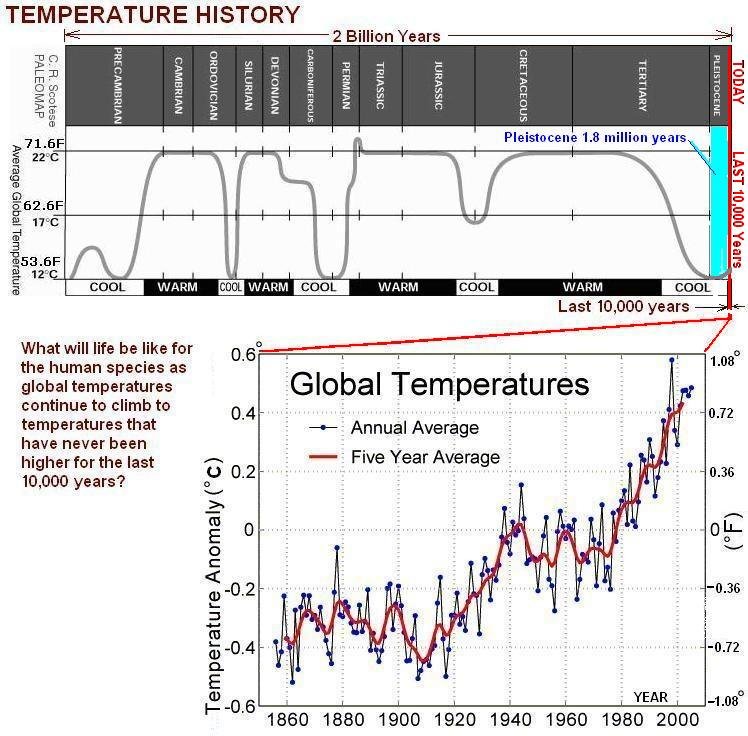
In the past 10,000 years, since the end of the Pleistocene Ice Ages, average global temperature has risen 7°F (4°C). Glaciers have been in retreat since then and are now found only in high mountains and at high latitudes.
Despite ups and downs, climate over the past 10 millennia has been milder and more stable than at any time since the Emiam interglacial of 130,000 years ago. Perhaps not surprisingly, this favorable climate period is the one during which human civilization developed. In his 2006 book, The Winds of Change: Climate, Weather, and the Destruction of Civilizations, Eugene Linden connects climate change with the rise and fall of civilizations. Linden cites scientists who say that climate does not shift from consistently warm to consistently cold but flickers rapidly between warm and cold and wet and dry over several decades. “Rapid shifts between warm and cold throw ecosystems out of balance, unleashing pests and microbes, and ruining crops,” says Linden. Just a few of the fascinating scenarios he presents, linking climatic shifts with cultural development, are presented below.
The generally upward temperature trend since the end of the Pleistocene has been punctuated by periods of more rapid warming and of rapid cooling. The most severe cooling was a freshwater influx into the North Atlantic around 8,200 years ago that caused a plunge in temperatures of 9°F (5°C). This event was similar to the Younger Dryas but lasted between 60 and 200 years. This cooling event interrupted the emergence of civilization in Turkey, where agriculture and cities had been developing. The return of cold, dry, and windy weather necessitated that people devote their energy not to innovation but to survival.
Ice core data show that the period from 8,000 to 5,200 years ago was relatively warm, allowing the development of irrigated agriculture and permanent settlements. An abrupt cooling that occurred about 5,200 years ago again derailed cultural advances. Conditions were very cold and very wet, although this period seems to correspond with the beginning of cities in Mesopotamia and the Nile Valley and with the start of calendars.
Climate again stabilized, and the Bronze Age began, although at different times in different parts of Europe and the Middle East. This stable climatic period was the time of the Akkadian empire, which emerged around the city of Akkad in Ancient Mesopotamia, beginning about 4,350 years ago. The Akkadians had a written language, an accounting system, and religious practices that suggest a sophisticated social organization. A heavy dust band in ice cores on Mount Huascarán in Peru and on Mount Kilimanjaro in Africa provides evidence of a disastrous drought that brought on massive starvation and brought an abrupt end in to the Akkadian Empire 4,200 years ago. The dust band was discovered by Professor Lonnie Thompson of the Byrd Polar Research Center of Ohio State University. Global patterns of droughts and flooding from that time period suggest that the climate was dominated by an extremely strong El Niño that lasted for more than two centuries.
Climate sometimes wreaks destruction on humans (or organisms) by creating the conditions that promote the spread of disease. The Justinian Plague, which occurred in a.d. 541 to 542, was the first pandemic, an outbreak of infectious disease that spreads over a large region of the world. This plague may have originated in a rapid freeze that came in a.d. 536. No one knows what caused temperatures to plummet, but the rapid change indicate that the event was catastrophic, such as an asteroid impact. The cold snap brought on a cycle of floods and drought, which increased the food supply for East African rodents and caused their populations to increase faster than their predators’ populations. The rodents harbored fleas (Xenopsylla cheopis) that contained the bubonic plague bacterium Yersinia pestis.
The rodents are not susceptible to the disease, but the plague bacteria block the fleas’ digestive tracts. The fleas bite everything to try to slake their hunger, spreading the infection as they go. The plague bacteria migrated northward on fleas that eventually infected Rattus rattus, the black rat, which has lived in close proximity with humans for millennia. The Justinian Plague laid waste to Constantinople, Alexandria, and other major world cities, killing millions of people during the following two centuries.
The Medieval Warm Period (MWP) lasted from about a.d. 900 to 1300. Although its cause is not yet well understood, it seems to be related to a strengthening of Atlantic meridional overturning. The MWP was a time of relatively warm, dry temperatures (although it is worth noting that temperatures during the MWP were never as high as during the 1990s). In Europe, crops thrived, and the people were healthy and prosperous. Europe’s population quadrupled and life expectancy increased to about 48 years of age. These favorable conditions allowed people to focus on art and religion, erecting extraordinary cathedrals and castles.
MWP climate was not nearly as advantageous in western North America and Central America: That part of the world suffered near permanent drought. The Maya civilization, centered in the Yucatan Peninsula of Mexico and the highlands of Guatemala, was in full swing when the drought began. Over a period of about 1,200 years, the Maya had built a remarkable civilization. They had constructed glorious pyramids, such as those located at Chichen Itza and Tikal.
The Maya were advanced in astronomy, the calendar, and in a skill that was extremely important for their drought prone location: water management. Mayan farmers depended on annual rains from late spring to early fall for maize production, and on their rulers for drinking and household water during the annual dry season. Water was the means by which the Mayan elite maintained their rule because only they had the resources to store water in reservoirs and maintain its quality.
Despite its accomplishments, the Mayan civilization collapsed around a.d. 900. Many hypotheses have been offered, but new seafloor sediment analyses and tree ring data point to extreme drought as the primary cause. Because reservoirs could store water only for a year or two, when Mayan rulers were no longer able to supply their subjects with water, the civilization failed.
Farmers moved to other areas or, more likely, died of starvation and thirst. People weakened by famine are also more prone to disease. The MWP was far kinder to the Vikings (Norse), who spread across the northern portion of Europe. The Norse had thriving colonies on Greenland and on Iceland, where they grew crops, raised farm animals, and hunted. But in the fourteenth century, Europe plunged into the Little Ice Age (LIA), which ebbed and flowed over the next 500 years, though scientists debate the exact dates of this period. This temperature drop came at somewhat different times in different locations: It struck Greenland in 1343. Archaeological evidence shows that at least one household slowly starved over the years until the inhabitants finally died out in 1355, the worst winter in 500 years.
During the LIA, global temperatures dropped between 0.9°F and 1.8°F (0.5°C and 1.0°C), a minor amount compared to those frigid periods of early civilization discussed on pages 53–56. Because the LIA was likely caused by a slowing of Atlantic meridional overturning, the largest temperature change was in the North Atlantic region, where the average temperature dropped 5.4°F (3°C). In Europe, weather during the LIA was often frigid, but it could also be warm, stormy, or dry in any combination. The extremely variable weather led to failed crops. Famine killed millions of people and triggered social conflict and war.
The LIA struck Great Britain earlier than Greenland. The River Thames, which flows through London, froze in 1309, but then the weather warmed up and brought in large storms. Crops rotted or failed to ripen, and livestock froze. Beginning in 1332, the cycle of floods and drought in Mongolia and China brought about the bubonic plague. After killing 35 million people in China, the Black Death spread to Europe, where it killed between one-quarter and one-half of the population: 20 to 50 million people who were already weakened by famine and other diseases. Bubonic plague came and went over the next few centuries.
Still, the LIA was not a time of constant cold: Between 1400 and 1550, the climate became more moderate. This mild period correlates with the Renaissance, a time of great technological and artistic advances. Then, from 1550 to 1850, winters again turned long and severe, and summers were short and wet. In the seventeenth century, in Switzerland, glaciers advanced down mountain valleys and crushed villages. In North America, in the winter of 1780, New York Harbor froze solid, allowing people to walk from Manhattan to Staten Island. Superimposed on the LIA was the Maunder Minimum, a period with extremely low sunspot activity. This period corresponds with the deepest cold of the LIA, from 1645 to 1715.
Wrap-Up
Scientists can learn about many important things from studying past climate. Evidence from ice cores, ocean sediments, and other sources has shown paleo climatologists that climate change was not always gradual and sometimes was extremely rapid. As climate changes from hot to cold or cold to hot, it does not do so abruptly, but flickers between the two states. Periods of great climatic change have generally been difficult during human history. Times such as the MWP and the LIA took enormous tolls on civilizations: Famine, thirst, and disease sometimes caused the deaths of tens of millions of people.