
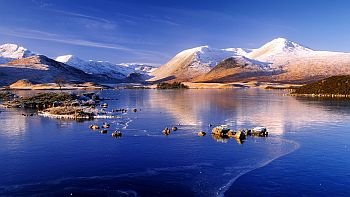
REFLECTION-SENDING ENERGY RIGHT BACK INTO SPACE
Some of the light coming from the sun is reflected back into space. The only way that it is possible to see the earth from space, is by means of reflection from the earth’s atmosphere and surface. Light reflected from the earth does not contribute to heating the earth. Clouds in the atmosphere and ice on the ground enhance reflection. The term albedo refers to how reflective various surfaces are.
Reflection from Ice and Snow
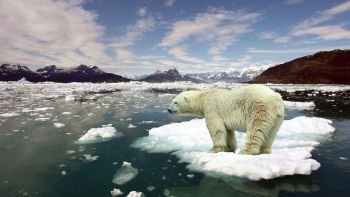
At present, ice permanently covers 10 percent of the earth’s total land area-nearly all of which is in Antarctica and Greenland. Ice covers another 7 percent of the earth’s oceans-including the Arctic Ocean. In midwinter, 49 percent of the land in North America is covered with snow.
As much as 90 percent of the light hitting ice- or snow-covered areas is reflected back into space. In contrast, only about 10 percent of the light hitting the oceans is reflected. Changes in the snow and ice cover can significantly affect the amount of solar heat that is retained in the earth. The impact of this on climate change would be more severe if the sun’s rays were less oblique at the poles, where the most reflective surfaces are located. The extent of reflective areas of ice and snow plays an important role in establishing the thermal balance of the earth.
The earth is visible from a satellite because about 30 percent of the light striking the earth’s surface and atmosphere is reflected back into space.
Reflection from Land
Changes in land can affect how much of the sun’s energy is reflected or absorbed in a particular area. Forests tend to be more reflective than clear-cut regions. As a result, loss of forests contributes to warming. Reflection of light from land may have played a role in Earth’s climatic history.
A. Wegener proposed that at one time in the Earth’s formative years, the land masses of the continents were located in a more centralized continent that he named Pangaea. According to his theory, the continents drifted apart. With the continents grouped together, there was more absorbing land mass than reflecting ocean area near the equator, where the suns rays are most direct. The rearrangement of continents as they slowly drifted over millions of years contributed to a cooling trend in the earth climatic history.
Reflection from Clouds
Although clouds both reflect and absorb energy from the sun, their main role is to reduce the amount of sunlight available by reflecting it back into space. Increased cloudiness caused by global warming is to some extent counterbalanced by more atmospheric water vapor in the air. The clouds reflect more sunlight. This partly offsets the warming effect of infrared absorption by water vapor.
If warmer average global temperatures result in an increase in the cloud cover, the overall effect will be to slow the temperature increase. Thus one change in the environment can have an impact on another in an interactive way. In this case, the increase in clouds (caused by higher temperatures) slows the effect of the warming. This is known as negative feedback.
Contrails
Cloud-like paths left by airplanes are called contrails. These are similar to a wake that trails behind a speedboat. Contrails can be thought of as artificial cirrus clouds that-like other clouds-can increase the reflection of incident solar energy. Contrails, once formed, become incorporated into the natural cirrus cloud pattern present on a given day. Regions of high air traffic have been found to have more cirrus clouds than regions of low air traffic. The water droplets in these clouds also can play a minor role as a greenhouse gas by retaining radiated infrared light from the earth. The effects are real, but the intricacies of the competing impacts on climate are not well understood by scientists at this time. Contrails are like artificial clouds that reflect incoming sunlight but which also retain heat emitted by the earth at night.
Owing to typically cooler nighttime temperatures, contrails form more on overnight flights. Redeye flight contrails form at a time when they contribute only to keeping the earth warm without being offset by reflection of incoming light. When air traffic controllers suspended flights in the United States on September 11, 2001, meteorologists noticed a warming effect that they attributed to the absence of contrails during that time period. However, this observation is based on limited data and possibly was enhanced by the unusually clear weather that occurred at that time.
The Intergovernmental Panel on Climate Change (IPCC) estimates that contrails contribute no more than 1-3 percent of all impacts on the climate generated by humans. Contrails, however, represent only part of aviation’s contribution to climate change. Aviation fuel is a fossil fuel that also contributes carbon dioxide emissions.
Airplane flight-despite its other many obvious benefits-is probably the least carbon-efficient commercial form of transportation of people and freight. The US Department of Energy estimates that for every gallon of jet fuel that is burned, over 9,500 kilograms (21,000 pounds) of carbon dioxide are emitted.
Aerosols
Aerosols are suspended particles in the air that are contributed by either humans or nature. Aerosols have an overall cooling effect on climate and include particulates resulting from combustion, soot, and ash from volcanic activity, nitrates from agriculture, mineral dust, and chemicals suspended in the air such as sulfates. There are many types of aerosols at various locations within the atmosphere, making an understanding of the effects of aerosols complicated. Aerosols are relatively short-lived in the atmosphere and can influence the earth’s temperature not only directly by reflecting sunlight but also indirectly by prolonging the time that clouds persist in the atmosphere.
Aerosols have both a direct and an indirect effect on how sunlight is received in the atmosphere. Aerosols scatter or reflect incoming radiation directly. This can cause either a heating or a cooling effect on the atmosphere. Sulfates, organic and solid carbon from fossil fuel, and biomass burning, and mineral dust all contribute to a direct aerosol effect.
Indirectly, aerosols influence the reflectivity and duration of clouds. Cloud formation is facilitated by the presence in the atmosphere of particles that serve as nuclei to initiate the condensation of water droplets. Clouds for the most part reduce the amount of incoming sunlight that could contribute to warming the earth’s surface.
Aerosols also play a role in modifying the reflectance, or albedo, of surfaces that are critical to maintaining the earth’s overall energy balance. Reflectance of ice and snow is reduced to the extent that absorbing particulates settle on frozen surfaces. Absorption in the oceans can be enhanced by the presence of particulates.
Volcanoes
Volcanic eruptions, such as those of El Chichon in 1982 and Mount Pinatubo in 1991, have had major impacts on the earth’s temperature by reflecting sunlight from the upper atmosphere. Let’s look at the impact of two significant volcanic eruptions: El Chinchon in 1982 and Mount Pinatubo in 1991. Following the Mount Pinatubo eruption in the Philippines, the clarity of the atmosphere and global temperatures decreased. The release of aerosol particles caused a measurable reduction of light transmitted into the atmosphere. This can be seen in the sharp increase in optical thickness in the year of the Mount Pinatubo in 1991. Optical thickness is a way to characterize the overall loss of clarity in the atmosphere from an eruption. This initial spike following the eruption is followed by a decline as the particles are removed from the stratosphere by natural processes. It took about 4 years for the atmosphere to recover from the Mount Pinatubo eruption. After a delay of about a year, the earth’s temperature dropped by as much as 4°C (7.2°F). In some places, the temperature decrease was even greater. Temperatures recovered by 1995, along with the decrease in particulates in the air. Every volcano, however, does not have the same impact. For instance, when Mount St. Helens erupted in 1980, its effect on climate was minimal because the plume of ash and other gases and particulates was released primarily into the troposphere, where it was fairly quickly washed out by rain and snow. Only during the first hour did any significant amount of reflective material get disbursed into the stratosphere.
Volcanoes add a large quantity of aerosols into the atmosphere for a concentrated period of time. Their effect on the earth’s temperature is significant, temporary, and largely unpredictable.