Epic New Hawaiian Volcano Activity
Minerals and Rocks
Unlike plants and animals, most rocks have long histories. They seem ancient and never changing because within our lifetimes, they don’t change much. A rock is a rock is a rock.
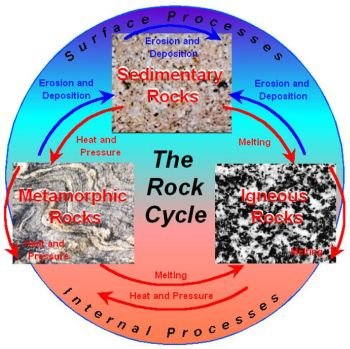
Igneous rocks, however, are probably the only rocks that give us a window into new rock formation. Igneous rocks are formed from magma that is sent through volcanic activity to the surface. Depending on the speed and way magma reaches the surface, the hardened igneous rock that is formed can look very different. There are three main rock types that come from magma: sedimentary, igneous, and metamorphic. Of these three, igneous is probably the most active and exciting. Igneous rock is created by exploding volcanoes and boiling undersea fissures. It has lots of distinct textures and colors depending on its chemical content and formation. Six minerals make up nearly all of igneous rock. These minerals are quartz, feldspar, pyroxene, olivine, amphibole, and mica. The chemical elements that make up these minerals are silicon (Si), calcium (Ca), sodium (Na), potassium (K), magnesium (Mg), iron (Fe), aluminum (Al), hydrogen (H), and oxygen (O).
Rocks formed by the hardening of molten rock (magma), whether deep in the Earth or blasted out during an eruption, are called igneous rock.
Igneous rock is formed from the cooling and hardening of magma within the Earth’s crust. Over 95% of the top 10 miles of the crust is made up of igneous rock formed from lava eruptions. The root word ignis in Latin means fire. It is formed in temperatures of at least 700. ºC, the temperature needed to melt rock. The deepest magma in the mantle, next to the super-heated extreme heat of the outer core, has a different makeup from magma just beneath the crust and squeezed up through cracks or conduits.
The study of igneous rock is a study of magma, since igneous rock comes from cooled magma that has made its way to the Earth’s surface. But not all magma is created equally. Depending on the time of heating and method of getting to the surface, different cooled magmas form rocks that look very different from each other. When scientists started studying igneous rock in the laboratory, they found two simple ways to separate igneous rock samples, texture, and composition.
Sitting around a campfire on a starry night, the encircling rocks around the fire don’t usually melt. It takes very high temperatures to melt rock. The type of rock-melting heat that affects igneous rock is a lot like that found on the Earth in its earliest days. From earlier chapters, we learned that the deeper into the Earth you go, the hotter the temperature. Sample temperatures taken at different depths commonly increase about 30.º C per kilometer (90.º F per mile). Of course, rock samples taken near magma lakes, along known fissures and near volcanoes, are a whole lot hotter.
The rate of temperature increase compared to depth is known as a geothermal gradient.
Pressure also has an effect on the melting of rock. The greater the pressure applied to a solid (rock), the more force is applied to its atoms. This force packs the rock into denser and denser structures. Rocks deep in the mantle are under a lot of pressure. When a tectonic plate shifts or a crustal fissure forms releasing some of the overlying pressure, tightly compressed rock structure loosens up. Atoms aligned and held in a certain pattern within the rock structure are then able to shift. Their movement becomes freer and a lot more like a liquid state.
For example, the compound albite melts at 1104. º C at the Earth’s surface where the pressure is 1 bar. The melting temperature at 100 km, where the pressure is 35,000 times greater, is 1440. ºC. The extreme heat that couldn’t affect the deeply pressurized rock can melt the less-compressed rock at the surface, allowing it to flow as a fluid.
Magma
What is magma, anyway? Magma is the sea of melted rock found in the mantle. This super-heated liquid is hotter and cooler depending on its location and activity within the mantle’s circulation currents.
Geologists use pyrometers to measure the temperature of lava from a distance. A pyrometer is an optical measuring device that allows temperature measurements to be taken safely. Freshly blasted magma has been measured at temperatures between 1000 and 1200.ºC. Once magma arrives, it cools. The cooler lava gets, the greater its viscosity and the slower it moves. But don’t get too close, lavas that are barely moving have been measured at temperatures of 800.ºC.
Viscosity is the resistance that a fluid has to flow because of its chemical and structural composition.
Temperature plays a big part in magma’s viscosity. Think of pancake syrup or molasses; the hotter it gets, the runnier it gets. Heat excites the atoms and adds energy. With magma, the silica content is also a big factor. Silicate minerals have a basic tetrahedral (pyramid-shaped) structure. They are linked together by shared oxygen molecules. However, silicate molecules in hot magma form crazy chains, sheets, and big matrices. As these linked silicate molecules get larger, the magma becomes more and more viscous and doesn’t want to flow. The number of tetrahedral bonds that can be formed into linked molecule groups depends on the amount of silica present in the magma. Put simply, silica in magma gets hard when it cools.
Some temperatures recorded at different sample locations are hotter in some areas of the crust than others. This tells geologists that the thickness of the crust changes and produces more volcanic activity in some areas than others. In active volcanic areas like Hawaii, the temperatures at 40km have been recorded as high as 1000.ºC, while in more stable areas, the temperature at the same depth is only 500.ºC. After magma flows from the depths of the mantle out onto the crust, it is called lava.
Magma chambers are pockets of molten rock formed in the lithosphere. These chambers may be formed as surrounding rock is pushed down during plate interaction and melted. The outline of magma chambers have been seen while recording earthquake waves from active volcanoes. The depth, size, and overall shape of magma chambers can be figured out based on these readings.
Magma is the origin of all volcanic rock. It has been around since the formation of the Earth.
When scientists studied the texture of quickly cooled magma, they found it took on two distinct forms: fine crystalline rock or glassy rock with no visible crystals. This is the magma blown violently from volcanoes during eruptions.
Some magma is very fluid and rains down fine molten fire, which cools quickly into ash. Some magma mixes with groundwater and creates superheated steam and land-leveling mudflows.
Lava that slowly blobs out in bubbles and globs like slow moving molasses has a different texture. Since slow flowing lava streams and lakes below ground have a longer trip to the surface, they have time to form crystals. The longer lava cools, the larger and more complex the crystals can grow without interruption.