
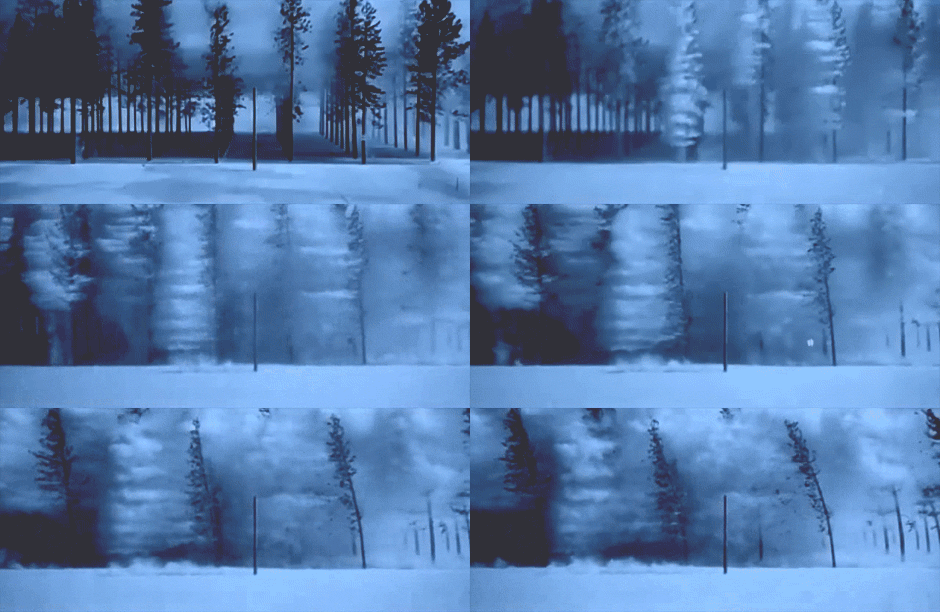
Insane Blizzard Video with Hurricane Force winds
Blizzards
Blizzards are extreme snow events that occur when high winds whip snow cover and falling snow into suspension in the air for prolonged periods, causing deep drifts, extreme wind chill, and severely reduced visibility. Blizzards typically occur from late fall to early spring at high latitudes and altitudes, and less frequently in temperate regions.
The effect of human-caused climate change on blizzards, which tend to be associated with cold, low pressure zones in storm systems called cyclones, has not been thoroughly studied and will likely vary from region to region. However, as with other types of snowstorms, blizzards are, in general, predicted to occur less frequently over the course of the century. This decrease in total number of storms will likely be accompanied by an increase in the intensity of blizzards that do occur, due to elevated levels of humidity as temperatures climb, resulting in more precipitation and more violent storms.
Historical Background and Scientific Foundations
The occurrence of blizzards has varied widely over the past 50 years in different locations. On the prairies of western Canada, for example, the number of blizzards decreased between 1953 and 1997. In the contiguous United States, the number of blizzards has increased slightly since the 1950s, while the overall number of severe, damaging snowstorms has shown no significant trend in either direction.
But the incidence of more extreme precipitation events like severe blizzards, as well as above normal temperatures and drought, rose considerably in different parts of the United States between 1980 and 1994. Meanwhile, subsistence reindeer herders in eastern Russia have also reported anecdotal increases in intense snowstorms and other extreme weather events.
As temperatures warm due to increased greenhousegas emissions over the coming century, storms may become more infrequent and more extreme. General circulation computer models show that extra-tropical cyclones, which tend to spawn severe snowstorms like blizzards in the wintertime at mid and high latitudes, will likely decrease. Rising temperatures will also mean that more precipitation falls as rain. These models also predict an increase in cyclone intensity, which may, in turn, result in an increase in the intensity of accompanying snowstorms. Climate models that factor in greater atmospheric concentrations of carbon dioxide and warming tend to predict the greatest increases in cyclone intensity.
Impacts and Issues
Blizzards can pose significant impediments to travel by ground and air, hamper economic activity, knock out electricity, damage structures, and wipe out livestock, as well as cause human injuries and death through vehicle crashes and exposure. But big storms can also boost soil moisture and water supplies, and be an economic boon to winter recreation industries like ski resorts. A decrease in the overall frequency of severe snowstorms may benefit certain industries, but an increase in the intensity of storms that do occur will increase the danger and damage resulting from individual storms. Meanwhile, less overall snowfall from fewer storms may jeopardize ecosystems that rely on snow for freshwater, such as those in big mountain ranges like the Himalayas or the Rocky Mountains.
The Himalayas have experienced a consistent increase in temperatures while receiving significantly less snowfall in recent years. Less snowfall and fewer storms may jeopardize ecosystems that rely on snow for freshwater.
Words to Know
Climate Model: A quantitative way of representing the interactions of the atmosphere, oceans, land surface, and ice. Models can range from relatively simple to quite comprehensive.
Latitude: The angular distance north or south of Earth’s equator measured in degrees.
Precipitation: Moisture that falls from clouds. Although clouds appear to float in the sky, they are always falling, the water droplets slowly being pulled down by gravity. Because the water droplets are so small and light, it can take 21 days to fall 1,000 ft (305 m) and wind currents can easily interrupt their descent. Liquid water falls as rain or drizzle. All raindrops form around particles of salt or dust. (Some of this dust comes from tiny meteorites and even the tails of comets.) Water or ice droplets stick to these particles, then the drops attract more water and continue getting bigger until they are large enough to fall out of the cloud. Drizzle drops are smaller than raindrops. In many clouds, raindrops actually begin as tiny ice crystals that form when part or all of a cloud is below freezing. As the ice crystals fall inside the cloud, they may collide with water droplets that freeze onto them. The ice crystals continue to grow larger, until large enough to fall from the cloud. They pass through warm air, melt, and fall as raindrops.
Bibliography
Books
Weart, Spencer. The Discovery of Global Warming. Cambridge, MA: Harvard University Press, 2004.Periodicals
Changnon, Stanley A., and David Changnon. ‘‘A Spatial and Temporal Analysis of Damaging Snowstorms in the United States.’’ Natural Hazards 37 (March 2006): 373-389.
Easterling, D. R., et al. ‘‘Observed Variability and Trends in Extreme Climate Events: A Brief Review.’’ Bulletin of the American Meteorological Society 81 (March 2000): 417–425.
Lambert, Steven J. ‘‘The Effect of Enhanced Greenhouse Warming on Winter Cyclone Frequencies and Strengths.’’ Journal of Climate 8 (May 1995): 1447–1452.
Lambert, Steven J., and John C. Fife. ‘‘Changes in Winter Cyclone Frequencies and Strengths Simulated in Enhanced Greenhouse Warming Experiments: Results from the Models Participating in the IPCC Diagnostic Exercise.’’
Climate Dynamics 26 (June 2006): 713–728.
Lawson, Bevan D. ‘‘Trends in Blizzards in Selected Locations on the Canadian Prairies.’’ Natural Hazards 29 (June 2003): 123–138.
McCabe, Gregory J., et al. ‘‘Trends in Northern Hemisphere Surface Cyclone Frequency and Intensity.’’ Journal of Climate 14 (June 2001): 2763–2768.
Schwartz, Robert M., and Thomas W. Schmidlin. ‘‘Climatology of Blizzards in the Conterminous United States, 1959–2000.’’ Journal of Climate 15 (July 2002): 1765–1772.
Stevens, William K. ‘‘Blame Global Warming for the Blizzard.’’ The New York Times (January 14, 1996).
Web Sites
‘‘Conservation News & Stories.’’ WWF, May 10, 2006. <http://www.panda.org/news_facts/newsroom/features/index.cfm?uNewsID=67580> (accessed August 4, 2015).